AI Insights On Email Timing For 2025
Jan 3, 2026
Timing is everything when it comes to email marketing. In 2025, AI tools have reshaped how businesses schedule emails, focusing on individual recipient behavior instead of generic schedules. Why does this matter? Because sending emails at the right time can boost open rates by 30% and drive sales by 20%, especially for local service businesses like landscaping, HVAC, and janitorial services.
Here are the key takeaways:
Best Times to Send Emails: Weekday mornings (8:00 AM–11:00 AM) perform the best. Tuesday mornings see the highest open rates (up to 22.5%), while Thursday generates more revenue per recipient.
Cold Outreach: Late evening emails (8:00 PM–11:00 PM) achieve a solid 6.52% reply rate, outperforming traditional business hours.
Challenges for Local Businesses: Field professionals often check emails in the afternoon (2:00 PM–4:00 PM), making this timing more effective for certain industries.
AI's Role: AI analyzes past engagement, time zones, and device usage to pinpoint the perfect send time for each recipient, ensuring emails land when they're most likely to be read.
Why Email Timing Matters for Local Service Businesses
How Timing Affects Email Campaign Results
The success of an email campaign often hinges on one critical factor: timing. For local service businesses targeting commercial clients - like property managers, facility directors, and business owners - choosing the right time to send your emails can mean the difference between being read or ignored in a crowded inbox.
Here’s what the data says: emails sent at 8:00 AM boast an open rate of 20.32% and a click-through rate of 7.79% [5]. But shift that timing to a less ideal hour, and your open rate could plummet by over 30% [1][3]. For B2B-focused services, such as commercial janitorial or HVAC maintenance, the sweet spot lies between 8:00 AM and 10:00 AM, when decision-makers are just starting their day and focusing on their inbox [1][5].
That said, timing isn’t just about the hour - it’s about the day too. Mondays might see high open rates, but they also have the lowest click-through rates at 13.07% [5]. Why? Many recipients are busy clearing out emails that piled up over the weekend. On the other hand, Tuesday and Wednesday consistently outperform other days, with professional services averaging open rates of 19.3% [5].
Then there’s the growing role of mobile. Over 55% of emails are opened on mobile devices [4], but desktop users still tend to convert at higher rates. Interestingly, for cold outreach campaigns - common in industries like landscaping and janitorial services - emails sent between 8:00 PM and 11:00 PM achieved a 6.52% reply rate, outperforming emails sent during traditional business hours [4].
These numbers highlight just how crucial timing is, especially for local service providers navigating unique challenges in their outreach efforts.
Timing Challenges for Local Service Providers
While sending emails at optimal times is key, local service providers face hurdles that standard timing advice often overlooks. For example, landscapers, HVAC technicians, and other field professionals rarely sit at desks during the morning hours when emails typically perform best. Instead, their schedules make afternoon sends (2:00–4:00 PM) a better fit, as they’re more likely to check emails after finishing fieldwork [3][5].
Time zones add another layer of complexity. A janitorial service in California emailing prospects in New York must account for the time difference - a 9:00 AM Pacific send will hit inboxes at noon Eastern. Since 50% of the U.S. population resides in the Eastern Time Zone [3], aligning email timing with the recipient's local hours becomes critical for nationwide campaigns.
Audience type also plays a big role. Commercial clients are most active during standard business hours, while residential customers - like homeowners needing HVAC repairs or lawn care - engage more during personal time. For residential services, emails sent on Thursday and Friday afternoons (3:00–7:00 PM) or Sunday evenings often perform better. A residential offer sent at 9:00 AM on a Tuesday might get buried under work emails, but a Sunday evening email could catch homeowners planning their week [4].
AI tools are helping businesses navigate these challenges. Nearly 39% of email marketing teams now use AI to optimize send times based on individual recipient behavior, rather than relying on generic schedules [4]. This approach tailors timing to specific industries and audiences, offering a smarter way to boost engagement.
Can AI Predict The Best Time To Send Emails? - TheEmailToolbox.com
Email Timing Data and Trends for 2025
Best Email Timing Statistics for 2025: Open Rates by Day and Hour
Best Times to Send Emails in 2025
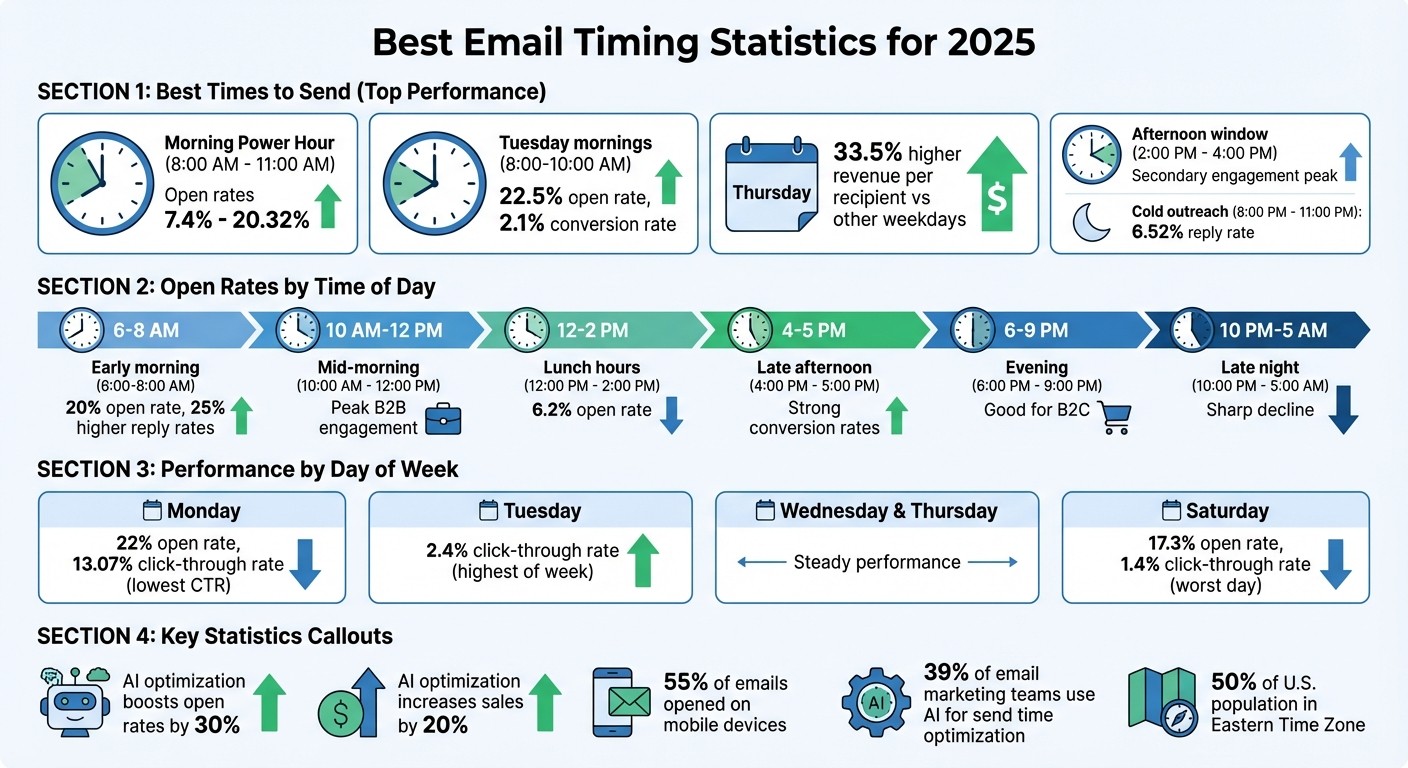
In 2025, mid-morning on weekdays continues to dominate as the prime time for email engagement. The "Morning Power Hour" - between 8:00 AM and 11:00 AM - sees open rates ranging from 7.4% to 20.32%. This is when professionals are settling into their day and clearing out their inboxes [2][5][6].
Tuesday mornings (8:00–10:00 AM) stand out, achieving open rates as high as 22.5% and conversion rates of 2.1% [5]. Thursdays also prove lucrative, with CampaignHQ reporting:
"Thursday [is] the champion with 33.5% higher revenue per recipient compared to other weekdays." [5]
Afternoons, particularly between 2:00 PM and 4:00 PM, offer another opportunity for engagement as people return to their inboxes after lunch. For cold outreach, late evening emails sent between 8:00 PM and 11:00 PM see a reply rate of 6.52% [4].
Saturdays, however, rank as the least effective day, with open rates averaging 17.3% and click-through rates dipping as low as 1.4% [4][5]. B2B outreach over the weekend generally underperforms, though Sunday evenings may see a slight increase as professionals prepare for the upcoming week [2][5].
For local service businesses, these timing insights can help refine email strategies and stand out in crowded inboxes. However, the best timing can vary significantly depending on the industry.
Timing Patterns by Industry
While general trends offer a starting point, industry-specific data provides a sharper focus. Email engagement patterns often align with the unique schedules of different audiences.
B2B and Professional Services: Monday and Tuesday mornings (8:00–10:00 AM) yield the best results [1][2].
SaaS and Software Companies: Perform well on Tuesday and Thursday afternoons, especially between 2:00 PM and 3:00 PM [1][2].
Manufacturing: Since mornings are often spent on the production floor, emails sent between 3:00 PM and 4:00 PM on Tuesday and Wednesday tend to perform better [3].
E-commerce and Retail: Tuesday and Thursday are key days, with optimal times around 10:00 AM or 3:30 PM [1][5].
Marketing Services: Wednesday at 4:00 PM stands out as particularly effective [2][5].
Nonprofits: Engagement peaks on Tuesday and Thursday afternoons, around 3:00 PM [2].
Tailoring email timing to an industry's rhythm can significantly improve engagement rates.
Open Rates by Day and Time
The time of day an email is sent has a noticeable impact on engagement. Early morning emails (6:00–8:00 AM) achieve 20% open rates and 25% higher reply rates, making this window ideal for reaching C-level executives before their day gets busy. Mid-morning (10:00 AM to 12:00 PM) is the sweet spot for most B2B campaigns [2][3][5].
Lunch hours (12:00 PM to 2:00 PM) see moderate engagement, with open rates hovering around 6.2%. Late afternoons (4:00 PM to 5:00 PM) can drive strong conversion rates, even if open rates are lower. Evening emails (6:00 PM to 9:00 PM) work well for B2C audiences, while late-night messages (10:00 PM to 5:00 AM) generally see a sharp decline in performance.
Across the week, Monday emails often achieve solid open rates - around 22% - but tend to generate fewer clicks. Tuesday, on the other hand, leads the week with the highest click-through rate at 2.4% [4]. Wednesday and Thursday also maintain steady performance for both opens and clicks [2][6].
How AI Determines the Best Email Send Times
Data Sources AI Uses for Timing Decisions
AI taps into a variety of data sources to pinpoint the perfect time to send emails. By combining historical engagement data, time zone information, device usage, and session activity, it creates a detailed engagement profile for each contact. For instance, it can identify if someone tends to check emails on their phone during a morning commute or on a desktop while at work. Additionally, session activity, such as recent website visits or app usage, offers clues about when a lead might be most receptive.
For businesses like local service providers, AI takes it a step further by factoring in industry-specific engagement trends. CRM data, including details about a lead's position in the sales funnel and past interactions, adds another layer of precision. Together, these data points allow AI to dynamically adjust email timing for maximum impact.
Data Signal | What It Tracks |
|---|---|
Engagement History | Tracks when a user typically opens or clicks emails [8] |
Timezone | Adjusts for the recipient's local time [8] |
Device Usage | Identifies if engagement happens more on desktop, mobile, or tablet [1] |
Session Activity | Monitors time spent on websites or apps after interacting with an email [1] |
Channel Behavior | Observes preferences for platforms like Email versus SMS [8] |
AI Methods: Machine Learning and Real-Time Changes
Using machine learning, AI analyzes thousands of data points for each recipient to predict the exact moment they’re most likely to engage. These algorithms constantly update, learning from new interactions and adapting to changes. For example, if someone shifts from checking emails early in the morning to later in the day, the system quickly adjusts its timing to match the new pattern [9][10].
Real-time behavioral analysis also allows for immediate follow-ups. If a lead visits your website, AI can trigger a follow-up email within minutes while their interest is still fresh [7][9]. For new leads without much historical data, AI relies on default timing based on trends within similar audience segments. Over time, as more data is collected, the system fine-tunes its approach. Studies suggest this method can boost open rates by up to 30% and increase sales by 20% compared to manually scheduled emails [1].
This ability to adapt in real-time highlights how AI transforms raw data into actionable strategies, ensuring emails land at the most effective moment.
How Cohesive AI Personalizes Email Timing
Cohesive AI builds on these AI techniques to provide tailored email timing for local service businesses. By analyzing engagement patterns from leads sourced through platforms like Google Maps and government records, it learns when business owners in fields such as landscaping, janitorial services, and HVAC are most likely to respond.
Instead of sending all campaign emails at once, Cohesive AI staggers delivery based on each recipient's ideal time window. For example, a restaurant owner might receive a catering proposal in the early afternoon between meal rushes, while a facilities manager could get a janitorial services pitch during their weekly planning period. This strategic timing ensures messages reach recipients when they’re most likely to engage.
What's Next for AI-Driven Email Timing
AI is stepping up its game, moving beyond analyzing past behavior to developing real-time strategies that are increasingly in tune with human emotions. These advancements are refining email timing, ensuring not only that emails land at the best possible moment but also that their content resonates with the recipient's mood and habits.
Context-Aware Timing and Emotional Analysis
AI doesn't just track when recipients open emails anymore - it now evaluates how they interact with them. By analyzing reply patterns and engagement, it can detect emotions like frustration, interest, or even overwhelm [7]. Predictions suggest that by the close of 2026, nearly half of email marketing operations could rely on AI's ability to interpret emotional cues [11]. For example, if a facilities manager shows enthusiasm for a janitorial services pitch, AI can schedule follow-ups during periods of peak interest. On the flip side, when engagement wanes, the system adjusts both the timing and tone to recapture attention.
Marketers tapping into these AI-driven emotional insights have seen revenue increases of 41% compared to those using traditional approaches [11][12]. As Salesforce highlights:
"In the next two to five years... AI will continue to help drive marketers toward more empathetic and thoughtful content" [9].
AI is also leveraging real-time data, like device usage patterns, to take email timing to the next level.
Real-Time Device Activity Integration
One of the most exciting developments in email timing is AI's ability to monitor real-time device activity. By tracking whether a recipient is active on their phone, tablet, or desktop, AI ensures emails arrive at the perfect moment - right when the recipient is online [1]. This just-in-time delivery strategy places messages at the top of active inboxes, dramatically improving visibility.
This approach is especially beneficial for local service providers, where email habits can vary widely. For instance, a landscaping company owner might check emails on their phone while visiting job sites, whereas an HVAC contractor might prefer to review proposals on a desktop during office hours. AI systems that analyze device usage can tailor delivery to match these preferences. Given that over 70% of people now read emails on mobile devices [3], understanding which device a recipient uses at specific times can make a big difference in engagement.
Moreover, AI's ability to detect anomalies in behavior means it can swiftly adapt to changes. If a recipient's habits shift, the system recalibrates delivery timing on the fly, ensuring campaigns stay effective [7]. This real-time responsiveness keeps marketers ahead of the curve as recipient behaviors evolve [7].
Conclusion
AI has completely transformed how local service businesses approach email timing. Instead of relying on outdated "best practices" like sending emails on a Tuesday at 10:00 AM, AI now predicts the exact moments when each lead is most likely to engage. The results? Open rates can climb by as much as 30%, with sales increasing by 20% - a game-changer for businesses in competitive fields like janitorial services, landscaping, and HVAC [1].
This level of precision doesn’t just boost engagement; it simplifies operations, too. By analyzing behavioral data - like past open rates, click habits, and even device preferences - AI pinpoints the optimal time to send emails for every individual recipient [1]. For lean teams, this means less time spent on technical guesswork and more time focused on building meaningful connections [13].
But the impact of AI goes beyond timing. It enhances operational efficiency and scalability, creating a smoother workflow for marketers. Jesse Sumrak from Twilio SendGrid puts it best:
"AI doesn't replace marketers. Instead, it works alongside them, handling data analysis and optimization so marketers can focus on creative strategy" [14].
Modern AI tools also coordinate timing across multiple channels, adjust in real time, and minimize manual errors - especially when managing large datasets across different time zones [1][13].
For local service businesses seeking alternatives to expensive lead generation agencies, solutions like Cohesive AI are stepping in. Platforms like this combine automated lead sourcing (from places like Google Maps and government filings) with AI-personalized cold emails and fully managed campaigns. At $500 per month - and a guarantee of at least four interested responses or a free month credit - it’s a cost-effective way to leverage cutting-edge AI timing strategies without breaking the bank.
AI takes email marketing from guesswork to precision. As inboxes become more crowded and recipient behaviors shift, businesses that adopt the personalized strategies outlined here will stand out - reaching decision-makers at the perfect moment [1].
FAQs
How does AI figure out the best time to send emails?
AI leverages sophisticated algorithms to study recipient behavior, including patterns like when they usually open or click emails, what devices they prefer, and their time zones. By running this data through machine learning models, it identifies the optimal times for each recipient to engage.
What’s more, these models adjust in real time to shifts in behavior or external circumstances, keeping email campaigns timely and effective. This strategy allows businesses to fine-tune their outreach efforts and boost response rates.
When is the best time to send emails for local service businesses?
The optimal times to send emails for local service businesses are generally mid-week, with Tuesday through Thursday being the most effective days. For timing, aim for the morning window between 8:00 AM and 11:00 AM (based on the recipient's local time). If mornings aren't an option, the afternoon slot from 2:00 PM to 4:00 PM also works well.
These periods are ideal because they align with when people are more likely to check their inboxes without feeling bombarded by other emails. Sending messages during these times can boost open rates and responses, making it easier to connect with potential clients.
How does AI optimize email timing to boost open and conversion rates?
AI takes the guesswork out of email timing by studying recipient behavior and identifying the ideal times to send messages. By delivering emails when people are most likely to check their inbox, it boosts visibility, leading to better open rates and stronger engagement.
This smart scheduling ensures your emails grab attention and encourage action exactly when it matters most.