AI Lead Scoring for Local Service Businesses
Dec 29, 2025
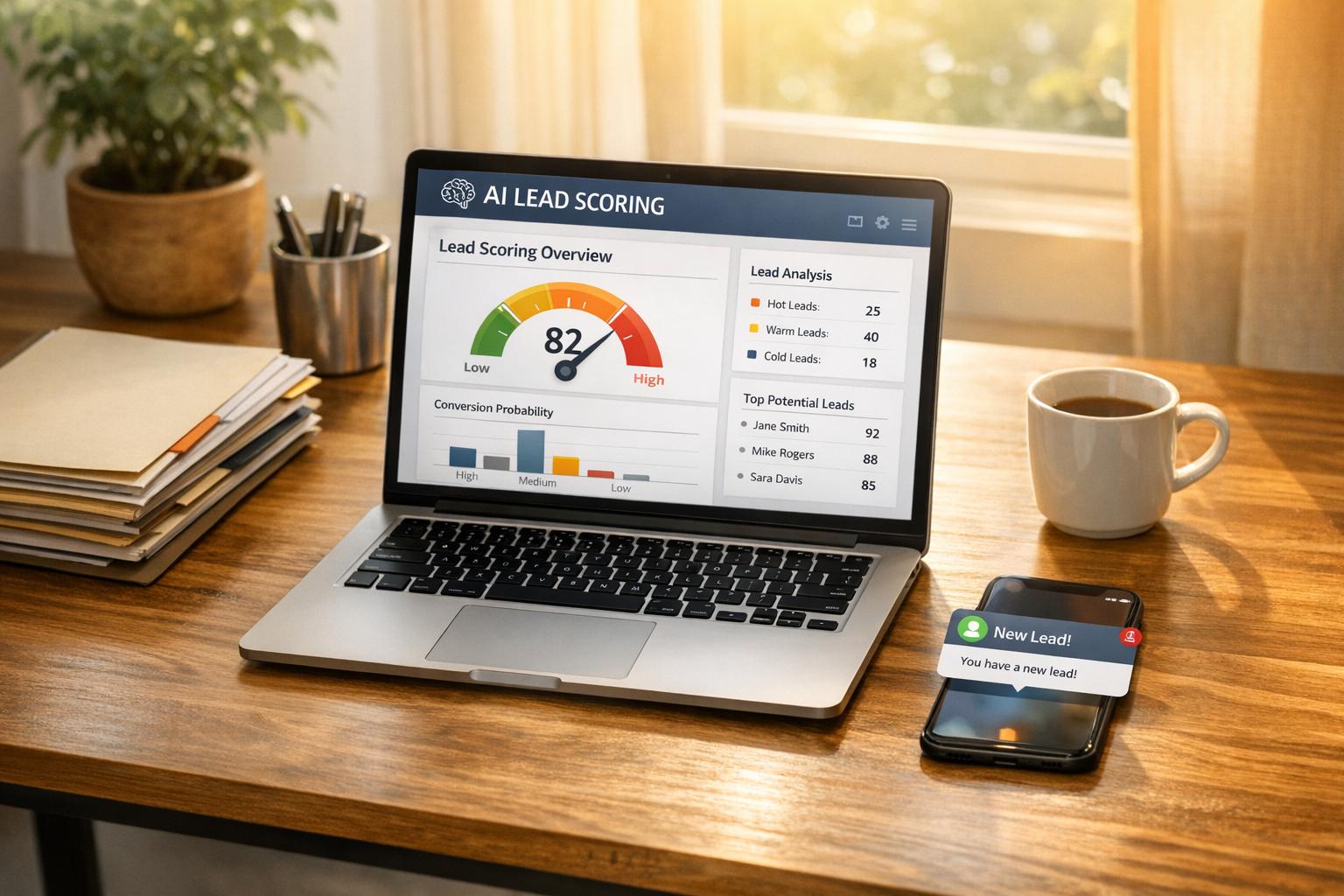
AI lead scoring helps local service businesses - like HVAC, landscaping, or janitorial services - identify and prioritize high-converting leads. Instead of manually sorting through inquiries, AI analyzes data like customer behavior, location, and urgency to predict which leads are most likely to book. Businesses using AI for lead scoring report faster response times (up to 31% quicker), increased conversions (9–20%), and better resource allocation.
Key benefits of AI lead scoring:
Saves Time: Automates lead prioritization, reducing manual effort and speeding up responses.
Boosts Conversions: Focuses on high-intent leads, increasing booking rates by up to 30%.
Personalized Outreach: Provides actionable insights for tailored follow-ups.
Local Insights: Accounts for location-specific factors like proximity and seasonal trends.
The SIMPLEST Way To Build An AI Lead Scoring Assistant (AI Automation)
How AI Lead Scoring Works
6 Steps to Implement AI Lead Scoring for Local Service Businesses
AI lead scoring takes your data and turns it into actionable priorities. It pulls information from various sources, spots patterns in how your top customers behaved before they converted, and applies those insights to new leads almost instantly. For local service businesses, this means recognizing leads that resemble your most profitable jobs in no time.
The process begins with gathering data. AI collects information from your CRM, website analytics, email campaigns, and even phone call transcripts. It then converts this data into signals - like how quickly someone opens an email or if they repeatedly visit a service-specific page. Anya Vitko, Content Marketing Specialist at Vendasta, puts it simply:
"AI lead scoring is the use of machine learning algorithms to automatically evaluate and prioritize leads based on their likelihood to convert into paying customers" [2].
What makes AI lead scoring stand out is its ability to learn continuously. As it processes more leads and tracks real outcomes, it fine-tunes its predictions. This is especially helpful for seasonal businesses, where demand can shift with weather changes or seasonal trends.
Once the data is collected, the system analyzes it to identify promising leads.
Data Points Used in AI Lead Scoring
The accuracy of AI lead scoring depends on the quality and variety of data you provide. For local service businesses, four key data categories are essential:
Geographic Fit: AI checks if a lead is within your service area by analyzing zip codes, service radii, or neighborhoods. It can even prioritize leads based on local factors, like HVAC needs during extreme weather [7].
Behavioral Signals: By tracking real-time engagement - such as website navigation, email interactions, and video views - AI gauges a lead's interest level.
Firmographics and Demographics: These details align leads with your Ideal Customer Profile. For example, HVAC companies might focus on homeownership status or property type, while landscapers might prioritize property size or whether it’s residential or commercial. Interestingly, only 35% of marketers feel confident in their lead scoring accuracy using traditional methods [6].
Predictive Intent Signals: AI analyzes past conversion trends to spot subtle buying cues. As Lorenzo Ciambotti from eMazzanti Technologies explains:
"AI catches the whispers human scorers miss... identifying a correlation between prospects' social media sentiment about industry trends and their likelihood to purchase" [7].
Data Category | Specific Data Points | Collection Source |
|---|---|---|
Geographic | Zip code, service area, local weather | CRM, IP tracking, Weather APIs |
Behavioral | Pricing page visits, email clicks, video views | Website analytics, Email platforms |
Firmographic | Company size, industry, property type | Web forms, LinkedIn, Enrichment tools |
Intent | Local search terms, call transcripts, hiring trends | SEO tools, Call recording software |
With these data categories in mind, here’s how you can set up an AI lead scoring system step by step.
Steps to Set Up AI Lead Scoring
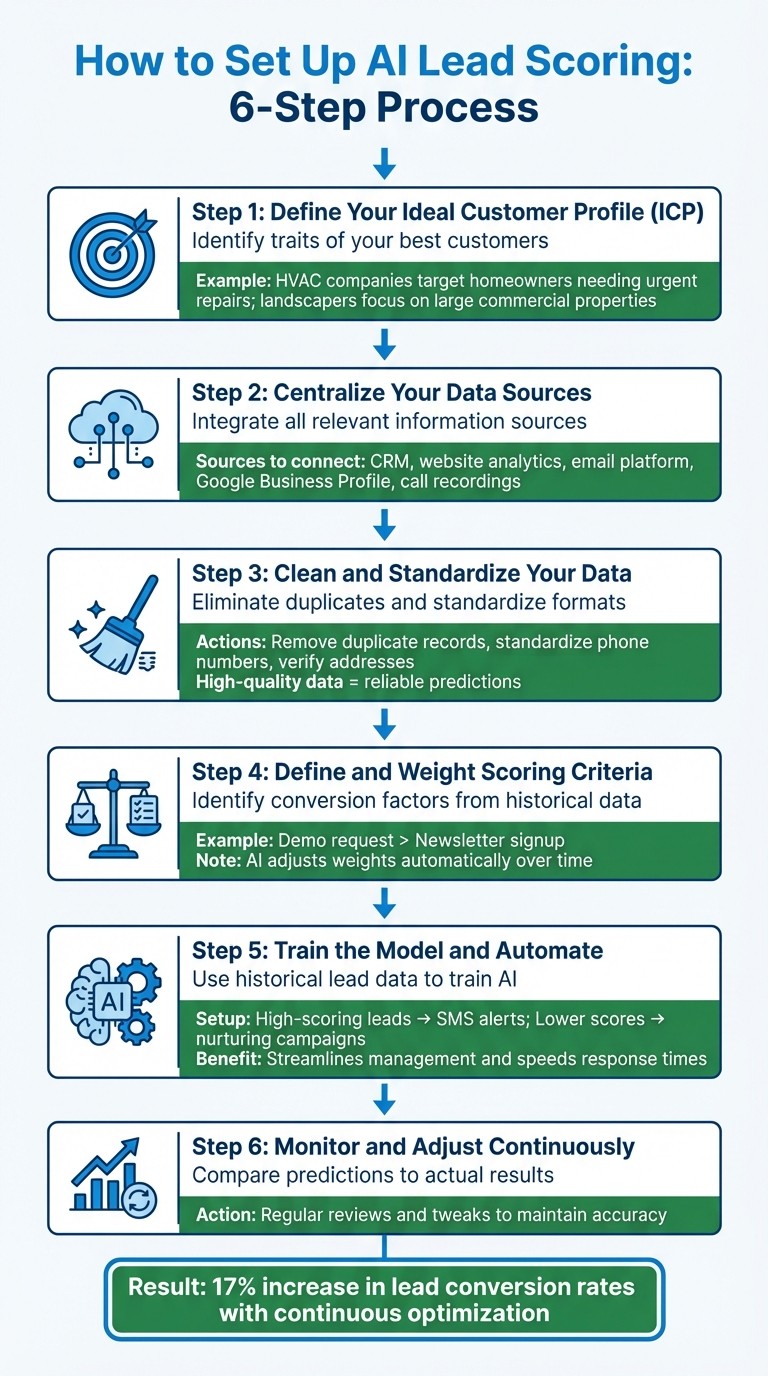
Implementing AI lead scoring starts with clean data and clear goals. Follow these steps to get started:
Define Your Ideal Customer Profile (ICP): Pinpoint the traits of your best customers. For instance, an HVAC company might focus on homeowners in a specific radius needing urgent repairs, while a landscaping business might target large commercial properties.
Centralize Your Data Sources: Make sure your AI has access to all relevant information by integrating your CRM, website analytics, email platform, and local signals like Google Business Profile interactions. If available, include call recording data.
Clean and Standardize Your Data: Eliminate duplicate records, standardize formats (like phone numbers), and verify addresses. High-quality data is crucial - messy data leads to unreliable predictions. Julian Alvarado, Content Lead at Coefficient, emphasizes:
"AI systems discover patterns humans might miss" [1].
Define and Weight Scoring Criteria Using Historical Data: Identify which factors most often lead to conversions. For example, a demo request might carry more weight than a newsletter signup. Over time, AI will adjust these weights automatically as it learns.
Train the Model and Automate Prioritization: Use several months of historical lead data - both successful and unsuccessful - to train your AI. Then, set up automated workflows so high-scoring leads trigger immediate alerts (like SMS notifications), while others enter nurturing campaigns. This streamlines lead management and speeds up response times [4].
Monitor and Adjust Continuously: Regularly compare your model’s predictions to actual results and tweak your criteria if needed. This ongoing adjustment ensures your scoring model stays accurate, even as market conditions change.
Best Practices for AI Lead Scoring
Once you've set up your AI lead scoring model, following these best practices can help you consistently improve lead conversion rates. AI lead scoring works best when it’s regularly updated and paired with personalized outreach. Companies that keep their models current have reported a 17% increase in lead conversion rates [9].
Combining Multiple Data Sources
To improve accuracy, merge data from multiple sources. Combine first-party data like CRM records and call logs with third-party information such as firmographics and local intent signals. For instance, tracking local search terms like "repair shop near me" and feeding those insights into your model can make a big difference [11][3].
Automated enrichment tools can fill in missing details - like company size or industry - when all you have is an email address [4]. Integrate your CRM, marketing automation platform, and web analytics via APIs to ensure lead scores update in real time as new data comes in [9][2].
Evaluate leads by considering both their fit for your ideal customer profile and their engagement level. For example, a landscaping company might prioritize commercial properties for fit, but a residential homeowner who visits the pricing page multiple times shows stronger intent.
Also, pay attention to SMS replies as a valuable behavioral signal - text messages boast open rates of over 98% [10]. On the flip side, assign negative scores to leads outside your service area or with invalid contact information to save your sales team’s time [12][4].
Data Category | Examples for Local Services | Impact on Lead Score |
|---|---|---|
Demographic | Job title, location, years of experience | |
Firmographic | Industry, company size, annual revenue | |
Behavioral | Website visits, email clicks, SMS replies | |
Local Signals | Proximity to service area, search terms used | |
Predictive | AI-modeled buying signals, historical patterns |
Creating Personalized Follow-Ups for High-Scoring Leads
Once your data is optimized, focus on tailoring follow-ups to engage leads effectively. Use AI scores to create Smart Lists that group leads based on specific behaviors, such as visiting a pricing page or downloading a guide. This way, your outreach aligns with where they are in their buying journey [2][12].
Set up automated triggers for leads with high scores (76+ points) to receive immediate personal calls or SMS messages. Mid-range leads (51–75 points) can enter email drip campaigns, while lower scores might receive educational content [12]. Provide your team with context behind the scores - for example, instead of just "87 points", they see "visited HVAC maintenance packages page three times this week" [9][5]. Joe Tankard, CMO at Maverick Windows, shared how this approach works for his team:
"Verse allows us to stand out in a crowded marketplace. We can make a connection via Verse, bring those clients back into our call center where they can have a human interaction with our team, and then we can really sell them on our services" [10].
By concentrating efforts on the top 30% of leads, companies have seen a 150% boost in conversion rates [2]. Tools like local presence dialers can also increase pick-up rates when contacting high-priority leads [12]. For high-stakes contracts, such as commercial HVAC installations, let AI qualify leads around the clock but hand off the warmest ones to your sales team for personalized conversations [10].
Monitoring and Improving Your Scoring Model
To keep your scoring model effective, establish regular feedback loops with your sales team. Have them rate lead quality on a 1–5 scale after each interaction, track conversion rates, and conduct quarterly reviews to adjust the model as market conditions evolve [2][8]. AI tools can also reduce the time it takes to handle inbound leads by 31% [4].
Measure conversion uplift by comparing AI-prioritized leads against a baseline of non-scored leads. Use this formula: (Conversion rate of AI-prioritized leads – Conversion rate of baseline leads) / Conversion rate of baseline leads × 100 [2]. As Stan Rymkiewicz, Head of Growth at Default, puts it:
"If you have a bunch of 'qualified' leads that don't convert into sales, that's a sign you need to reconfigure your model" [4].
Monitor how well leads in different scoring brackets convert. If low-scoring leads outperform high-scoring ones, it’s time for a recalibration [2]. Go beyond counting "qualified" leads - track metrics like "second meeting" or "opportunity creation" rates to ensure quality over quantity [4].
Experiment with A/B testing different scoring models to determine which one better identifies high-value customers [1]. Set up real-time alerts via Slack or email when a lead reaches a high-priority threshold, so your team can act quickly [1]. Advanced tools like Salesforce Einstein can even refresh models automatically every 10 days to keep them accurate [1].
Cohesive AI: AI-Powered Lead Scoring Solution
Cohesive AI offers a game-changing solution for local service businesses struggling with the high costs of traditional lead generation. Designed for industries like janitorial services, landscaping, HVAC, roofing, flooring, and handyman work, this platform provides a steady flow of qualified local leads - without the hefty price tag associated with agencies.
How Cohesive AI Simplifies Lead Scoring
Cohesive AI handles the lead generation process from start to finish. It begins by scraping Google Maps to find profitable local businesses, automatically pulling owner email addresses. Additionally, it taps into public registries and government filings to generate and qualify leads, ensuring you're connecting with verified business owners who align with your ideal customer profile.
Once leads are identified, the platform sends AI-personalized cold emails to increase engagement. It then monitors key actions - like email opens, website visits, link clicks, and form submissions - to score leads based on their interest level. High-intent leads are flagged for immediate follow-up, giving your sales team a head start.
The platform integrates effortlessly with popular CRMs like HubSpot and Salesforce, syncing lead scores and interaction histories in real time. It also features an automated lead distribution system, assigning leads to sales reps based on their skills, location, and workload. This streamlined process ensures efficient lead management and boosts conversion potential.
Features and Pricing
Cohesive AI's automated tools not only simplify lead qualification but also offer a straightforward pricing model that makes scaling easy.
The platform supports up to three simultaneous email campaigns, designed to bypass spam filters and maximize deliverability. Automated reminders and smart notifications help your team stay on top of follow-ups, while the built-in CRM brings all your marketing tools under one roof.
Pricing is simple: $500 per month with a one-time setup fee of $75. There are no long-term contracts, and the platform guarantees at least four interested responses each month. If this benchmark isn’t met, you’ll receive a free month of service. For local service businesses currently spending between $2,000 and $5,000 monthly on lead generation, this pricing structure provides substantial savings while keeping you in full control of your lead pipeline.
Conclusion
AI-powered lead scoring is changing the game for local service providers by weeding out low-quality leads and spotlighting high-intent prospects. Businesses that adopt lead scoring tools report a 77% boost in lead generation ROI [13]. On top of that, companies leveraging AI for lead prioritization have slashed qualification times by as much as 62% [14]. For small teams juggling heavy workloads, these time savings mean fewer resources wasted on unqualified leads and more deals closed.
Beyond efficiency, speed-to-lead is critical in converting prospects. With 70% of leads lost due to poor follow-up [13], automated scoring ensures high-priority leads get immediate attention while lower-priority ones are nurtured over time. This system works 24/7, capturing opportunities even after hours, so potential revenue doesn’t slip away.
Platforms like Cohesive AI make this process even more accessible. By combining automated data collection from sources like Google Maps and government filings with AI-driven personalized outreach and real-time scoring, they simplify lead management. At a flat rate of $500 per month and a guarantee of at least four interested responses, Cohesive AI offers a low-risk way to secure verified leads and streamline operations.
AI doesn’t just improve lead management - it also supports sustainable business growth. By spotting patterns that human methods might miss, AI refines its accuracy over time, adapting to market shifts. This leads to better revenue forecasting, 13% to 31% reductions in customer churn [1], and more consistent cash flow. For local service providers, this means less time worrying about revenue fluctuations and more time focusing on delivering exceptional service.
FAQs
How can AI lead scoring help local service businesses boost their conversion rates?
AI lead scoring leverages machine learning to evaluate data such as website visits, email engagement, and other interaction metrics. It assigns a ranking to leads, helping local service businesses zero in on the prospects most likely to convert.
By focusing on top-tier leads, businesses can increase conversion rates, save time, and get more out of their return on investment (ROI). This method proves particularly useful for industries like janitorial services, landscaping, HVAC, and catering, where tailored outreach can drive meaningful results.
What data is essential for effective AI lead scoring?
Effective AI lead scoring combines demographic, firmographic, and behavioral data to pinpoint leads with the highest potential. Factors like company size, industry, location, and job title help gauge how well a lead matches your ideal customer profile.
On the behavioral side, actions such as website visits, time spent on key pages, email interactions, and CRM updates reveal a lead’s level of interest and buying intent. Adding third-party data - like financial health metrics or recent filings - further refines the process. By analyzing all these inputs, AI models can dynamically rank leads, enabling local service businesses to channel their efforts toward the most promising prospects.
How can local service businesses keep their AI lead scoring model accurate over time?
To keep an AI lead scoring model accurate and effective, businesses need to update it frequently with fresh, high-quality data and monitor key performance metrics. As customer behaviors and market trends shift, fine-tuning or retraining the model becomes necessary to maintain its relevance.
Integrating real-time data syncing and establishing feedback loops with sales teams can make the model more adaptive. This approach ensures the system keeps identifying and prioritizing top-value leads efficiently, even as circumstances evolve.