Email Personalization vs. Generic Outreach: Conversion Impact
Jan 31, 2026
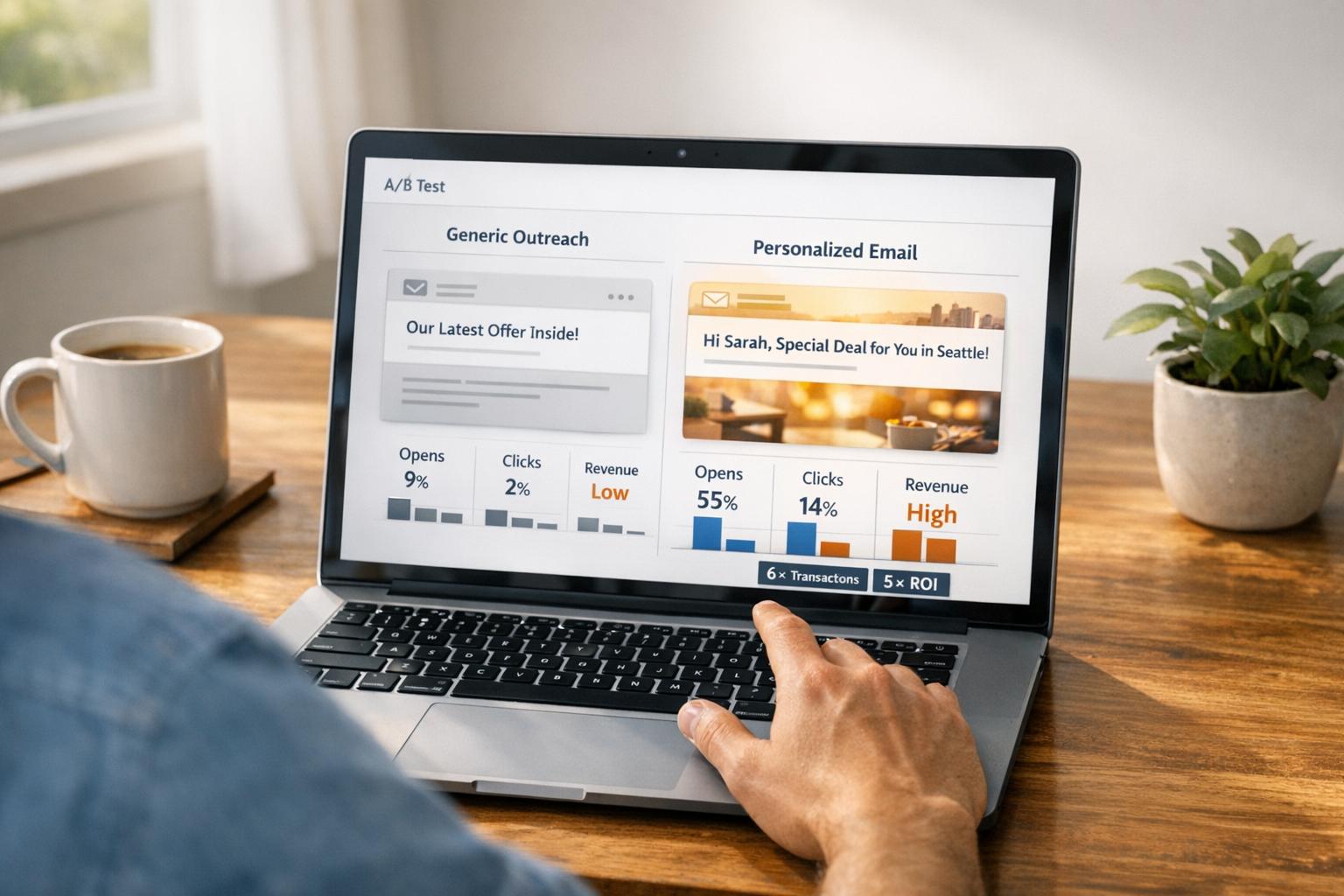
Email personalization significantly outperforms generic outreach when it comes to driving conversions for local service businesses. Why? Because personalized emails feel relevant, tailored, and timely, while generic emails often come across as impersonal and easy to ignore.
Key Findings:
Personalized emails generate 6× higher transaction rates and 5× higher ROI.
Including a personalized subject line can boost open rates by 26%.
Generic outreach struggles with low response rates, averaging 1%-5%.
Quick Comparison:
Metric | Generic Outreach | Personalized Outreach |
|---|---|---|
Open Rate | 15%-25% | 26%-29% higher |
Response Rate | 8.5% | 32.7% higher |
Click-Through Rate | Standard | 41%-51% higher |
Transaction Rate | Standard | 6× higher |
Revenue Per Email | Standard | 6× higher |
Takeaway:
If you're looking to boost conversions, personalization isn't optional - it’s essential. Tailor your emails to address specific needs, behaviors, and local challenges. While generic outreach can work for broad awareness campaigns, it’s personalization that drives meaningful results.
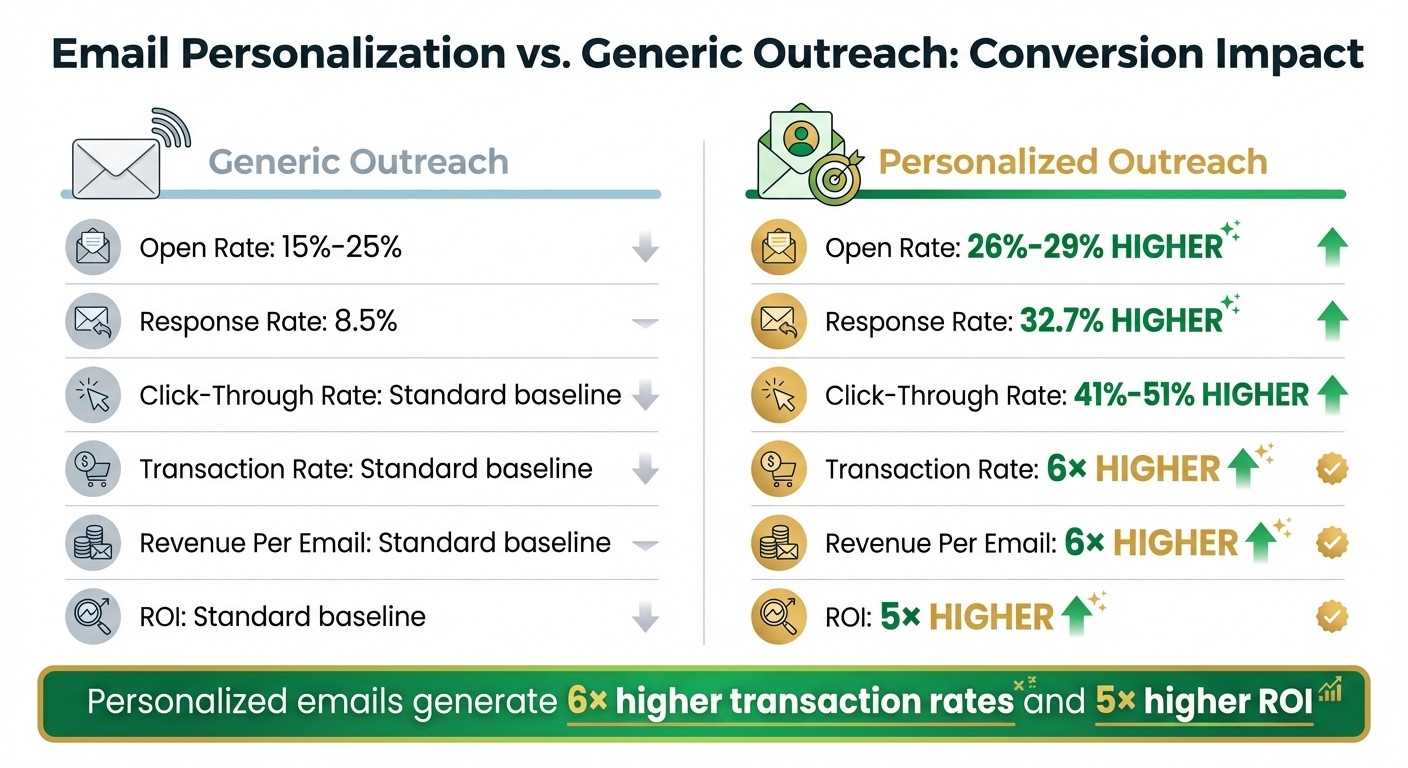
Email Personalization vs Generic Outreach: Performance Metrics Comparison
AI Email That Converts - Without Sounding Like a Robot | INBOUND 2025
What is Email Personalization?
Email personalization is all about customizing email content to fit the recipient's data, actions, and preferences. It goes beyond just adding someone's name - it involves tweaking the subject line, email body, and even the call-to-action based on factors like location, purchase history, or recent interactions.
The goal? To create a one-on-one conversation instead of a generic mass email. For local service businesses, this means addressing specific challenges tied to their industry and region.
"Real email personalization is about sending the right message to the right person at the right time, based on who they actually are and what they've actually done." – Nutshell [5]
This approach delivers measurable results: emails with personalized subject lines are 26% more likely to be opened [2][8], and businesses using personalization can see revenue increases ranging from 5% to 15% [7]. These results stem from several key elements of personalization, which are explored below.
Key Components of Personalized Emails
Successful email personalization hinges on a few essential factors:
Recipient Details: Including job titles, company names, or industry-specific challenges makes your email feel relevant [9].
Contextual Data: Using geographic or regional information ensures the message resonates. For example, an HVAC company in Phoenix would focus on different topics than one in Minneapolis [9].
Behavioral Triggers: Tailoring emails based on actions like visiting a pricing page, downloading a guide, or previous purchases ensures the timing and content are spot on [7][5].
Addressing Pain Points: Directly tackling the recipient's unique challenges boosts engagement. A janitorial service might highlight compliance with local health regulations or offer post-event cleanup solutions [9].
Personalized content in the email body can increase response rates by 32.7% [4], while overall personalization can lead to a 139% jump in click-through rates [8].
Personalization Examples for Local Service Businesses
Here’s how personalization works in practice for different industries:
HVAC Businesses: Imagine sending a "winter prep" email to customers who haven’t scheduled a service in six months. Include details like their unit model and tips for the upcoming cold season. During a heatwave, your system could automatically send tune-up reminders to customers in affected zip codes [7][5].
Landscaping Companies: Providing lawn care tips tailored to local weather patterns makes emails more relevant. After heavy rainfall, you might send advice on drainage solutions or preventing lawn fungus to customers in impacted areas [2][8].
Janitorial Services: Targeted emails can focus on industry-specific compliance needs. For example, a janitorial service might offer post-event cleanup services based on local event calendars or highlight updated health code regulations for restaurants. For medical offices, you could emphasize infection control protocols, while retail stores might benefit from reminders about maintaining clean, customer-facing spaces during busy seasons [9][5].
Tools like Cohesive AI make this level of personalization easier for local service businesses. By pulling data from sources like Google Maps and government filings, Cohesive AI uses advanced insights to craft emails that mention specific business details, local conditions, and industry challenges. The result? Emails that feel genuinely tailored, not mass-produced.
What is Generic Outreach?
Generic outreach involves sending the same email to a large group of people, focusing on quantity over quality [9][5]. Often referred to as "spray-and-pray" marketing, this approach sends thousands of identical emails, hoping for a small percentage of responses.
These campaigns typically use basic templates with minimal personalization - often just a merge field for the recipient's name or company [3][5]. The content doesn’t adapt to specific industries or local needs, meaning an HVAC company in Phoenix might receive the same email as a landscaping business in Seattle.
"The telltale 'Hi,' or 'Hello,' is usually enough to let you know that this exact same email has been sent to hundreds of other people." – Backlinko [4]
On average, generic campaigns tend to yield a response rate of around 5.1% [9].
Features of Generic Email Campaigns
Generic emails are easy to spot. Their subject lines are often vague and unoriginal - think "Quick Question" - offering little incentive to open the message [4][13]. The greetings are equally impersonal, using phrases like "Hi", "Hello", or even "Current Resident" [4][12].
The body of these emails sticks to a one-size-fits-all formula. For instance, a janitorial service might receive the same pitch as a catering company, with no acknowledgment of their specific challenges or industry standards [7][2]. Even the email signatures lack effort, often omitting links to social media profiles or personalized contact details [9].
Attempts at personalization are often superficial. For example, including a line like "I saw your article at XYZ.com" without any meaningful context can actually reduce reply rates by 1.3% compared to a straightforward template [3]. These shortcomings highlight the limitations of generic outreach, but there are scenarios where it can still be useful.
When Businesses Use Generic Outreach
Despite its flaws, generic outreach does have its place. It works well in situations like initial cold prospecting, market testing, or brand awareness campaigns, especially when resources are tight [3][9][10]. It’s also a practical option for businesses that lack the tools or expertise needed for more personalized campaigns, such as CRMs or advanced data systems [10][5].
"Generic outreach is faster and easier to scale but often fails to connect with recipients." – Artemis Leads [10]
The trade-off is simple: generic outreach is cheaper and easier to execute [10], but it often lacks the personal touch needed to truly engage recipients. For small, local businesses operating in competitive markets, this lack of connection can mean missed opportunities. Understanding where generic outreach fits can help businesses decide when it’s worth using as part of their broader strategy.
Performance Metrics: Email Personalization vs. Generic Outreach
Side-by-Side Metric Comparison
The numbers don’t lie - personalized emails consistently outperform generic outreach across key metrics for local service businesses.
Metric | Generic Outreach | Personalized Outreach |
|---|---|---|
Unique Open Rate | 15% – 25% (Average) [14] | |
Response Rate | 8.5% (Average) [4] | 32.7% higher [4] |
Click-Through Rate | Standard | 41% – 51% higher [1] |
Transaction Rate | Standard | |
Revenue per Email | Standard | |
Return on Investment | Standard | 5x higher [5] |
Let’s break it down further. Personalized subject lines alone boost open rates by 26% [6][2], while behavioral triggers can drive up to 51% higher click-through rates [1].
"Personalized emails generate six times higher transaction rates and revenue per email than nonpersonalized email." – Peter DeNunzio, General Manager, Experian Marketing Services [1]
These stats highlight the power of tailored messaging - it’s not just about better engagement; it’s about creating a direct line to higher sales and ROI.
Revenue and Conversion Differences
For local service businesses, the impact of personalization goes beyond clicks and opens. These performance improvements lead to stronger client relationships and quicker sales cycles. Personalized campaigns deliver a 20% average sales increase and up to 6× higher revenue per email, all while improving lead quality [2][5].
Here’s a practical example: imagine an HVAC company receiving an email that directly addresses their industry-specific pain points or references their recent website activity. That level of customization builds trust and credibility far faster than a generic email ever could. It’s no wonder that 83% of marketers who exceeded their revenue goals had a dedicated budget for personalization [12].
The takeaway? Personalization isn’t just a “nice-to-have” - it’s a must-have for businesses looking to maximize their email marketing ROI.
Benefits and Drawbacks of Email Personalization
Benefits of Email Personalization
Personalized emails can deliver 6× higher transaction rates and generate 5× higher ROI compared to generic campaigns[1][5]. For local service businesses, this means more than just higher open rates - it translates directly into increased revenue. Imagine sending an email that directly addresses a prospect's industry challenges or recent activities. It’s not just about being noticed; it’s about closing deals.
Trust is another key factor. 80% of consumers are more likely to purchase from brands that offer personalized experiences[15]. For businesses like HVAC companies or landscaping services, follow-up emails referencing specific details - like property size or seasonal needs - can create a genuine connection. Instead of feeling like spam, these emails feel tailored and relevant.
The benefits of personalization grow over time. Businesses using advanced strategies report a 20% higher sales conversion rate[15]. Triggered emails based on specific actions, such as abandoned booking forms, can achieve a 152% higher open rate compared to generic mass emails[16]. Even simpler tactics, like including the recipient's name or job title, can boost open rates by 50%[17].
"Consumers have come to expect content tailored to their unique interests and preferences, and there is a clear business case for why marketers need to meet those expectations."
Peter DeNunzio, General Manager, Experian Marketing Services[1]
These numbers highlight the direct link between personalized content and improved results. For local service businesses, prioritizing personalization isn't just a nice-to-have - it’s a key strategy for driving consistent growth.
Drawbacks of Email Personalization
Despite its benefits, email personalization comes with challenges. One of the biggest hurdles is the time and resources required. Creating tailored content for multiple audience segments can be exhausting, with 51% of marketers reporting it takes two or more weeks to launch a single campaign[19]. For smaller businesses without dedicated marketing teams, this can feel like an impossible task.
Another issue is managing data. Personalization relies on clean, comprehensive data, but many businesses struggle with fragmented or incomplete information stored across various systems[18][19]. Without a unified view of customers, creating effective campaigns becomes a guessing game.
There’s also the risk of overstepping boundaries. While personalization can be powerful, 44% of consumers are less likely to buy if a brand’s efforts feel intrusive or miss the mark[20]. Misusing personal details or referencing incorrect information can create a "creepiness factor" that drives potential customers away.
Technical complexity adds yet another layer of difficulty. Advanced techniques like dynamic 1:1 content or real-time behavioral triggers often require specialized expertise that many local businesses simply don’t have[19][21]. On top of that, stricter spam regulations from major email providers mean poorly executed campaigns can end up in spam folders, wasting both time and money[19].
To overcome these challenges, automation tools like Cohesive AI offer practical solutions. By leveraging AI, businesses can scale personalized outreach without the heavy manual workload. For instance, the platform can generate tailored opening lines, manage email deliverability, and even scrape Google Maps for leads. This allows local service providers to focus on closing deals while the technical and repetitive tasks are handled behind the scenes.
Benefits and Drawbacks of Generic Outreach
Benefits of Generic Outreach
Generic outreach shines when it comes to quickly reaching a large audience without breaking the bank. Its standout feature is its scalability - you can send mass emails using basic templates with merge fields, reaching thousands of people in just minutes. For businesses like local service providers testing new markets or promoting seasonal deals, this method gets the message out fast and efficiently[3].
Another plus? It’s resource-light. You don’t need a big marketing team or fancy tools to run these campaigns. Take Wayne McFarland, for example - he contacted over 1,200 independent bookstores using nothing more than a simple Excel list and standardized templates. This case highlights how generic outreach can be scaled without requiring hefty investments[9].
It also works well as a screening tool. By casting a wide net, you can identify interested prospects and then focus your personalized efforts on those who respond. For campaigns aimed at raising awareness - like announcing a new service area or promoting an upcoming webinar - this approach is an efficient way to generate leads at the top of the funnel.
But while generic outreach offers a broad reach, it often struggles to keep audiences engaged.
Drawbacks of Generic Outreach
The biggest downside of generic outreach is its low engagement rates. Response rates typically hover between 1% and 5%, far below the 10–25%+ seen with personalized approaches[10]. With the average office worker receiving 121 emails daily, your generic message risks getting lost in the clutter[10].
Another issue is spam risk. Bulk emails are often flagged as spam by email service providers. In fact, 69% of email recipients decide whether to mark a message as spam based solely on the subject line[13]. If your emails repeatedly land in spam folders, it can harm your sender reputation - and in worst-case scenarios, even get your domain blacklisted[23].
Generic outreach can also damage trust. A lack of personalization frustrates 75% of consumers, and 63% admit they’ll stop buying from brands that don’t tailor their outreach[22]. When your email feels like it was sent to everyone and no one at the same time, it’s easy for prospects to tune out. This can be especially harmful for local service businesses looking to build meaningful connections within their communities.
"Generic outreach works for large-scale, low-priority campaigns."
Artemis Leads[10]
Ultimately, these limitations can make it harder to convert leads, especially for businesses that rely on building trust and personal relationships.
Conversion Impact for Local Service Businesses
How Personalization Increases Conversions
Personalized emails are more than just a nice touch - they directly impact revenue for local service businesses. On average, businesses using personalized email campaigns experience conversion rates of 3–5%, compared to only 1–2% for generic emails. That’s a 150% boost in performance [25]. For B2B service providers, where building trust is critical, 62% of buyers say they’re more likely to engage when content aligns with their specific business needs [5]. For instance, an HVAC company targeting clinics could focus on "HEPA filtration for clinics" instead of a generic "AC repair" message [24].
Even small efficiencies, like closing deals a week earlier, can translate into meaningful revenue increases [5]. Behavioral triggers also play a big role. For example, following up within 24 hours after a prospect visits your pricing page can triple response rates [9].
Tools like Cohesive AI make this process seamless. By scraping data from sources like Google Maps and government filings, it identifies leads and crafts personalized cold emails at scale. Cohesive AI even guarantees at least four interested responses per month - or you get a free month of service. This automation takes the guesswork out of lead generation and ensures that tailored messaging delivers results.
These examples underscore how personalized outreach can significantly outperform generic strategies when it comes to driving conversions.
When Generic Outreach Makes Sense
While personalization is a powerhouse for conversions, generic outreach still has its place - mainly for building broad visibility. It’s especially useful in awareness campaigns or as a way to screen potential leads before moving to more targeted follow-ups [11].
For example, a local service business might send out a general email like "Spring Cleanup Available" to all businesses within a 10-mile radius. This type of approach can help identify warm leads, but it shouldn’t be the backbone of your strategy.
"Starting a relationship with a generic script is like proposing marriage on the first date without even knowing the other person's name."
Key Takeaways
Personalized emails consistently deliver better results than generic outreach, driving faster deal closures and boosting revenue for local service businesses. For example, personalized emails generate 6× more transactions [22][1], and companies that prioritize personalization see earnings increase by 40% compared to those that don’t [22][10].
The key to successful personalization lies in making your messaging contextually relevant. Instead of sending out generic emails like "Spring Cleanup Available" to everyone, effective businesses tailor their emails with specific details - like referencing "HEPA filtration for clinics" or acknowledging a recipient's recent 5-star reviews [27]. This targeted approach can cut deal closure times in half, reducing the process from six months to just three [10]. It’s no wonder that 73% of B2B decision-makers consider personalization essential in cold outreach [10].
While achieving this level of personalization used to demand a lot of manual effort, AI tools have made it much easier. For instance, Cohesive AI automates personalized email campaigns for $500 per month, with no long-term commitments. They even guarantee at least four interested responses monthly - or they’ll give you a free month.
To make the most of these benefits, try implementing practical personalization strategies. Use the 30/30/40 rule: dedicate 30% of your email to a personalized opening, 30% to delivering clear value, and 40% to a compelling call to action [26]. Save detailed personalization for high-value prospects, while using semi-custom templates for larger campaigns. Don’t forget to follow up - doing so can increase reply rates by 65.8% [4]. With tools like Cohesive AI handling research and drafting, your team can focus on refining messages and closing deals effectively.
FAQs
How does personalizing emails help improve conversion rates?
Personalized emails drive better conversion rates because they make messages feel more relevant and engaging. When content is tailored to match individual preferences or needs, it resonates on a deeper level. This often translates into higher open and click-through rates compared to generic, one-size-fits-all emails. Think about it - an email that feels like it was written just for you is far more likely to grab your attention than something that screams "mass mailing."
Beyond just catching attention, personalization builds trust and strengthens relationships with potential customers. When businesses address specific pain points or interests, their messages feel more thoughtful and meaningful. This approach not only encourages recipients to take action but also helps turn leads into loyal, long-term customers. It's about creating a connection that feels personal, not transactional.
What are the key steps to effectively personalize an email?
To make an email truly personal, start by gathering relevant and precise information about your recipient. This could include their preferences, past behaviors, or demographic details. With this foundation, you can craft messages that resonate on a personal level.
Key areas to customize include the subject line, email body, and call-to-action. These elements should directly address the recipient's needs or interests, making the email feel tailored just for them. Tools like segmentation and automation can help deliver your message at the perfect time to the right audience. Plus, using AI-driven tools can take your personalization to the next level by dynamically adjusting content based on real-time data, boosting engagement and conversions.
By blending accurate data, meaningful content, and well-timed delivery, you can create emails that not only connect but also deliver stronger results for your campaigns.
When should you choose generic outreach instead of personalized emails?
Generic outreach works well when you need to connect with a large audience quickly and on a budget. It’s especially useful when the leads aren’t considered high-value. While personalized emails tend to get better response rates, they also demand more time and effort to craft.
For tasks like promoting broad offers, engaging a wide audience, or gauging initial interest, generic outreach proves to be a practical and time-saving approach.