How Google Maps API Powers Local Leads
Oct 30, 2025

Google Maps API and tools like Cohesive AI are changing how local service businesses find customers. These solutions simplify lead generation by automating data collection and outreach, saving time and money. Here's a quick breakdown:
Google Maps API: Offers access to over 200 million business listings. It provides detailed data like names, addresses, and phone numbers, but requires technical expertise for setup and integration. Costs are pay-as-you-go, starting at $17 per 1,000 requests.
Cohesive AI: A ready-to-use platform that combines Google Maps data with government records, automates email campaigns, and guarantees at least four interested responses monthly. Costs $500/month with a $75 setup fee.
Key Takeaways:
Google Maps API is ideal for tech-savvy teams needing custom solutions.
Cohesive AI is better for businesses seeking a simple, all-in-one lead generation tool.
Feature | Google Maps API | Cohesive AI |
|---|---|---|
Data Sources | Google Maps only | Google Maps + government data |
Automation | Requires custom setup | Fully automated |
Cost | Pay-as-you-go ($17/1,000) | $500/month + $75 setup |
Ease of Use | Requires technical skills | Plug-and-play |
Choose based on your technical skills, budget, and need for automation.
Build the Ultimate AI Lead Outreach Machine with Google Maps and n8n
1. Google Maps API
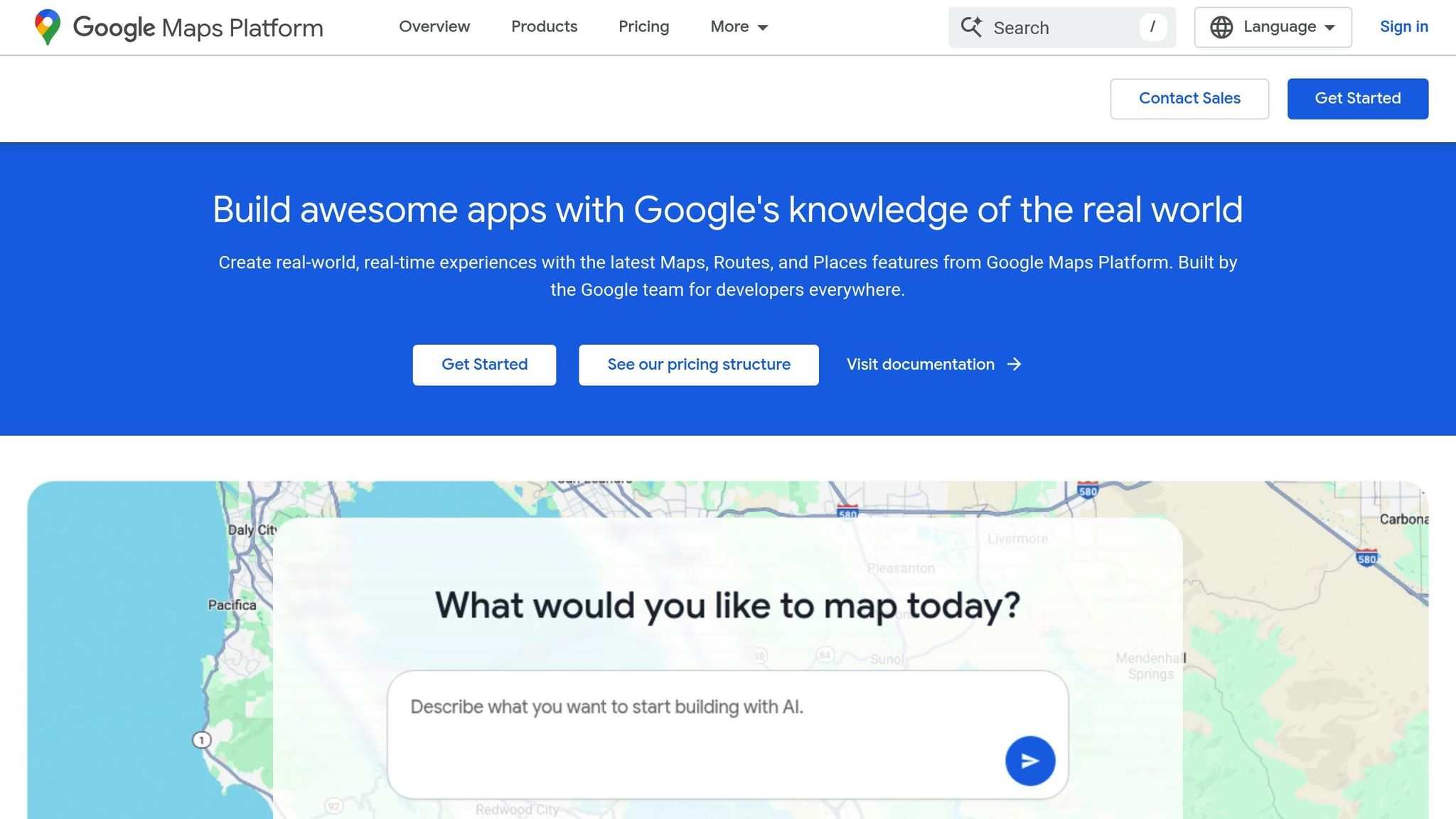
The Google Maps API takes raw business data and turns it into actionable insights for lead generation. With access to one of the largest business directories - covering over 200 million businesses across more than 4,000 categories[2] - it’s a game-changer for local service companies aiming to connect with potential clients.
Data Extraction Capabilities
The API provides robust tools for gathering detailed business information. The Places API allows users to search for businesses by category within specific geographic areas, while geocoding converts addresses into precise coordinates, enabling more targeted outreach[6].
Through this API, you can access critical details like business names, addresses, phone numbers, websites, ratings, reviews, hours of operation, and even photos[2]. For those needing advanced data, the API can retrieve up to five email addresses per business, along with social media profiles and website metadata[2]. Its geographic targeting is incredibly versatile, supporting searches by city, county, state, or even nationwide[2].
This rich data serves as a foundation for creating automated workflows that save time and effort.
Automation and Workflow Efficiency
One of the API’s standout features is its ability to automate tasks that would otherwise take hours to complete manually. Automated workflows can continuously collect, filter, and organize business data[2]. Some systems even go beyond Google’s typical 120-place display limit per search area, allowing for larger datasets to be extracted, resulting in more comprehensive lead lists[5]. Once collected, the data can be exported in formats like Excel, CSV, or JSON, making it easy to integrate with CRM systems and email marketing tools.
Cost and Scalability
The automation capabilities of the Google Maps API not only save time but also significantly lower the cost of lead generation. For small and medium-sized service businesses, this cost efficiency is a major advantage, especially for those working within tight marketing budgets. The API is designed to grow with your business. While there’s a free tier for basic needs, larger-scale operations require a paid account. Even so, the cost per lead is often much lower than traditional methods[4][6]. On average, an exported dataset yields 97+ leads per targeted search, complete with contact details and engagement-ready information[2].
Compliance and Data Privacy
Maintaining compliance with legal and ethical standards is essential for sustainable lead generation. The Google Maps API focuses on publicly available business data, which helps ensure adherence to data privacy regulations[2]. However, it’s crucial to follow Google’s Terms of Service, including respecting rate limits and avoiding excessive scraping that could disrupt the platform. For businesses in the U.S., compliance with laws like the CAN-SPAM Act and relevant state privacy regulations is vital to responsibly handle any personal data obtained through the API.
2. Cohesive AI
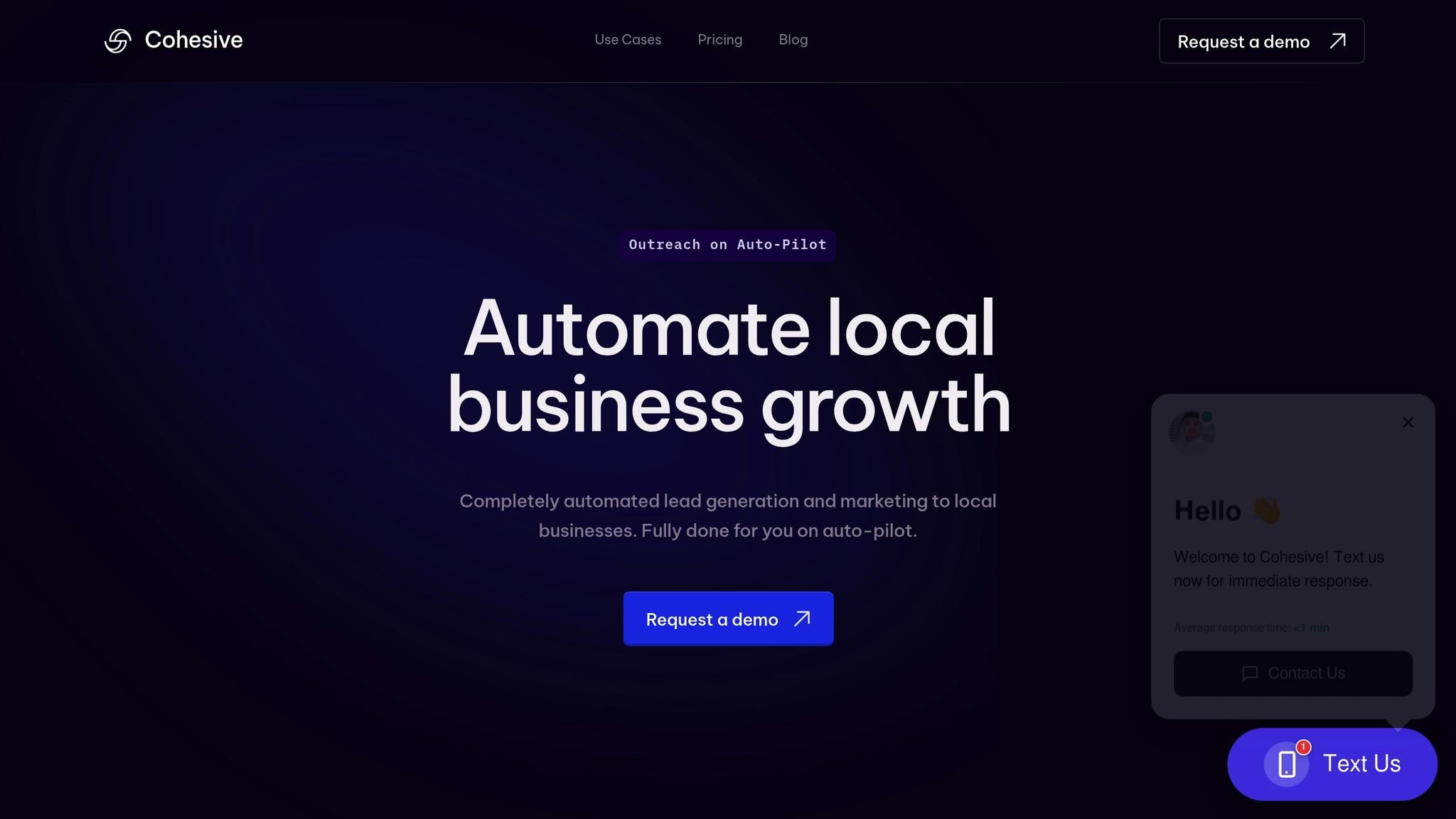
Cohesive AI is an AI-driven platform tailored for local service businesses like janitorial services, landscaping, HVAC, catering, and business brokers. It simplifies lead generation by managing the entire process - from gathering and enriching data to personalized outreach and campaign management.
Data Extraction Capabilities
Cohesive AI pulls detailed business profiles directly from Google Maps. This includes essential information like business names, categories, addresses, phone numbers, emails (when available), websites, social media links, and operating hours. It also scans government filings to identify business owners. By combining these sources, the platform creates a rich, specialized dataset for local service industries. Automated tools prevent duplicates, validate data, and enhance the information, ensuring each lead is accurate, actionable, and unique [3]. This solid foundation supports the platform's fully automated workflow.
Automation and Workflow Efficiency
Once the data is enriched, Cohesive AI takes over the heavy lifting. The platform automates the entire lead generation process, from data collection to campaign execution, without requiring constant monitoring. It uses AI to craft personalized cold emails, which are far more engaging than generic ones, and handles follow-ups while optimizing email deliverability. Businesses can run up to three campaigns simultaneously, allowing them to focus on higher-priority sales tasks while the platform manages the outreach seamlessly [4].
Cost and Scalability
Cohesive AI is available at a flat rate of $500 per month, with an additional monthly setup fee of $75. There are no long-term contracts, and the service includes a guarantee: at least four interested responses per month, or a free month of service is provided. This pricing model is a stark contrast to traditional lead generation agencies, which often charge much more without offering clear results. Designed to replace these conventional services, the platform allows businesses to efficiently handle a high volume of leads, meeting the growing demand for reliable and scalable local lead solutions [4].
Compliance and Data Privacy
In addition to its automation and efficiency, Cohesive AI prioritizes compliance with data privacy regulations. It focuses solely on publicly available business information and adheres to the CAN-SPAM Act in the United States. This means all outreach includes proper opt-out options, and the platform avoids collecting personal data not intended for public use [7]. By maintaining these standards, Cohesive AI ensures ethical and lawful lead generation practices.
Comparison of Features and Benefits
When deciding between Google Maps API and Cohesive AI for local lead generation, the right choice often depends on your technical needs and budget.
Let’s start with Data Extraction and Accuracy, which form the backbone of any lead generation strategy. Google Maps API offers access to a vast database of businesses, pulling directly from Google’s own information. It provides key details like business names, addresses, phone numbers, websites, ratings, reviews, and operating hours. However, the Places API has a limit - it displays a maximum of 120 places per area [2][3][5].
Cohesive AI, on the other hand, takes a more layered approach by combining data from Google Maps with government filings. This creates enriched business profiles that go beyond the basics. For instance, it often identifies business owners and, when available, includes email addresses. Automated processes for validation and deduplication enhance data quality, though the platform is less transparent about its specific data sources.
Technical Implementation and Ease of Use highlight a key difference between the two. Google Maps API demands technical skills. You’ll likely need developers to handle coding, manage API keys, process data, and integrate it with your systems. While this approach offers flexibility, it also requires ongoing maintenance.
Cohesive AI, in contrast, is a plug-and-play solution. It handles everything - from data extraction to campaign execution - with minimal setup. The service charges a one-time onboarding fee of $75 [1], making it accessible even for businesses without a technical team.
Feature | Google Maps API | Cohesive AI |
|---|---|---|
Data Sources | Google Maps only | Google Maps + government filings |
Email Addresses | Not typically available | Included when available |
Technical Setup | Requires custom development | Minimal setup required |
Customization | Highly flexible with custom coding | Pre-built for specific local services |
Outreach Automation | Not included | Fully automated campaigns |
Data Validation | Manual or custom validation required | Automated validation and deduplication |
Compliance Management | User responsibility | Handled by the platform |
Now, let’s talk about Cost Structure and Scalability. Google Maps API works on a pay-as-you-go model. For example, as of 2025, it costs $17 per 1,000 Places Details requests. Scraping tools can reduce costs to as low as $0.20 per 1,000 leads [4]. However, these savings don’t account for development time, third-party tools for data enrichment, or subscriptions to outreach platforms - all of which can add up quickly.
Cohesive AI takes a simpler approach with a $500 monthly subscription [1]. This flat fee covers everything: data extraction, enrichment, email creation, campaign management, and deliverability optimization. Plus, the platform guarantees at least four interested responses per month or offers a free month of service, making costs predictable and results measurable.
Automation and Workflow Efficiency set these two options even further apart. Google Maps API provides raw data, but you’ll need additional tools and systems for tasks like data enrichment, email marketing, CRM integration, and campaign tracking. Cohesive AI, however, automates the entire process. It collects data, crafts personalized cold emails, manages up to three campaigns at once, and ensures email deliverability - all with minimal oversight.
Lastly, Compliance and Risk Management is another important factor. With Google Maps API, users are responsible for navigating Google’s terms of service, managing API rate limits, and ensuring compliance with data privacy laws. There’s also the risk of incomplete or outdated listings. Cohesive AI simplifies this by managing compliance automatically. It adheres to the CAN-SPAM Act, uses only publicly available business information, and includes opt-out mechanisms to reduce legal risks [7].
Final Thoughts
Deciding between the Google Maps API and Cohesive AI comes down to your technical skills, budget, and whether you prioritize customization or simplicity.
For businesses with tech-savvy teams, the Google Maps API offers access to a massive database - over 200 million businesses across 4,000+ categories [2]. Its pay-as-you-go pricing, around $0.20 per 1,000 leads [4], works well for occasional data needs. However, this option requires a considerable investment in development, ongoing maintenance, and additional tools to handle email and CRM integration. It’s a powerful tool, but one that demands strong technical support.
On the other hand, Cohesive AI caters specifically to local service businesses like janitorial, landscaping, HVAC, catering, and business brokerage. It’s a no-code, fully managed lead generation platform with straightforward pricing: a $500 monthly flat fee and a $75 setup cost. This approach ensures predictable costs, guarantees at least four interested responses per month, and removes the hassle of juggling multiple software platforms.
FAQs
How does Google Maps API help local service businesses generate leads?
The Google Maps API is a powerful tool for local service businesses looking to generate leads. It grants access to detailed location-based data, which can be used to pinpoint local businesses, collect contact information, and gain a clearer understanding of specific geographical markets.
Take platforms like Cohesive AI, for example. They use the Google Maps API to streamline lead generation. By pulling business details directly from Google Maps, tailoring outreach efforts with AI, and running targeted email campaigns, they make it easier for industries like janitorial services, landscaping, HVAC, catering, and others to connect with potential clients.
How does Google Maps API differ from Cohesive AI in extracting local business data?
Cohesive AI taps into Google Maps data to gather detailed insights about local businesses, focusing on industries such as janitorial services, landscaping, HVAC, and catering. While the Google Maps API supplies basic location and business details, Cohesive AI takes it up a notch. It personalizes this data for lead generation, creates customized cold emails using AI, and even handles email campaigns to connect with potential clients.
By simplifying the lead generation process, this approach replaces traditional methods, offering local service businesses an efficient way to expand their reach and grow.
What factors should businesses consider when using Google Maps API or Cohesive AI for lead generation?
When choosing between Google Maps API and Cohesive AI for lead generation, it's important to assess your business's specific goals and how much automation you need. Cohesive AI simplifies lead generation for local service industries like janitorial, landscaping, and HVAC by automating key tasks. These include pulling data from Google Maps, crafting personalized cold emails with AI, and overseeing email campaigns.
For businesses looking to move away from manual lead generation and adopt a more streamlined approach, Cohesive AI provides a purpose-built platform designed to save time while efficiently targeting local prospects.