Local Tax Policies: Impact on Service Providers
Jan 6, 2026
Local tax policies create significant challenges for service providers like HVAC, janitorial, and landscaping businesses. These businesses face complex tax systems, varying rules across states, and administrative burdens that can cut into profits. Key points include:
State and Local Taxes: In FY23, businesses paid $1,096.2 billion in state and local taxes, accounting for 44.7% of total revenue. Service providers often deal with different tax rates and rules in each jurisdiction.
Service Tax Variability: Some states, like Hawaii and New Mexico, tax a broad range of services, while others, like Vermont, tax very few. This inconsistency complicates compliance.
Double Taxation: Taxes on tools and supplies, combined with service taxes, lead to cascading costs.
Compliance Costs: Over 11,000 tax jurisdictions in the U.S. require businesses to navigate varying rates, filing deadlines, and sourcing rules.
Recent Changes: The 2025 One Big Beautiful Bill Act restricts Medicaid provider taxes, impacting healthcare service providers' revenue.
Automation tools can help businesses manage compliance by tracking tax rates, monitoring thresholds, and simplifying filings. However, staying informed about local rules and maintaining accurate records remain critical for avoiding penalties and protecting profits.
Webinar: The blueprint for tax compliance automation
How Local Tax Policies Differ Across States
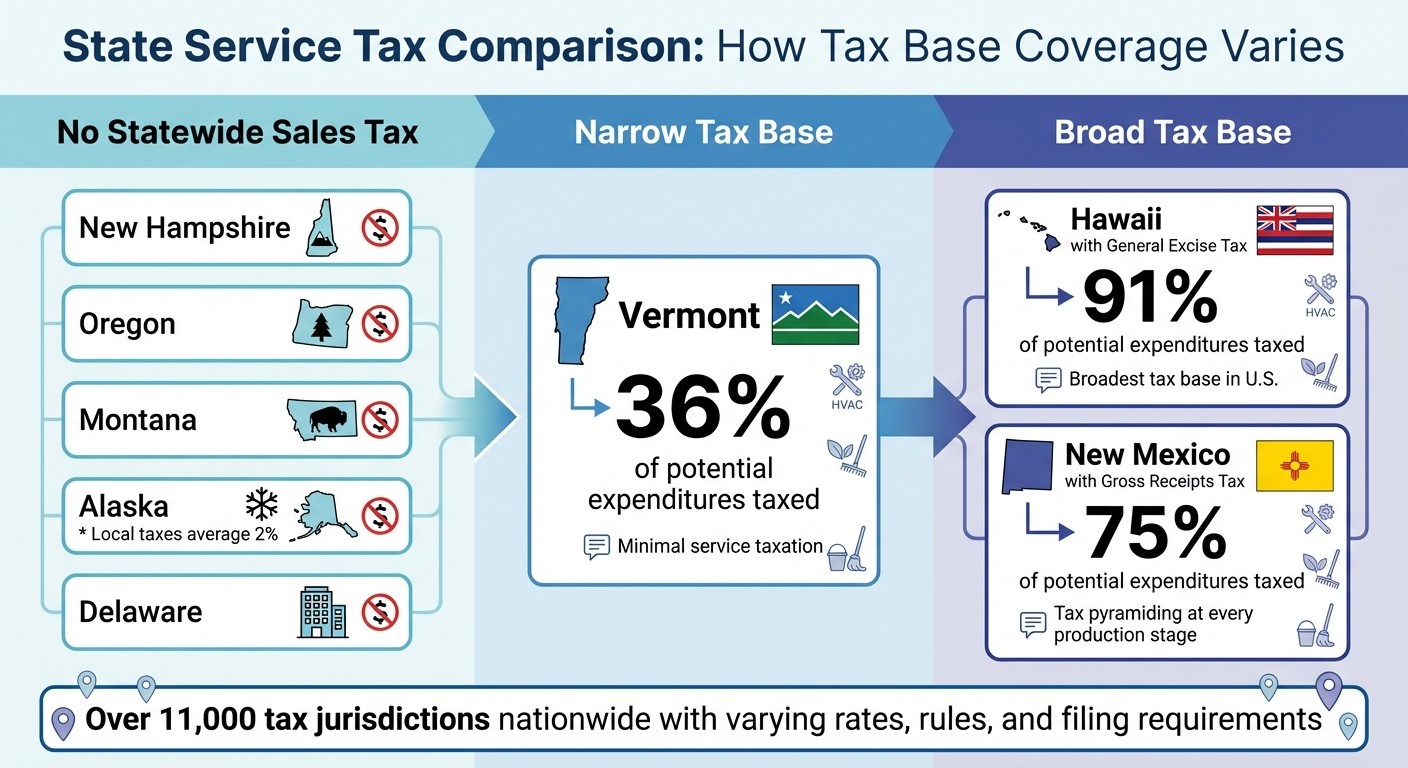
State-by-State Service Tax Comparison: Tax Base Coverage Across U.S. States
Local tax rules can vary dramatically from one state to another. For example, a janitorial company operating in three states might face completely different regulations regarding what’s taxable, where taxes are owed, and how much must be paid. These differences highlight the complexity of staying tax-compliant across state lines.
State-by-State Service Tax Rules
Some states make things simpler by not imposing a statewide sales tax at all. These include New Hampshire, Oregon, Montana, Alaska, and Delaware. However, Alaska allows local jurisdictions to levy their own taxes, which average about 2% [6].
At the other end of the spectrum, Hawaii has the broadest tax base in the U.S., taxing 91% of potential expenditures through its General Excise Tax [7]. This means nearly every service a business offers is subject to taxation. Similarly, New Mexico applies a Gross Receipts Tax to 75% of potential expenditures [7]. Unlike standard sales taxes, these Gross Receipts Taxes are applied at every production stage, often resulting in "tax pyramiding." Essentially, the same value gets taxed multiple times as it moves through the supply chain [5] [2].
In contrast, Vermont has one of the narrowest tax bases, taxing only 36% of potential expenditures [7]. For example, an HVAC company might find nearly all its transactions taxed in Hawaii, while facing minimal taxation for similar services in Vermont.
Recent changes in tax policies add another layer of complexity. Maryland has introduced a 3% tax on digital services, Louisiana has adjusted its tax rates, and Washington has implemented new capital gains and estate taxes [2]. These shifts mean that businesses must stay updated, as yesterday's rules might not hold true today.
How States Determine Where Services Are Taxed
The challenge of tax compliance doesn’t stop at what gets taxed - it also extends to figuring out where taxes are owed. States use two main approaches to determine taxable location: origin-based sourcing (taxing based on the seller’s location) and destination-based sourcing (taxing based on where the buyer receives the service). The majority of states follow destination-based rules. This means, for instance, that a landscaping company might need to track tax rates for hundreds of local jurisdictions [9].
California, however, complicates things further with its "benefit received" framework. According to the state’s Franchise Tax Board, businesses must answer four key questions: Who is the customer? What service is being provided? What benefit is being received? Where did the customer receive that benefit? [8] The Board explains:
"The location where a service is performed does not determine where to assign the gross receipts from the sale of that service. Rather, the gross receipts are assigned to the location where the direct benefit of the service is received by the customer." [8]
For example, a service provider based in San Francisco performing work for a client in Los Angeles would typically owe taxes based on Los Angeles, not its own location. For businesses operating across multiple cities or states, this creates a significant administrative challenge, requiring precise tracking of job locations and client addresses.
How Industry-Specific Taxes Affect Service Providers
Industry-specific taxes can create unique hurdles for certain service sectors, going beyond general sales and service taxes. For example, Medicaid provider taxes require service providers to rethink their operations and financial strategies.
Provider Taxes in Healthcare and Other Industries
Medicaid provider taxes are the most common industry-specific levy in the U.S., especially in healthcare. By 2025, 49 states and the District of Columbia relied on these taxes to fund their share of Medicaid expenses [10][12]. Federal law allows states to tax 19 specific types of providers, including hospitals, nursing facilities, managed care organizations, and ambulance services [10][13].
Here’s how widespread these taxes are: 47 states tax hospitals, 45 states tax nursing facilities, and 33 states tax intermediate care facilities for individuals with intellectual disabilities [10]. In fiscal year 2026, provider taxes made up a median of 18% of state Medicaid funding [10]. As of July 2024, 38 states reported at least one provider tax exceeding 5.5% of net patient revenue [13].
Interestingly, many states use the revenue from these taxes to enhance Medicaid reimbursements or provide supplemental payments. This approach can actually increase total revenue for healthcare providers [11][15][16].
However, the One Big Beautiful Bill Act (OBBBA), enacted on July 4, 2025, brought major changes. The law bans new provider taxes and prevents states from increasing existing ones [10][14]. Alice Burns, Associate Director at KFF, explained:
"The 2025 reconciliation law imposes significant new restrictions on states' ability to generate Medicaid provider tax revenue, including prohibiting all states from establishing new provider taxes or from increasing existing taxes" [10].
The law also lowers the "safe harbor" threshold for Medicaid-expanded states from 6% to 3.5% by fiscal year 2032 [10][13][14]. This adjustment is projected to cut federal Medicaid spending by $226 billion over the next decade [10]. For providers, this could translate into reduced Medicaid payment rates, as states scramble to fill budget gaps left by the loss of tax revenue. The American Hospital Association warned:
"states would need to make significant cuts to Medicaid to balance their budgets, including reducing eligibility, eliminating or limiting benefits, and reducing already low payment rates for providers" [12].
These industry-specific taxes highlight the critical need for strong compliance systems across all service sectors. Keeping up with these changes is essential for navigating the financial and operational challenges they bring.
How to Stay Compliant with Local Tax Regulations
Staying on top of local tax regulations can feel like a daunting task, especially for businesses operating across multiple states. With thousands of tax jurisdictions to navigate, avoiding common mistakes and leveraging efficient systems is key to staying compliant.
Common Tax Compliance Mistakes to Avoid
One of the biggest challenges for service providers is underestimating the complexity of multi-state operations. There are over 11,000 distinct tax jurisdictions in the U.S., each with its own rates, rules, and audit processes [18]. In "home rule" states like Colorado and Alabama, local governments have the authority to create their own tax systems, making uniformity nearly impossible [1].
Another frequent misstep is assuming certain services are tax-exempt. States are increasingly updating their tax codes to include services that were previously exempt. It’s crucial to verify the taxability of your services in every jurisdiction where you operate [3]. Additionally, some businesses neglect to file "zero returns" when they have no taxable sales during a reporting period. Many states still require these filings, and skipping them can lead to penalties or even trigger audits [18][19].
Tax pyramiding is another issue that often goes unnoticed. This occurs when businesses are taxed on the tools and services they use to operate, which can inflate costs and reduce profitability. In 2022 alone, $185.4 billion in state sales tax revenue came from business inputs rather than final consumer purchases [3]. Jared Walczak of the Tax Foundation explains:
"The taxation of intermediate transactions (business inputs) can turn that portion of the sales tax into a tax on production, driving up consumer prices through tax pyramiding" [3].
The upcoming 2026 reporting requirements under the One Big Beautiful Bill Act add yet another layer of complexity. Employers will need to separately report qualified tips and overtime compensation on Form W-2 or 1099-NEC. This means payroll and timekeeping systems will require significant updates. As Grant Thornton points out:
"The new deductions for tips and overtime mean that accurate employer timekeeping and payroll reporting will be more important than ever before" [4].
Using Automation to Simplify Tax Compliance
Automation has become a game-changer for managing tax compliance across thousands of jurisdictions. Modern tools can handle real-time tax rate calculations for more than 11,000 jurisdictions, taking into account state, county, city, and special district layers. They also include economic nexus monitoring, which tracks when your sales activity nears thresholds - like $100,000 in sales or 200 transactions - and alerts you when it’s time to register in a new state [18]. This is critical since tax rates can vary even within the same city block.
Automated systems also simplify destination-based sourcing, ensuring you charge the correct tax rate based on where the customer receives the service, not where your business is located [18]. This has become increasingly important in the wake of the Wayfair decision, which expanded tax obligations for remote service providers.
For small businesses, automation can be especially beneficial. These businesses often face 30% higher compliance costs per employee compared to larger corporations [17]. Automation helps level the playing field by streamlining data collection from banks and accounting systems, centralizing multi-state filing, and identifying industry-specific deductions that might be missed during manual preparation [17].
Where possible, take advantage of centralized tax administration systems. In 34 states, local sales taxes can be filed at the state level, reducing the need to manage separate local relationships [1]. Additionally, the Streamlined Sales and Use Tax Agreement (SSUTA) allows businesses to register in 44 participating states through a single system, making multi-state compliance more manageable [18].
While automation reduces the burden of manual tracking, specialized platforms can further optimize operations.
How Cohesive AI Helps Service Providers Focus on Compliance
Service providers in industries like HVAC, landscaping, and janitorial services often struggle to balance tax compliance with day-to-day operations. Cohesive AI (https://getcohesiveai.com) offers a solution by automating lead generation, freeing up time to focus on compliance.
The platform uses AI to scrape Google Maps and government filings, identifying local business owners and personalizing cold email campaigns. For businesses managing multi-state tax obligations, this means less time spent on prospecting and more time dedicated to critical tasks like tracking nexus thresholds, verifying service taxability, and maintaining accurate records.
Take HVAC companies as an example. These businesses often operate across multiple states, each with different tax rules for installation versus repair services. By automating lead generation, they can redirect valuable hours toward understanding local tax distinctions and ensuring proper compliance. Similarly, landscaping and janitorial service providers can use the time saved to update payroll systems for the 2026 reporting requirements or to confirm tax rules in every jurisdiction where they work.
Unlike traditional lead generation agencies that require ongoing management, Cohesive AI offers a hands-off approach, allowing businesses to prioritize compliance without sacrificing growth. This balance is essential in today’s complex tax environment, where accurate compliance not only avoids penalties but also protects profit margins.
Conclusion: Managing Tax Policies Effectively
Navigating the intricate landscape of local tax policies can feel overwhelming, but with the right strategies and tools, it becomes much more manageable. The key lies in strategic planning, understanding the rules, and leveraging technology to stay compliant.
Key Considerations for Service Providers
One critical step is reviewing nexus thresholds - typically $100,000 in sales or 200 transactions [21] - to determine when tax obligations are triggered. Additionally, pay close attention to service classification. In some jurisdictions, modern services, like those involving AI or digital components, might be taxed as tangible personal property, while in others, they’re considered non-taxable services. It’s essential to verify the taxability of your services in each specific location instead of relying on assumptions or past practices.
While automation can handle repetitive tasks, human oversight remains indispensable. For example, indirect tax departments often spend over 80% of their time on low-value tasks like aggregating data [20]. Automated tools can alleviate this burden by performing real-time rate calculations and monitoring economic nexus. However, as Mark Price from Deloitte emphasizes:
"informed human judgment remains essential" [22]
to catch errors that automation might overlook.
For industries like HVAC, landscaping, and janitorial services, balancing compliance with growth can be particularly demanding. This is where technology becomes a game-changer. Tools like Cohesive AI (https://getcohesiveai.com) simplify lead generation by scraping Google Maps and government filings to identify prospects and manage personalized email campaigns. With a cost of $500/month and a guarantee of at least four interested responses - or a free month credit - it’s an efficient alternative to traditional agencies. This hands-off approach lets businesses focus on compliance tasks, such as monitoring nexus thresholds, updating payroll for 2026 OBBBA requirements, and verifying jurisdiction-specific tax rules, without sacrificing growth opportunities.
FAQs
How do local tax policies impact the profitability of service providers?
Local tax policies, like sales taxes, property taxes, and local income taxes, can have a noticeable impact on service providers' bottom lines. These taxes not only increase costs but also add layers of administrative work. Take sales taxes on services such as landscaping or janitorial work - businesses are required to collect, remit, and carefully document taxes for every invoice. This process eats into net revenue and can make it harder to stay price-competitive.
For businesses operating across multiple areas, the situation becomes even trickier. Different jurisdictions often have their own tax rates, filing deadlines, and exemption rules, creating a maze of regulations to follow. Navigating this patchwork system means higher compliance costs, whether that’s investing in specialized software, hiring a bookkeeper, or paying professional fees. On top of that, frequent changes to tax laws can disrupt cash flow, making it tough for businesses to plan ahead with confidence.
Automation tools offer a practical way to tackle these challenges. They can simplify tasks like tax calculations, filings, and reporting, cutting down on manual work and reducing errors. By using these tools, service providers can save valuable time, lower compliance expenses, and focus their energy on growing their business - even in the face of complex local tax rules.
What challenges do service providers face with different state tax laws?
Service providers operating across multiple states often face the daunting challenge of navigating a maze of tax laws. Each state sets its own economic nexus thresholds, which are usually tied to sales revenue (like Alabama’s $250,000 threshold) or the number of transactions. Hitting these thresholds means businesses must register, collect, and file taxes - requirements that differ significantly from state to state. On top of that, states vary in how they define taxable sales and set deadlines for compliance, making it tough to keep everything in check.
To make matters even more complicated, some states allow local jurisdictions - like cities and counties - to impose their own tax rates and rules. This is particularly tricky in "home-rule" states, where local governments handle their own taxes, audits, and forms. For businesses, this often leads to higher administrative costs and the risk of overlapping audits.
Adding to the complexity, tax laws are constantly evolving. States regularly introduce new rules and updates, making it nearly impossible to stay compliant without the help of automation tools. Without these, managing tax obligations can quickly turn into a time-intensive and error-prone task.
How can service providers use automation tools to simplify tax compliance?
Automation tools simplify tax compliance for service providers by taking over tedious tasks like managing spreadsheets and manual data entry. Instead, these tools work in real time, seamlessly integrating with systems such as point-of-sale, invoicing, or accounting software. This setup ensures accurate tax rate calculations across various jurisdictions - whether city, county, or state - without the hassle of keeping up with complex tax rules. The result? Fewer errors and a lot less stress.
What’s more, AI-driven rule engines keep these platforms up to date with constantly changing tax laws. They can identify potential audit risks, reconcile payments, and even produce ready-to-file reports. By automating these processes, service providers not only save time and avoid costly penalties but also get to focus on what they do best - whether that’s HVAC repairs, landscaping, or janitorial services.