Tax Compliance for Cleaning Services: Checklist
Jan 2, 2026
Running a cleaning service? Staying tax-compliant is essential to avoid penalties, safeguard your reputation, and ensure smooth business operations. Here’s a quick summary of what you need to know:
Business Structure Matters: Sole proprietorships are simple but offer no liability protection. LLCs and corporations provide more options as your business grows.
Worker Classification: Correctly classify workers as employees (W-2) or contractors (1099) to avoid IRS penalties.
Federal Tax Deadlines: Key dates include January 15, 2026 (final estimated tax payment for 2025) and January 31, 2026 (W-2 and 1099 forms due).
Payroll Taxes: Employers must handle FICA, FUTA, and federal income tax withholding. Use tools like Form 941 for quarterly filings.
State and Local Taxes: Requirements vary, including unemployment insurance, sales tax, and workers' compensation. Check your state’s rules.
Recordkeeping: Maintain organized records for at least 3–7 years, depending on the document type, to prepare for audits.
Pro Tip: Use IRS tools like Form SS-8 for worker classification and Form 1040-ES for estimated tax payments. Staying on top of deadlines and documentation can save you time and stress.
Keep reading for a detailed breakdown of how to manage taxes for your cleaning business.
1099 Cleaners vs W2 Employees: Why 1099 Cleaners Can Benefit Your Cleaning Business
Business Structure and Worker Classification
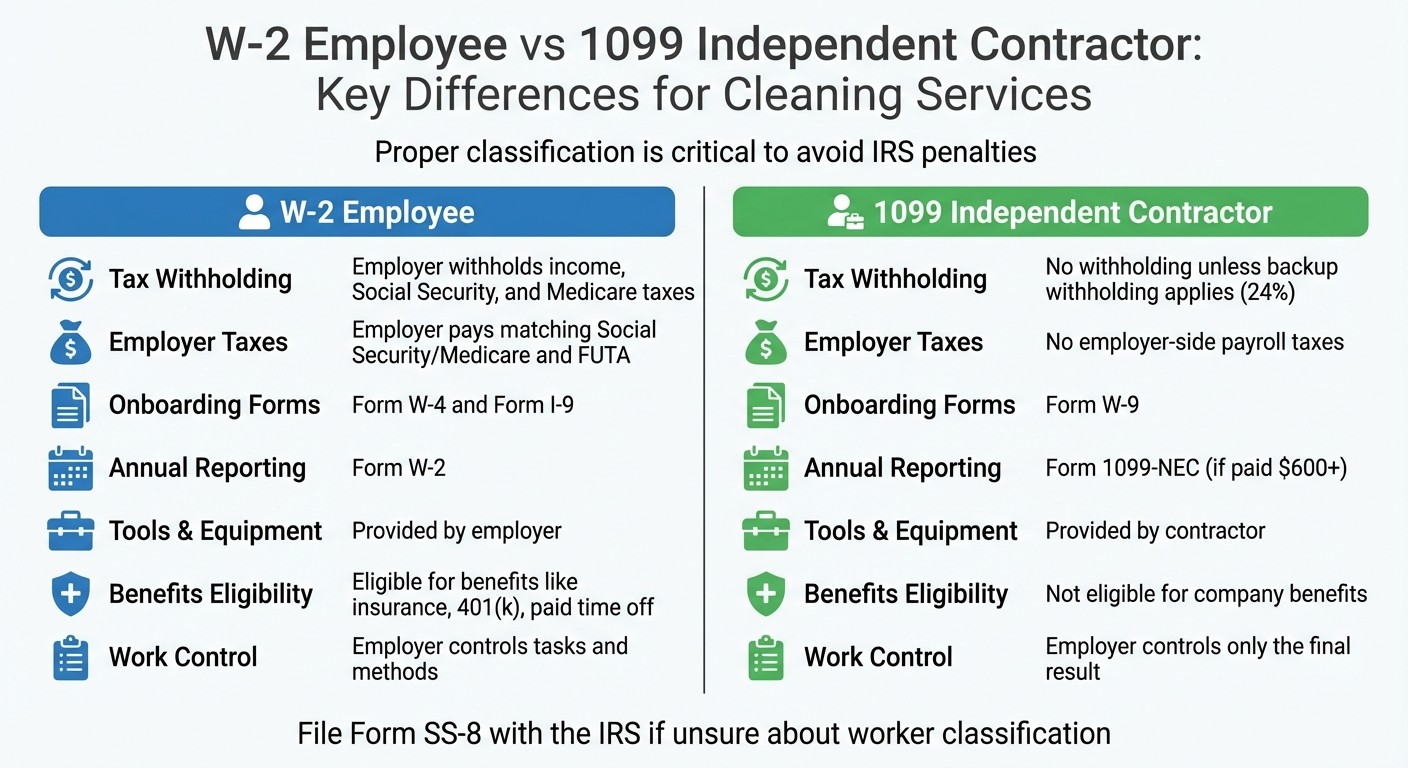
W-2 Employee vs 1099 Independent Contractor Tax Comparison for Cleaning Services
Selecting Your Business Structure
The type of business structure you choose shapes how you file taxes and the forms you'll need to complete each year. For many new cleaning businesses, a sole proprietorship is the simplest option. In this setup, you and your business are legally the same entity, and you report income and losses on your personal tax return using Schedule C with Form 1040. This straightforward approach often appeals to startups due to its low cost and ease of management [7].
As your business grows, you might want to explore forming an LLC (Limited Liability Company) to gain limited liability protection. A single-member LLC is taxed like a sole proprietorship, while a multi-member LLC is treated as a partnership for tax purposes [7]. For larger businesses, C Corporations and S Corporations provide additional options. C Corporations operate as separate entities and are subject to corporate income tax. S Corporations, on the other hand, allow for pass-through taxation, which can reduce Social Security and Medicare taxes since you only pay self-employment tax on your salary - not on distributions [7].
"The form of business you operate determines what taxes you must pay and how you pay them." - IRS [1]
Many cleaning businesses start as sole proprietorships to keep initial costs low, then transition to an LLC or corporation as their revenue grows [7]. Keep in mind that if your net earnings from self-employment hit $400 or more, you'll need to file Schedule SE to account for self-employment tax [1].
Employee vs. Contractor Classification
Once you've chosen a business structure, the next step is correctly classifying your workers. The IRS evaluates this based on three key factors: behavioral control (who determines when, where, and how the work is done), financial control (who supplies tools and equipment, and whether the worker has a chance for profit or loss), and type of relationship (contracts, benefits, and the nature of the arrangement) [5][9].
If you set the specifics of how tasks are performed - like schedules, methods, or training - you should classify the worker as an employee and withhold the required payroll taxes [5]. On the other hand, independent contractors typically set their own schedules, use their own equipment, and are responsible for paying their own taxes through self-employment tax.
"The keys are to look at the entire relationship and consider the extent of the right to direct and control the worker." - IRS [5]
Misclassifying employees as contractors can lead to serious consequences, including liability for unpaid employment taxes. If you're unsure about a worker's classification, you can file Form SS-8 with the IRS to get a determination. Documenting your decision-making process can also help establish a reasonable basis for your classification [5].
W-2 vs. 1099 Comparison Table
Here’s a quick breakdown of the differences between W-2 employees and 1099 independent contractors:
Feature | W-2 Employee | 1099 Independent Contractor |
|---|---|---|
Tax Withholding | Employer withholds income, Social Security, and Medicare taxes [5] | No withholding unless backup withholding applies (24%) [8] |
Employer Taxes | Employer pays matching Social Security/Medicare and FUTA [5] | No employer-side payroll taxes [5] |
Onboarding Forms | ||
Annual Reporting | Form 1099-NEC (if paid $600+) [8] | |
Tools & Equipment | Provided by employer [5] | Provided by contractor [9] |
Benefits Eligibility | Eligible for benefits like insurance, 401(k), paid time off [9] | Not eligible for company benefits [9] |
Work Control | Employer controls tasks and methods [5] | Employer controls only the final result [5] |
Before making payments to contractors, make sure to collect Form W-9 to obtain their Taxpayer Identification Number (TIN). If a contractor doesn’t provide a valid TIN, you’ll need to apply backup withholding at 24% [8]. For employees, complete Form W-4 and Form I-9 during the hiring process [8]. Be sure to keep these tax records for at least four years to stay compliant [8].
Federal Tax Filing and Payment Checklist
This section outlines your federal filing and payment responsibilities, building on earlier discussions about your business structure and worker classification.
Income Tax Filing Requirements
The type of business you operate determines the federal income tax forms you'll need to complete. For sole proprietors, business profits or losses are reported on Schedule C, which is attached to Form 1040. If your net earnings hit $400 or more, you'll also need to calculate self-employment tax using Schedule SE. Partnerships file an information return on Form 1065, and each partner reports their share on Schedule E. For corporations, C-Corporations file Form 1120, while S-Corporations use Form 1120-S.
By January 31, 2026, you must provide Form W-2 to employees and Form 1099-NEC to independent contractors who earned $600 or more during the 2025 tax year. However, starting with payments made after December 31, 2025, the reporting threshold for nonemployee compensation increases to $2,000.
If your annual tax liability reaches $1,000 or more, you’ll need to make quarterly estimated payments using Form 1040-ES to avoid penalties. The final estimated tax payment for 2025 is due on January 15, 2026.
Once you've covered income tax filing, it's essential to review your payroll tax responsibilities to ensure you're meeting all federal requirements.
Payroll Taxes and Withholding
When you classify workers as employees, you're responsible for withholding and paying various payroll taxes. Both employees and employers contribute to FICA taxes. For 2026, the Social Security tax rate is 6.2% on wages up to $184,500, while the Medicare tax rate is 1.45% with no wage limit.
Employers also pay the Federal Unemployment Tax (FUTA), which is 6.0% on the first $7,000 of each employee’s wages. Additionally, you must withhold federal income tax based on each employee's Form W-4. To calculate the correct withholding amount, refer to the tables in IRS Publication 15-T.
Starting in 2025, employees can deduct up to $25,000 in qualified tips and $12,500 for qualified overtime compensation. This change may require employees to update their W-4 forms to ensure accurate withholding.
Most cleaning service providers report Social Security, Medicare, and federal income tax withholding using Form 941, which is filed quarterly. However, small employers with an annual payroll tax liability of $1,000 or less may qualify to file Form 944 annually. Employers also file Form 940 once a year to report FUTA tax.
With payroll taxes covered, the next step is staying on top of critical tax deadlines to avoid penalties.
Federal Tax Deadlines
Here are the key dates to keep in mind for federal tax compliance:
January 15, 2026 – Deadline for self-employed cleaning service providers to pay the final 2025 estimated tax payment using Form 1040-ES.
January 31, 2026 – Deadline to provide Form W-2 to employees, send Form 1099-NEC to contractors, and file the fourth-quarter Form 941 for 2025.
Throughout 2026, payroll taxes must be deposited either semiweekly or monthly, depending on your deposit schedule. Using the Electronic Federal Tax Payment System (EFTPS) can help you meet these deadlines. Quarterly Form 941 filings are due on the last day of the month following the end of each quarter.
State and Local Tax Compliance
Once you've tackled federal tax obligations, it's time to focus on state and local tax rules. For cleaning service providers, these rules can vary widely depending on where you operate. States have different requirements for unemployment insurance, income tax withholding, sales tax, and workers' compensation coverage.
State Unemployment and Income Taxes
If you hire employees, you’ll need to register for State Unemployment Insurance (SUI) and set up state income tax withholding. The specific thresholds for registration differ by state. For instance:
California: Registration is required with the Employment Development Department within 15 days of paying more than $100 in wages during a calendar quarter [12].
Mississippi: You must register after paying $1,000 in wages in a quarter [13].
Utah: Registration kicks in once you pay $1,500 in wages or employ at least one worker for 20 weeks[13].
Most states provide online portals to streamline the process. For example, California has e-Services for Business, while Utah offers OneStop Business Registration. Some states, like California, also require withholding for State Disability Insurance (SDI) in addition to unemployment and income taxes [12][2].
After addressing unemployment and income tax requirements, you’ll need to determine whether your services are subject to sales tax.
Sales Tax on Cleaning Services
When it comes to sales tax, 45 states and Washington D.C. require businesses to collect it, while five states - Delaware, Montana, New Hampshire, Oregon, and Alaska - do not have a statewide sales tax. However, local jurisdictions in Alaska can still impose their own sales taxes [14][15].
The taxability of cleaning services depends on state laws and whether your business has a nexus in that state. Nexus is often triggered by:
Economic thresholds: For most states, this means reaching $100,000 in gross annual sales or 200 transactions. States like California and Texas set a higher threshold of $500,000 in gross annual sales[14].
Before collecting sales tax, you must obtain a sales tax permit from the state’s Department of Revenue. Collecting tax without this permit can lead to penalties [14].
States use one of two sourcing methods to determine tax rates:
Destination-based sourcing: Tax is based on where the customer receives the service.
Origin-based sourcing: Tax is based on your business location. This method is used in Arizona, Ohio, Pennsylvania, Texas, Utah, and Virginia[14].
Even if you don’t collect any sales tax, you’re often required to file a "zero return" to avoid penalties. Additionally, some states allow businesses to keep 1–2% of the taxes they collect as compensation for the administrative effort [14].
Workers' Compensation Insurance
If you have employees, most states require you to carry workers' compensation insurance to cover workplace injuries [2]. For example, in Oregon, workers' compensation assessments are handled through the same payroll tax reporting system used for unemployment insurance [13]. Coverage generally begins as soon as you hire your first employee or meet specific wage thresholds.
It’s important to note that workers' compensation is required for employees, but not for independent contractors. Misclassifying employees as contractors can result in serious consequences, including liability for unpaid employment taxes under Internal Revenue Code section 3509, as well as state penalties. Some areas may also impose additional local payroll taxes [2][14].
Recordkeeping and Audit Preparation
Keeping detailed records isn’t just a good habit - it’s a legal requirement. The IRS holds you accountable for every entry, deduction, and claim on your tax returns [3]. Without organized documentation, you risk losing legitimate deductions and facing challenges during an audit. A structured recordkeeping system can make audits and reconciliations far less stressful.
Maintaining Tax Records
Accurate records are the backbone of tax compliance, whether at the federal or local level. The IRS has specific rules for different types of records, and the retention periods vary depending on the category. For example, employment tax records must be kept for at least 4 years after the tax is due or paid [16][17]. These include essential documents like your Employer Identification Number (EIN), employee wage records, Social Security numbers, W-4 and W-2 forms, and tax deposit confirmations.
For general business receipts and expenses, the standard retention period is 3 years from the date you filed your return [17]. However, if you underreport income by more than 25%, the IRS can review records going back 6 years [17]. Records tied to bad debt deductions or worthless securities should be kept for 7 years [17][18].
The IRS has specific requirements for receipts. For any single business expense of $75 or more, you must have a receipt. Lodging expenses require a receipt regardless of the amount [18]. Each receipt should clearly show the date, amount, vendor, and a description of the expense. For business meals, you’ll also need to note the purpose of the meeting, topics discussed, and the names of attendees.
Digital records, such as scanned receipts, credit card statements, and bank records, are accepted as proof of deductions [18]. To avoid losing important documents, scan or photograph receipts as soon as possible. For vehicle expenses, keep a real-time mileage log that records the date, destination, and business purpose of each trip [18][21]. Claiming 100% business use without supporting logs is a red flag for auditors, so tracking mileage in real time is critical.
Record Type | Retention Period | Key Documents to Retain |
|---|---|---|
Income/Receipts | 3 Years | Invoices, 1099s, deposit slips, cash logs |
Employment Taxes | 4 Years | W-2s, W-4s, payroll journals, tax deposit confirmations |
Business Expenses | 3 Years | Receipts (especially over $75), canceled checks, account statements |
Assets/Property | 3 Years after disposal | Purchase invoices, depreciation schedules, sales records |
Special Tax Credits | 6 Years | Documentation for paid leave or retention credits |
Bad Debt/Losses | 7 Years | Records of worthless securities or bad debt deductions |
Year-End Audits and Reconciliation
Reconciling your records monthly is far more effective than waiting until year-end. Match your receipts with bank and credit card statements regularly to catch missing documentation or duplicate entries early [18]. This habit helps you maintain clean financial records.
At the end of the year, compare your actual transactions with your Balance Sheet and Profit and Loss Statement to ensure accuracy. Cross-check payroll records to confirm that wages and withholdings in your Profit and Loss report align with payroll tax returns filed during the year. Double-check employee classifications to ensure compliance [20][21].
To avoid confusion, keep business and personal finances separate by using dedicated bank accounts and credit cards. For cash transactions, log them immediately since they lack the automatic documentation of digital payments [18][21]. With reconciled records in hand, you’ll be better prepared to defend your filings if the IRS comes knocking.
Preparing for IRS Audits
A well-organized record system not only simplifies audits but also strengthens your overall tax compliance. Group your documents by category - such as gross receipts, inventory, expenses, and assets - to make retrieval easier [4]. Employment records, including I-9 forms, W-4 certificates, and payroll journals, should be stored separately [6][20].
Some common triggers for IRS audits include underreporting income (e.g., missing 1099-NEC or 1099-K forms from payment apps), claiming expenses that seem excessive or unrelated to your business, and reporting losses over several consecutive years [21]. If your business doesn’t turn a profit in at least three out of five consecutive years, the IRS may reclassify it as a "hobby", which significantly limits your deductions [21].
Keeping a daily business journal is another way to ensure accuracy and create a reliable paper trail [19]. This habit supports your tax positions and provides documentation the IRS can review if needed. Remember, the IRS can look back 3 years for most issues, 6 years for substantial underreporting of income, and 7 years for bad debt claims [17][18].
Conclusion
Key Takeaways
Tax compliance for cleaning services boils down to three essential aspects: worker classification, timely filing, and recordkeeping. The IRS has specific requirements for how cleaning service providers should manage their tax responsibilities.
Worker classification is the cornerstone of compliance. Misclassifying employees as independent contractors can result in liability for unpaid employment taxes [5]. If you're unsure about a worker's status, you can file Form SS-8 with the IRS for clarification [5].
Staying on top of deadlines is crucial to avoid penalties. If you're an individual or sole proprietor expecting to owe $1,000 or more, or a corporation anticipating $500 or more in taxes, you must make estimated tax payments [4]. An IRS tax calendar for small businesses can help you track important filing and payment dates [22]. Additionally, employment tax records must be retained for at least four years [3], and it's your responsibility to provide proof for deductions and entries on your tax returns [3].
These points provide a solid foundation for managing your tax obligations effectively.
Next Steps for Compliance
Start by setting up a reliable recordkeeping system to organize receipts, inventory, and expenses [3][10]. If you don’t already have one, apply for an Employer Identification Number (EIN) online or allow at least four weeks if applying by mail [4]. Keep in mind, using a Social Security Number instead of an EIN on tax returns is not permitted [4].
Make sure all employees complete Forms I-9 and W-4 when they are hired [4][11]. Double-check your worker classifications and, if needed, use the Voluntary Classification Settlement Program (VCSP) by filing Form 8952 to correct any errors [5]. Regularly review your classification processes and filing practices to ensure consistency and compliance across your business. Following these steps will help you stay organized and reduce stress when tax season rolls around.
FAQs
What’s the difference between a sole proprietorship and an LLC for cleaning businesses?
A sole proprietorship is the most straightforward business structure, where the owner and the business are considered one and the same legally. This means the owner is personally responsible for any debts or liabilities the business incurs, and all profits are reported on their personal tax return. Setting up a sole proprietorship is simple and involves minimal paperwork. However, it doesn’t provide any protection for personal assets.
An LLC (Limited Liability Company) offers a different approach by creating a separate legal entity. This separation shields the owner’s personal assets from most business-related liabilities. Setting up an LLC requires filing Articles of Organization with the state and adhering to ongoing requirements, such as keeping separate business bank accounts and filing annual reports. Despite the added responsibilities, an LLC provides benefits like flexibility in tax treatment, enhanced credibility, and the ability to transfer ownership without dissolving the business.
For cleaning businesses, a sole proprietorship is a cost-effective option for starting out, while an LLC is better suited for those seeking greater security and the potential to grow their operations over time.
How do I know if my cleaning staff should be classified as employees or independent contractors?
Determining whether your cleaning staff are classified as employees or independent contractors hinges on how much control your business exerts over their work. The IRS evaluates this using a three-part test:
Behavioral control: Do you dictate how tasks are performed?
Financial control: Who supplies the tools, covers expenses, and takes on the risk of profit or loss?
Type of relationship: Is there a contract, benefits, or an expectation of ongoing work?
These factors are considered collectively, not in isolation.
The IRS may also examine additional details, such as whether the worker has invested in their own equipment, whether they can hire assistants, and how long the working relationship has lasted. If you direct how the work is done, the worker is likely an employee. On the other hand, if they operate their own business and you only control the final outcome, they are probably an independent contractor.
Still unsure? You can file Form SS-8 with the IRS to get an official determination. This step can help you steer clear of costly penalties tied to misclassification.
What federal tax deadlines should cleaning service providers keep in mind?
Cleaning service businesses need to stay on top of important federal tax deadlines to remain compliant. Most businesses are required to make quarterly estimated tax payments, which are due on these dates: April 15, June 15, September 15, and January 15 of the following year. On top of that, annual income tax returns are generally due by April 15, unless you’ve filed for an extension.
If your business has employees, you’ll also need to handle payroll taxes. This means filing Form 941 quarterly and depositing withheld taxes following the IRS’s schedule. Keeping these deadlines in check is essential to avoid penalties and keep your operations running smoothly.