Ultimate Guide to Drip Campaign Timing
Jan 29, 2026
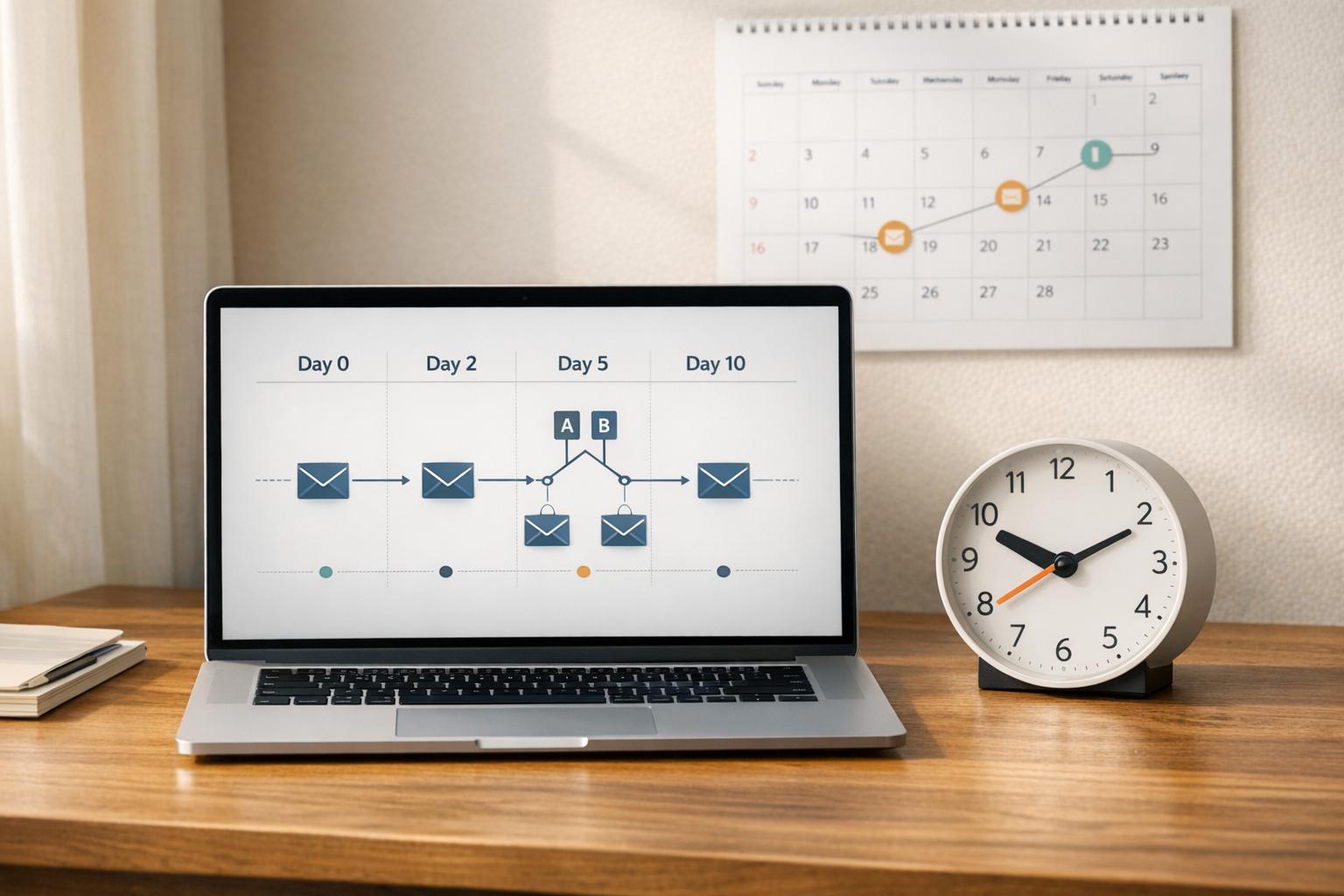
Drip campaigns automate email sequences to nurture leads over time. The timing of these emails is critical - it can directly impact open rates, engagement, and conversions. Here’s what you need to know:
Why Timing Matters: Emails sent at the right moment can boost click rates by 119% and generate 20% more sales opportunities. Poor timing, however, can lead to unsubscribes or lost leads.
Best Practices:
Behavior-Driven Emails: Trigger emails based on actions like sign-ups, abandoned carts, or page visits.
Ideal Frequency: Start with 2–4 emails in the first two weeks for new leads, then slow down as prospects move through the funnel.
Best Days/Times: Tuesday mornings (9:00–11:00 a.m.) perform best for open rates, while late afternoons work well for purchases.
Testing and Metrics: Use A/B testing to optimize send times and track metrics like open rates, click-through rates, and conversions to refine your strategy.
Automation Tools: Platforms like AI-driven systems can save time by personalizing email timing based on user behavior and engagement patterns.
Timing isn’t just about when to send - it’s about aligning with your audience’s needs and behavior. Nail this, and your campaigns can drive higher engagement and revenue.
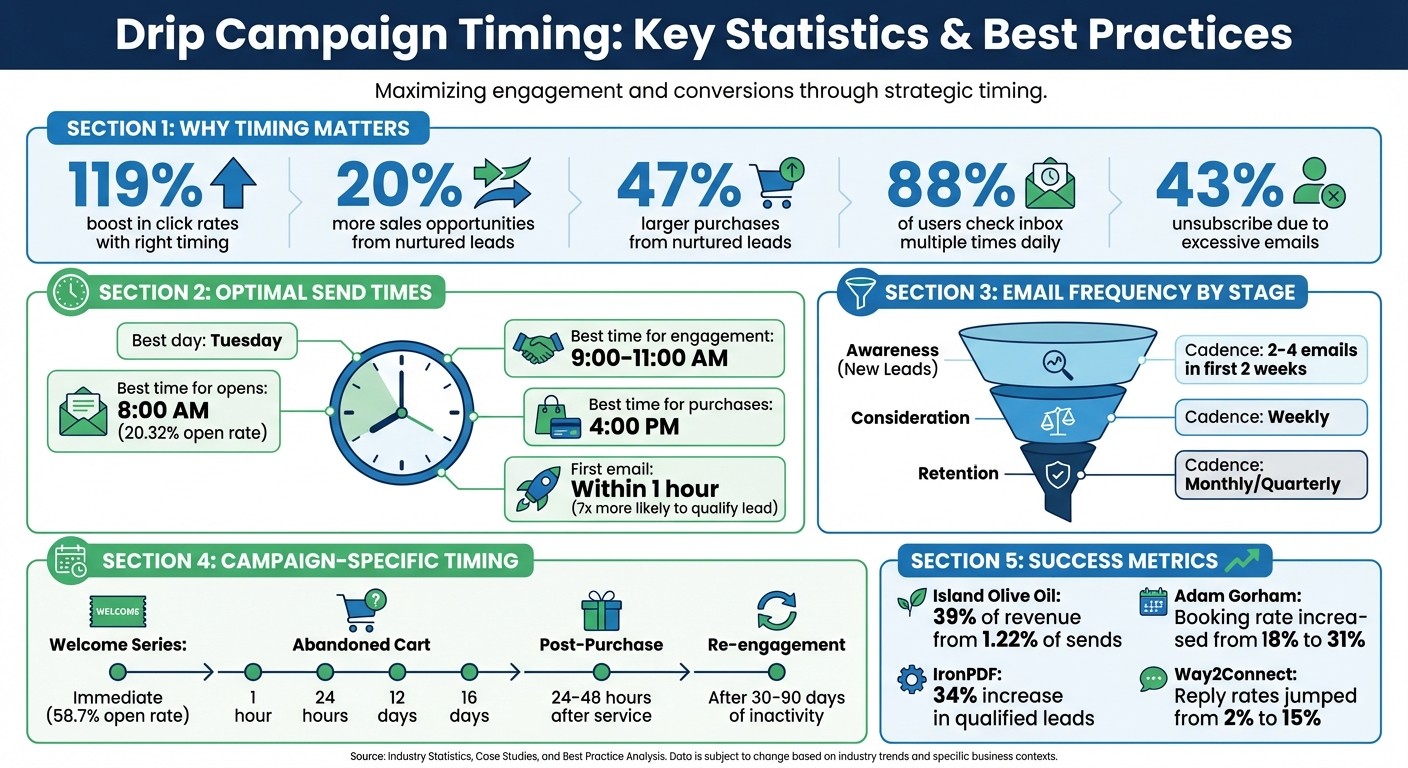
Drip Campaign Timing Statistics and Best Practices
How to setup drip email campaigns with real-world examples (step-by-step)
Why Timing Matters in Drip Campaigns
Timing can make or break your email campaigns, directly influencing open rates. With 88% of users checking their inbox multiple times a day [6], the competition for attention is fierce. That’s why delivering emails at the right moment is essential.
Here’s the payoff: nurtured leads generate 20% more sales opportunities and make 47% larger purchases [12][3]. But these results only happen when your emails land at the perfect time.
Consistency also plays a key role. When emails arrive on a predictable schedule - like every Tuesday at 10:00 a.m. - subscribers start to anticipate them. This builds trust and keeps your audience engaged [6]. A great example is Island Olive Oil. In 2025, they introduced a three-part welcome sequence triggered immediately after sign-up. Although these emails accounted for just 1.22% of their total sends, they drove 39% of the company’s total email revenue [2].
On the flip side, poor timing can hurt your efforts. Sending too many emails too quickly leads to audience fatigue - 43% of subscribers cite excessive emails as their main reason for unsubscribing [10]. Wait too long between messages, and you risk being forgotten altogether.
Sending Emails Based on Recipient Behavior
Effective timing isn’t just about the calendar; it’s about responding to what your audience is doing. Behavioral triggers, such as downloading a guide, visiting a pricing page, or abandoning a service request, signal intent in real time.
Take filmmaker Adam Gorham, for instance. In summer 2023, he used behavioral tracking to send personalized follow-ups within an hour of repeat visits. This reduced his response time from 18 hours to under three hours and boosted booking rates from 18% to 31% [11]. Similarly, IronPDF CEO Cameron Rimington timed emails to align with key engagement signals - like downloading API documentation or attending demos. This approach increased qualified lead conversions by 34% in just three months in 2025 [11].
For businesses like local service providers, timing is especially critical. Imagine a homeowner requesting an HVAC quote on a Tuesday morning. They’re likely comparing contractors the same day. An email response within the hour positions you as professional and responsive. A delay? You might not even make the shortlist.
Work schedules and industry patterns also influence timing. For example, landscaping companies targeting commercial property managers should send emails early in the morning when plans for the day are being made. Avoid Friday afternoons, when engagement drops. Research shows that emails sent between 9:00 a.m. and 12:00 p.m. on Tuesdays consistently perform best [9].
Once you’ve nailed behavior-driven timing, the next step is determining how often to send emails.
Finding the Right Email Frequency
Timing isn’t just about when you send emails - it’s also about how often. The space between messages can significantly impact engagement. Send emails too frequently, and you risk being labeled as spammy. Space them out too much, and your audience might lose interest. The ideal frequency depends on where the recipient is in their journey with your brand.
For new leads, aim to send 2–4 emails within the first two weeks to build momentum [12]. However, allow at least a three-day gap between educational emails to give recipients time to process the information [12]. As prospects move further down the funnel, slow the pace. Someone actively considering your services might appreciate weekly updates, while existing customers are likely fine with monthly or even quarterly messages [6].
Lifecycle Stage | Email Focus | Recommended Cadence |
|---|---|---|
Awareness | Educate and introduce value | Every 2–3 days (short series) |
Consideration | Nurture with social proof/case studies | Weekly |
Retention | Reinforce loyalty and updates | Monthly or quarterly |
Source: monday.com [6]
One success story comes from Way2Connect Solutions. Over a 90-day period ending in early 2026, they implemented a structured four-email cadence for a SaaS startup. This sequence started with a problem-focused introduction, followed by social proof, objection handling, and a soft breakup email. The result? Reply rates jumped from 2% to 15%, and weekly qualified meetings tripled [10].
How to Time Your Drip Campaigns
To make your drip campaigns effective, timing is everything. By studying when your audience is most engaged and aligning your emails with their behavior, you can significantly improve results.
Best Days and Times to Send Emails
For local service businesses in the U.S., Tuesday is the top-performing day for both open rates and conversions, closely followed by Thursday and Wednesday [14][16]. Avoid sending emails on Monday - most people are catching up on weekend tasks, and your message is likely to get lost in the clutter [13].
The best time to send emails is typically between 9:00 a.m. and 11:00 a.m., as professionals settle into their workday and check their inboxes [16]. Interestingly, emails sent at 8:00 a.m. achieve the highest open rate, clocking in at 20.32% [14]. On the other hand, if you're aiming for purchases rather than opens, consider sending emails at 4:00 p.m. - this is when many people browse and shop during afternoon breaks or as their workday winds down [14].
For lead nurturing, timing is even more critical. Send the first email within an hour of the trigger - businesses that act within this window are nearly seven times more likely to qualify the lead compared to those that wait two hours or more [15]. This is especially important for industries like HVAC, landscaping, or janitorial services, where same-day decision-making is common.
B2B campaigns, however, follow a slightly different rhythm. While mid-morning emails work well, cold emails sent between 8:00 p.m. and 11:00 p.m. achieve a 6.52% reply rate [18].
Campaign Type | Best Day | Best Time | Primary Reason |
|---|---|---|---|
Lead Nurturing | Immediate | Within 1 hour | |
Welcome Series | Day 0 | Immediate | Capitalizes on peak interest (58.7% open rate) [15] |
B2B Outreach | Tuesday | 10:00 a.m.–12:00 p.m. | Aligns with peak productivity [16] |
Promotions/Sales | Thursday/Friday | 6:00 p.m.–7:00 p.m. | Prepares for weekend shopping [16] |
These patterns provide a baseline, but tailoring your timing to your specific campaign goals will yield the best results.
Matching Timing to Your Campaign Goals
Different campaigns require unique timing strategies. For instance, a welcome series should start immediately after signup to capture attention while interest is at its peak [1][2]. A great example is Island Olive Oil’s three-part welcome sequence, which began right after signup and generated 39% of the company’s total email revenue, even though it accounted for just 1.22% of their total sends [2].
Abandoned cart campaigns also thrive on urgency. Wayfair’s 16-day sequence includes four emails: the first arrives one hour after abandonment, the second at 24 hours, the third at 12 days, and a final push - “Hurry, only 8 left!” - at 16 days [7]. This staggered approach appeals to both immediate and delayed buyers.
Post-purchase emails work best 24 to 48 hours after a service is completed, when the experience is still fresh. For example, Amundsen Sports turned routine order confirmations into opportunities for upselling by including product recommendations, achieving a 32% conversion rate on these emails [2].
Re-engagement campaigns, on the other hand, operate on a slower timeline. They usually start after 30, 60, or 90 days of inactivity and continue for three months with six to eight emails spaced weekly or bi-weekly [1][2]. As Elcee Vargas, Lead Product Marketing Manager at Klaviyo, puts it:
"Nurtures are more focused on the entire buyer journey, to maintain a direct relationship with each customer. For them, you have to think bigger, longer-term" [1].
Fine-tuning your timing even further by considering time zones and audience segments can make a big difference.
Adjusting for Time Zones and Audience Segments
If your campaign spans multiple time zones, adjustments are key. When automated local-time delivery isn’t an option, default to Eastern Standard Time (EST) - about 50% of the U.S. population lives in the Eastern timezone, and another 30% is just one hour behind in Central Time [15].
For better precision, divide your audience geographically. For example, send emails to East Coast recipients at 9:00 a.m. EST, then schedule separate sends for Central, Mountain, and West Coast audiences to hit their inboxes at 9:00 a.m. local time. This ensures your message reaches people at the right moment, whether it's a property manager in Boston or one in Los Angeles.
Audience behavior also plays a role. B2B audiences are most active between 9:00 a.m. and 12:00 p.m., Tuesday through Thursday [16][17], while B2C audiences tend to engage during personal time, such as Friday evenings (6:00 p.m. to 9:00 p.m.) or Sunday mornings, when inbox competition is lower [16][18].
Industry-specific habits can further shape your strategy. For instance, healthcare professionals often check emails early in the morning or late at night, tech workers engage more in the late afternoon, and facility managers for janitorial services are most responsive between 7:00 a.m. and 8:00 a.m., as they plan their day and address maintenance needs.
Testing and Improving Your Timing
Even though industry data can provide useful benchmarks, your audience's behavior is unique. The key to success lies in constant testing and measuring. By refining your send times and frequency, you can gradually improve your campaign's performance.
A/B Testing Send Times
A/B testing send times is a simple yet effective way to identify what works best for your audience. Start by dividing your audience into two equal, random groups. Group A (the control group) receives the email at your usual time, while Group B (the test group) gets it at a different time or day. To keep the results clear, make sure to test only one variable at a time [5][19].
Timing is crucial when analyzing the results. For open rates, waiting just 2 hours can predict the winner 80% of the time. However, waiting 12 or more hours increases accuracy to over 90% [19]. For click-through rates, a 3-hour wait is typically enough to reach 90% accuracy [19]. If you’re testing for revenue impact, you’ll need to wait a full 24 hours for the most reliable results [19].
For meaningful outcomes, aim for sample sizes between 1,000 and 5,000 subscribers per variant [19]. Also, avoid running tests during unusual times, like Black Friday or major holidays, as these periods can produce misleading data that won’t apply to your regular campaigns [19].
In addition to testing the time of day, experiment with frequency. For example, try comparing weekly versus bi-weekly emails to discover the sweet spot that keeps your audience engaged without overwhelming them [6]. Once you’ve made adjustments, use performance metrics to measure the impact of your changes.
Metrics to Track for Timing Success
The first metric to watch is your open rate. This helps you gauge whether the email arrived at a convenient time and if the subject line resonated [20][6]. However, with Apple’s Mail Privacy Protection inflating open rates, this metric is becoming less reliable on its own [2]. Click-through rate (CTR) offers more clarity by showing whether recipients engaged with your content when they received it [20][6].
For a deeper understanding, track your conversion rate. This metric ties timing directly to results, showing how many recipients completed your desired action - whether that’s booking a demo, making a purchase, or something else [20][6].
Keep an eye on your unsubscribe rate as well. A sudden spike could indicate email fatigue or poor timing [20][6]. If your campaign requires direct replies, monitor the response rate to see whether your timing encouraged the desired interaction [5].
Metric | What It Indicates for Timing | Action If Metric Is Low |
|---|---|---|
Open Rate | Subject line appeal and relevance of send time [20] | Test different days or hours [5] |
Click-Through Rate | Content relevance and timing of the offer [20] | Adjust sequence order or frequency [6] |
Unsubscribe Rate | Subscriber fatigue or excessive frequency [6] | Reduce send frequency or add a preference center [6] |
Conversion Rate | Alignment of timing with the buyer’s journey [20] | Map triggers more closely to lifecycle stages [11] |
For inactive segments - those who haven’t engaged in 30 to 60 days - consider reducing your email frequency. For instance, switch from weekly to bi-weekly sends to avoid further disengagement [6]. If a subscriber has been inactive for more than 90 days, try a re-engagement campaign. If that doesn’t work, it’s better to remove them to protect your sender reputation [6].
Using Cohesive AI to Automate Timing
Manually managing timing can eat up hours that could be better spent closing deals or nurturing leads. Cohesive AI eliminates this hassle by automating the timing process from start to finish - covering everything from initial outreach to follow-up emails. By analyzing lead data, the platform identifies the best times to engage each recipient, ensuring that your timing aligns perfectly with your overall campaign strategy.
How Cohesive AI Handles Drip Campaign Timing
Cohesive AI takes timing to the next level by using behavioral triggers and predictive segmentation to analyze engagement metrics like email opens, clicks, and website interactions[22]. Instead of sending emails to everyone at once, the platform customizes delivery times based on each lead's behavior.
Its CRM and Google Maps scraper consolidate lead information, making it easy to manage timing across multiple campaigns[21]. For example, an HVAC company targeting commercial property managers can segment their leads by factors like property size, climate zone, and system type. Emails can then be triggered based on service history or seasonal maintenance needs. This ensures messages land at the most relevant times - not just when it's convenient for the sender.
Event-based triggers are another standout feature. If a lead opens an email but doesn’t click, the system can automatically schedule a follow-up. Similarly, if a lead clicks through to your website, it can trigger a tailored message based on that specific action[22]. This kind of real-time responsiveness keeps outreach timely without requiring constant manual effort.
Here’s how AI-driven timing stacks up against traditional manual methods:
Feature | AI-Driven Timing (Cohesive AI) | Traditional Manual Timing |
|---|---|---|
Speed | Instantly processes data and sends | Requires manual scheduling, slower |
Scalability | Effortlessly handles multiple campaigns | Scaling is labor-intensive |
Optimization | Adjusts in real time using data | Relies on periodic manual reviews |
Consistency | Automated follow-ups prevent missed leads | Human error can lead to missed opportunities |
Efficiency | Saves ~13 hours per week | High time investment |
Benefits for Local Service Businesses
Precise timing isn’t just a convenience - it’s a game-changer for local service businesses. Cohesive AI saves an average of 13 hours per week, directly improving ROI. For $500 per month (plus a one-time $75 onboarding fee), the platform includes 12,000 research credits and 7,200 data credits - enough to run up to three campaigns simultaneously[21]. Plus, the company guarantees at least four interested responses per month, offering a free month credit if this benchmark isn’t met.
Take a landscaping company as an example. They could use Cohesive AI to target property managers of commercial buildings. The platform scrapes Google Maps for leads, personalizes emails using AI, and schedules follow-ups based on each lead’s engagement. If a lead opens the first email but doesn’t respond, the system calculates the ideal interval - based on similar leads’ behavior - before sending a second email. This ensures no leads are lost due to forgotten follow-ups or scheduling mishaps.
The platform’s ability to scale is especially useful during peak seasons. Imagine an HVAC business gearing up for summer. They could launch one campaign targeting businesses with older cooling systems while simultaneously running a maintenance reminder campaign for existing customers. Cohesive AI handles all the timing adjustments for both campaigns, ensuring messages are sent at the right moments based on each segment’s engagement patterns - all without adding extra manual work to the team’s plate.
Conclusion
Getting the timing right in drip campaigns can significantly boost conversions. Drip emails, for instance, see a 119% higher click rate compared to standard promotional emails [4]. On top of that, automated campaigns are responsible for about 75% of all email marketing revenue [4]. For local service businesses navigating crowded inboxes, these stats translate directly into more revenue opportunities.
To make the most of these insights, there are three principles to keep in mind:
Send welcome emails immediately and use behavioral triggers to stay relevant.
Experiment with send times and frequencies to find what works best for your audience.
Be consistent - it often takes around eight touchpoints to turn a prospect into a paying customer [8].
"Effective drip campaign practices aren't just about sending automated emails – it's about creating targeted messages that happen at exactly the right moment."
Magee Clegg, CEO, Cleartail Marketing[4]
Manually managing timing can be a major time sink. That’s where tools like Cohesive AI come in. It automates everything from lead research and email personalization to follow-ups. For $500 per month, with a guarantee of at least four interested responses, it’s a practical choice for HVAC companies, landscapers, janitorial services, and other local businesses aiming to scale without extra workload. This kind of automation strengthens your timing strategy and keeps your focus on delivering services.
The winning combination? Pair strategic timing with automation to turn cold leads into loyal customers.
FAQs
What’s the best time to send drip campaign emails to my audience?
Finding the right time to send drip campaign emails means understanding when your audience is most likely to engage. Typically, weekdays - especially Tuesday and Wednesday mornings between 9:00 AM and 11:00 AM in the recipient's local time - tend to perform well for open and click-through rates.
However, to tailor this timing to your audience, dive deeper into their habits. Consider factors like time zones, industry standards, and typical behavior patterns. Tools that analyze engagement metrics or running A/B tests can help pinpoint the best times for your specific audience. Also, keep in mind that the type of email and the nature of your relationship with recipients can influence the ideal timing. Adjust accordingly for the best results.
What happens if I send emails too often or not often enough?
Sending emails too often can backfire. It might annoy your audience, leading to frustration, a spike in unsubscribes, or even worse - spam complaints. This not only damages your brand’s reputation but can also hurt your email deliverability.
On the flip side, if you send emails too rarely, you risk fading from your audience’s memory. They might lose interest or even forget about your brand entirely, which means lower engagement and missed chances to nurture leads.
The trick lies in finding the right balance. Consistent and well-timed emails keep your audience interested without overwhelming them. This approach helps build stronger connections and boosts the overall success of your campaigns.
How does Cohesive AI help optimize drip campaign timing?
Cohesive AI improves drip campaign timing by using AI-driven personalization and automation. It studies how prospects behave and engage with your content, allowing messages to be sent when they’re most likely to resonate. This makes your outreach feel more timely and relevant.
By automating this process, Cohesive AI ensures your campaigns stay consistent while also addressing the specific needs of your audience. The result? Better engagement and a higher likelihood of turning leads into loyal customers.