AI Demand Forecasting for Local Services: Case Studies
Aug 6, 2025

AI is transforming how local service businesses predict customer demand. By analyzing real-time data like weather, local events, and economic trends, businesses can make more accurate predictions, improve staffing, reduce costs, and enhance customer satisfaction.
Key takeaways:
Janitorial services boosted efficiency by 30% and client retention by 25% using AI.
Landscaping companies reduced missed appointments and improved inventory management.
HVAC providers cut response times by 20-30% and prevented equipment failures.
AI-driven tools also integrate demand forecasting with lead generation, helping businesses identify and target potential clients. For example, platforms like Cohesive AI automate lead sourcing and personalized outreach at a fraction of traditional costs, offering a flat fee of $500/month compared to agencies charging $2,000–$50,000.
AI is no longer optional for local services. It’s a practical way to predict demand, optimize resources, and grow efficiently. Start small with pilot tests and ensure your data is clean to see measurable results.
My vision for demand planning using AI and humans.
Real Case Studies: Local Service Businesses Using AI
AI has proven to be a game-changer for local service businesses. These real-world examples highlight how AI-driven demand forecasting has reshaped operations, making them more efficient and customer-focused. From janitorial services to HVAC providers, these case studies showcase the tangible results businesses across the United States have achieved by embracing AI technology.
Case Study: Janitorial Services
For commercial cleaning companies, demand can fluctuate based on factors like occupancy levels, events, and seasonal changes. One janitorial service provider tackled this challenge by implementing an AI system that pulled data from various sources, including historical booking trends, local business occupancy data from SafeGraph, and weather forecasts. This allowed them to predict demand spikes with remarkable precision.
The results? A 30% boost in operational efficiency and shorter cleaning times, thanks to robotic vacuum systems guided by AI predictions [3]. Their AI-powered chatbots also streamlined client communication and scheduling, leading to a 25% increase in client retention rates [3].
What made this system so effective was its ability to combine real-time data with historical trends. For instance, when a corporate client announced a large meeting, the AI system adjusted staffing schedules based on similar past events, ensuring adequate coverage without overstaffing.
Case Study: Landscaping Businesses
Landscaping companies often face seasonal demand swings influenced by weather, local events, and property development cycles. One East Coast landscaping business used AI to overhaul its approach to labor, equipment, and material management.
Their AI system analyzed weather forecasts, municipal event schedules, and historical service data to anticipate demand patterns. For example, it could predict spikes in requests based on temperature trends or upcoming events. This allowed the company to proactively adjust staffing and inventory levels, avoiding last-minute scrambles.
Another key improvement came in client communication. By using AI to track and optimize how often they reached out via email, text, or phone, they saw noticeable gains in customer satisfaction and retention [4].
"A common industry challenge is labor shortages, but if you're able to use AI to help manage resources, labor, equipment, materials, cost estimation, and supply chain optimization - if you can streamline all of that - you can make some tremendous savings on your gross margin." - Robert Clinkenbeard, CEO of Wilson360 [4]
This approach significantly reduced missed appointments, improved workforce allocation, and helped the company build stronger customer relationships.
Case Study: HVAC Service Providers
HVAC companies often deal with unpredictable surges in emergency calls, driven by weather changes, aging equipment, and seasonal trends. One HVAC provider implemented an AI system that transformed its operations by predicting service needs with impressive accuracy.
The system analyzed local temperature patterns, customer service histories, and equipment details to forecast demand. It also incorporated TechRoute AI for route optimization, which cut drive times by 20-30% and allowed technicians to handle more jobs daily [7]. By positioning technicians in areas likely to experience demand spikes, the company improved response times and efficiency.
One Fortune 500 commercial office building working with this AI-assisted HVAC provider saw 19% energy savings and a productivity boost worth $300,000 through optimized HVAC operations [6]. Predictive analytics also enabled the company to anticipate equipment failures before they happened, improving inventory management and reducing downtime.
In addition to emergency repairs, the company used AI-driven sales tools to analyze customer preferences and recommend energy-efficient upgrades. This opened up new revenue streams while enhancing customer satisfaction [5].
"Just having those insights allows us to adapt and be nimble on the ground and figure out what we need to do on the operational side to meet our customers' needs." - Robert Clinkenbeard, CEO of Wilson360 [4]
The Takeaway
These case studies show how AI can revolutionize local services by integrating diverse data sources - like weather trends, customer behavior, and historical patterns - to deliver actionable insights. Whether it’s optimizing schedules, improving communication, or anticipating demand, AI is helping businesses operate smarter and more efficiently. And this is just the beginning, as tools like Cohesive AI pave the way for combining demand forecasting with targeted lead generation.
Combining Demand Forecasting with Lead Generation: The Role of Cohesive AI
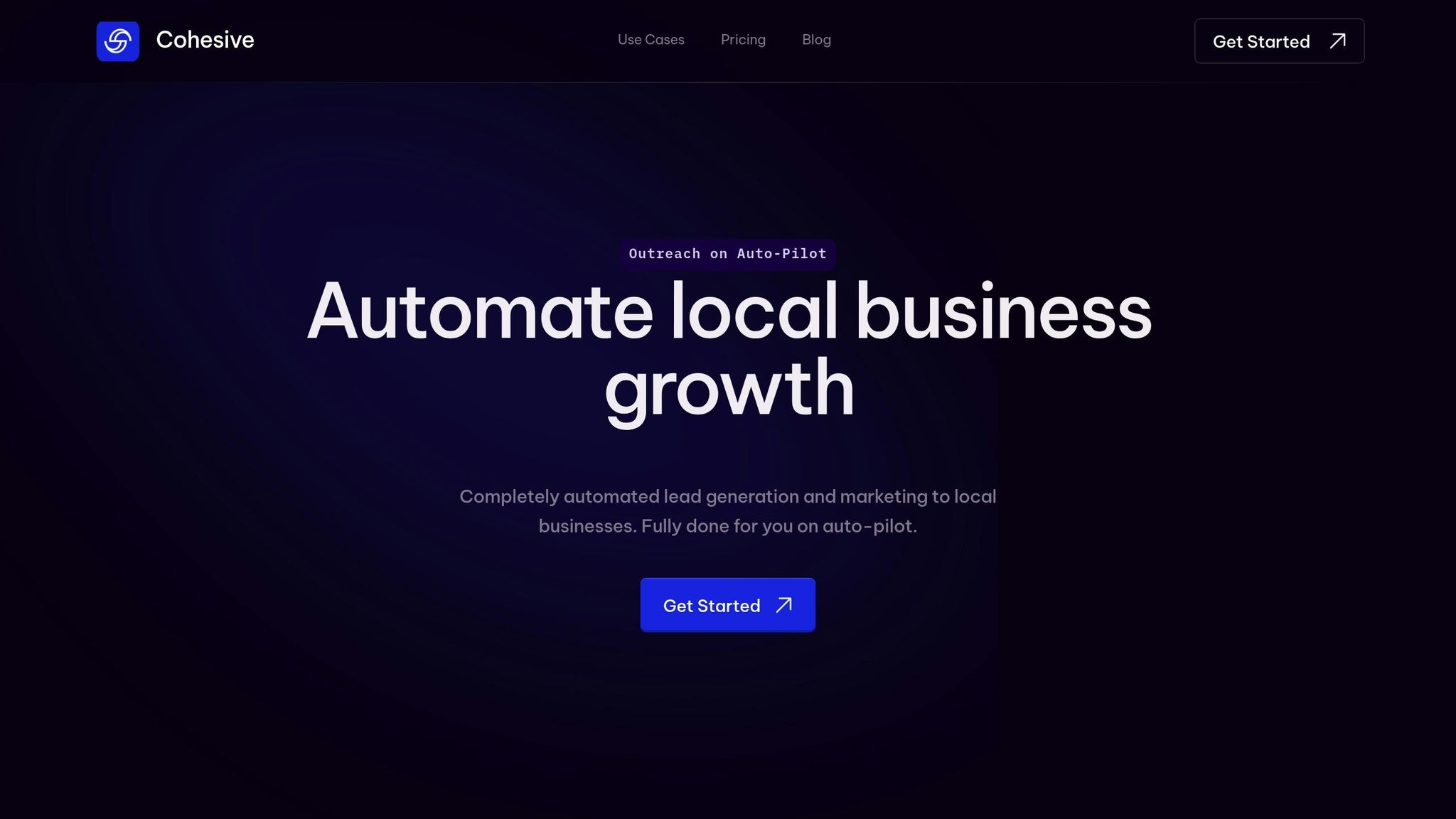
The examples above highlight how AI can revolutionize demand forecasting, but when paired with automated lead generation, the impact grows exponentially. This is where Cohesive AI steps in, seamlessly linking demand predictions with customer acquisition to give local service providers a significant edge.
Traditional lead generation agencies often charge between $2,000 and $50,000 per month, with an average cost of $198 per lead. These high costs stem from manual processes that limit scalability. Cohesive AI, on the other hand, automates the process by integrating demand data, making it both efficient and cost-effective [8].
Here’s how it works: the platform scrapes data from sources like Google Maps and government filings to instantly identify potential clients. For example, if a janitorial company’s demand forecast predicts a spike in office cleaning requests, Cohesive AI can pinpoint newly opened or expanding businesses in the area. This targeted approach ensures that businesses focus on prospects who are most likely to need their services, eliminating wasted effort on cold leads.
Personalized outreach takes this targeting to the next level. Instead of sending generic emails, the system analyzes each prospect’s business type, location, and market conditions to craft tailored messages. For instance, if an HVAC company anticipates a heat wave based on demand forecasting, Cohesive AI can generate emails offering emergency cooling services or maintenance packages to local businesses.
The automation doesn’t stop there. Campaign management is also optimized, with messaging and timing adjusted based on demand trends. During peak landscaping season, for instance, the system can increase outreach to property management companies, emphasizing seasonal services like spring cleanups or irrigation system installations. This level of efficiency bridges the gap between demand forecasting and precision-targeted lead generation.
Feature | AI-Driven Platforms (Cohesive AI) | Lead Generation Agencies |
|---|---|---|
Lead Sourcing Efficiency | Automated data collection from sources like Google Maps and government filings; handles large volumes | Manual research and networking; limited by human capacity |
Personalization Capabilities | AI-driven, behavior-based email personalization; 41% higher click-through rates | Human-created messaging; less scalable |
Cost Effectiveness | $500/month flat fee; 30–40% lower customer acquisition costs with predictable ROI | $2,000–$50,000 retainers; $198 per lead on average |
Scalability | Supports exponential growth; can handle up to 10x more leads | Linear growth requiring additional staff and resources |
The financial benefits are clear. For just $500 per month and a one-time setup fee of $75, Cohesive AI reduces customer acquisition costs by 30–40% compared to traditional agencies [8]. Plus, the platform guarantees at least four interested responses each month, offering a free month of service if this benchmark isn’t met. This removes much of the risk typically associated with lead generation investments.
For local service businesses already leveraging demand forecasting, this combination creates a major competitive advantage. Imagine an HVAC company that knows a cold snap is coming. With Cohesive AI, their sales pipeline can be filled with warm leads before competitors even notice the surge in demand. The same applies to landscaping companies gearing up for the spring rush or janitorial services preparing for office reopenings.
Cohesive AI also allows businesses to run up to three campaigns simultaneously, targeting different customer segments. A landscaping company, for instance, could tailor campaigns for residential clients, commercial properties, and municipal contracts, aligning each with seasonal trends and local economic conditions. This multi-campaign capability ensures businesses can maximize their reach and adapt to varying demand patterns.
Key Results and Success Factors
AI-driven demand forecasting has delivered measurable improvements across various local service sectors, offering valuable lessons for businesses looking to achieve similar outcomes.
Take janitorial services, for instance. Companies that adopted AI forecasting saw a 30–50% reduction in forecast errors and managed to cut labor costs by 18% by fine-tuning staff schedules based on predicted demand[1]. One standout example involved a janitorial provider that reduced its delivery fleet by 30%, slashing transportation costs without compromising service quality[9].
In landscaping, businesses experienced major benefits in inventory management and seasonal planning. By implementing AI, they reduced stockouts by 25–37% and cut waste by 33–34% within the first year[2]. Some even avoided up to $1.4 million in quarterly lost sales by maintaining optimal inventory levels during peak seasons. With AI's ability to predict seasonal demand spikes with 85% accuracy - a leap from the 60% accuracy of traditional methods - these companies gained a crucial competitive advantage[2].
HVAC service providers also reaped significant rewards. On-time service rates jumped from 82% to 97%, while changeover times dropped from 4–6 hours to just 1–2 hours[2]. Additionally, raw material inventory levels were reduced from 30 days to 12 days, freeing up working capital for other growth opportunities[2].
Transportation and warehousing also saw cost reductions of 5–10%, while supply chain administration expenses dropped by 25–40%[1]. Lost sales caused by out-of-stock situations decreased by up to 65%, directly boosting revenue[1].
Here’s a breakdown of the key metrics across these sectors:
Metric | Janitorial Services | Landscaping Businesses | HVAC Service Providers |
|---|---|---|---|
Forecast Accuracy | 30–50% error reduction | 85% vs. 60% (traditional) | 37% error reduction |
Cost Savings | 18% labor, 30% fleet cut | 34% waste reduction | 25–40% admin expense reduction |
Service Improvements | 30% fleet optimization | 25–37% stockout reduction | 82% to 97% on-time delivery |
Inventory Optimization | N/A | $1.4M quarterly savings | Raw materials: 30 to 12 days |
Operational Efficiency | Automated scheduling | Seasonal demand prediction | Changeover: 4–6 hrs to 1–2 hrs |
What Drives These Results?
Several factors contribute to these successes, and they go beyond just crunching numbers. Data quality stands out as a critical foundation. Businesses that conducted thorough data audits before implementation saw faster and more impactful results.
A phased rollout approach also proved essential. Starting with pilot projects in specific areas allowed companies to test the waters, address challenges, and celebrate quick wins, which helped build confidence within their teams.
Integration with existing systems played a big role too. Many businesses invested in custom APIs to connect legacy systems and used data lakes to consolidate information from multiple sources. This kind of seamless integration made it possible to achieve wide-ranging improvements.
Change management was another key piece of the puzzle. Educating employees early on and involving them in the process helped teams adapt more quickly. Setting clear, measurable KPIs - like forecast accuracy, inventory turnover, and customer satisfaction - allowed businesses to track progress and showcase tangible ROI.
Interestingly, while 67% of professionals cite data quality as a major challenge[2], companies that tackled this issue with automated data cleaning tools and feedback loops saw the strongest outcomes. With 45% of businesses now using machine learning for demand forecasting[10], it's clear that AI has shifted from being an experimental tool to an essential part of driving growth and efficiency in local service industries.
Conclusion
AI demand forecasting has transitioned from being a niche experiment to becoming a powerful tool for local service businesses. Case studies from janitorial services, landscaping, and HVAC providers highlight how it has consistently improved operations and elevated customer service.
The key to success lies in improving data quality, starting with pilot projects, and seamlessly integrating AI into existing workflows. Research shows that even a 1% increase in demand forecast accuracy can reduce labor costs by 0.5% [12]. Over time, these small improvements can create substantial competitive advantages.
To get started, focus on these action steps: set clear objectives and KPIs, ensure your data is accurate and consistent, and begin with small-scale pilot projects before rolling out AI solutions across your entire operation [11]. Companies like Amazon, Zara, and Walmart have proven that AI forecasting delivers results at scale. Whether you're managing a handful of trucks or a large fleet, the same principles apply. Pairing these operational improvements with targeted lead generation strategies can further accelerate business growth.
Cohesive AI builds on these operational wins by combining demand forecasting with lead generation. Using data from sources like Google Maps and government filings, the platform helps businesses predict demand while attracting new customers. This approach offers a cost-effective alternative to traditional lead generation agencies, addressing two critical growth areas simultaneously.
For businesses that succeed, AI forecasting is more than just a prediction tool - it’s a way to streamline operations, improve customer satisfaction, and drive long-term growth. The case studies prove its effectiveness, so now is the time to start putting these strategies into action.
FAQs
How does AI-driven demand forecasting help local service businesses like janitorial and HVAC improve efficiency?
AI-powered demand forecasting is transforming how local service businesses - like janitorial or HVAC companies - manage their operations. By delivering precise predictions about customer demand, these tools help businesses streamline scheduling, inventory management, and maintenance planning. The result? Lower costs and smarter resource allocation.
With the ability to spot demand trends and automate repetitive tasks, AI supports proactive decision-making. Businesses can adapt swiftly to changes, improving productivity while ensuring customers receive prompt and dependable service.
What steps should local service businesses take to effectively use AI for demand forecasting and achieve measurable results?
To make the most of AI for demand forecasting, local service businesses should begin by collecting and organizing historical data. This includes details like service requests, seasonal patterns, and customer behavior. The accuracy and cleanliness of this data are crucial - it’s the backbone of creating forecasts you can trust.
It’s smart to start with small, targeted projects that focus on specific areas of demand. By doing this, you can test and fine-tune AI models without taking on too much at once. Running pilot programs or proof-of-concept tests with your own data gives you a practical way to assess how well the forecasts work before expanding their use.
Don’t overlook the importance of data governance practices. Regular audits and checks help ensure your AI models stay reliable over time. These steps lay a solid groundwork for smarter demand planning, better use of resources, and measurable improvements in your business outcomes.
How can AI demand forecasting and automated lead generation, like with Cohesive AI, help local service businesses stay ahead of the competition?
Combining AI demand forecasting with automated lead generation gives local service businesses a serious edge over the competition. With AI demand forecasting, businesses can predict customer needs with greater accuracy. This means they can better allocate resources, cut down on unnecessary waste, and quickly adapt to shifts in the market.
Pair this with automated lead generation tools like Cohesive AI, and businesses can pinpoint potential clients and reach out to them with tailored messaging. Together, these tools empower service providers to anticipate demand, attract ideal customers, and streamline operations - keeping them ahead in a crowded marketplace.