AI vs. Manual Privacy Compliance in Campaigns
Dec 11, 2025

Managing privacy compliance in marketing campaigns is no longer optional - it’s a legal necessity. Businesses in the U.S. must follow laws like CCPA/CPRA, CAN-SPAM, and TCPA to protect consumer data and avoid hefty fines or lawsuits. But how should you handle compliance: manually or with AI?
Here’s the bottom line:
Manual compliance relies on human review to manage tasks like consent tracking, suppression lists, and legal checks. It allows for nuanced decisions but is slow, error-prone, and expensive.
AI-driven compliance automates these processes, offering faster checks, real-time monitoring, and lower costs. However, it might miss context or require human oversight for complex cases.
Key Takeaways:
Manual compliance is detailed but time-consuming and costly.
AI compliance is faster, more consistent, and reduces costs by up to $1.76M on average.
A hybrid approach combines AI’s efficiency with human judgment for the best results.
Quick Comparison:
Dimension | Manual Compliance | AI-Driven Compliance |
|---|---|---|
Speed | Hours to days per campaign | Real-time monitoring in seconds |
Cost | High labor costs | Lower costs after setup |
Error Rate | Prone to human mistakes | Consistent but may lack context |
Scalability | Limited by team size | Easily scales with campaign volume |
Risk Detection | Periodic checks | Continuous, automated monitoring |
For small businesses, platforms like Cohesive AI simplify compliance by automating tasks like consent tracking and opt-out management, helping you stay compliant without large legal teams.
AI and manual methods each have strengths, but combining them ensures compliance while keeping campaigns efficient and scalable.
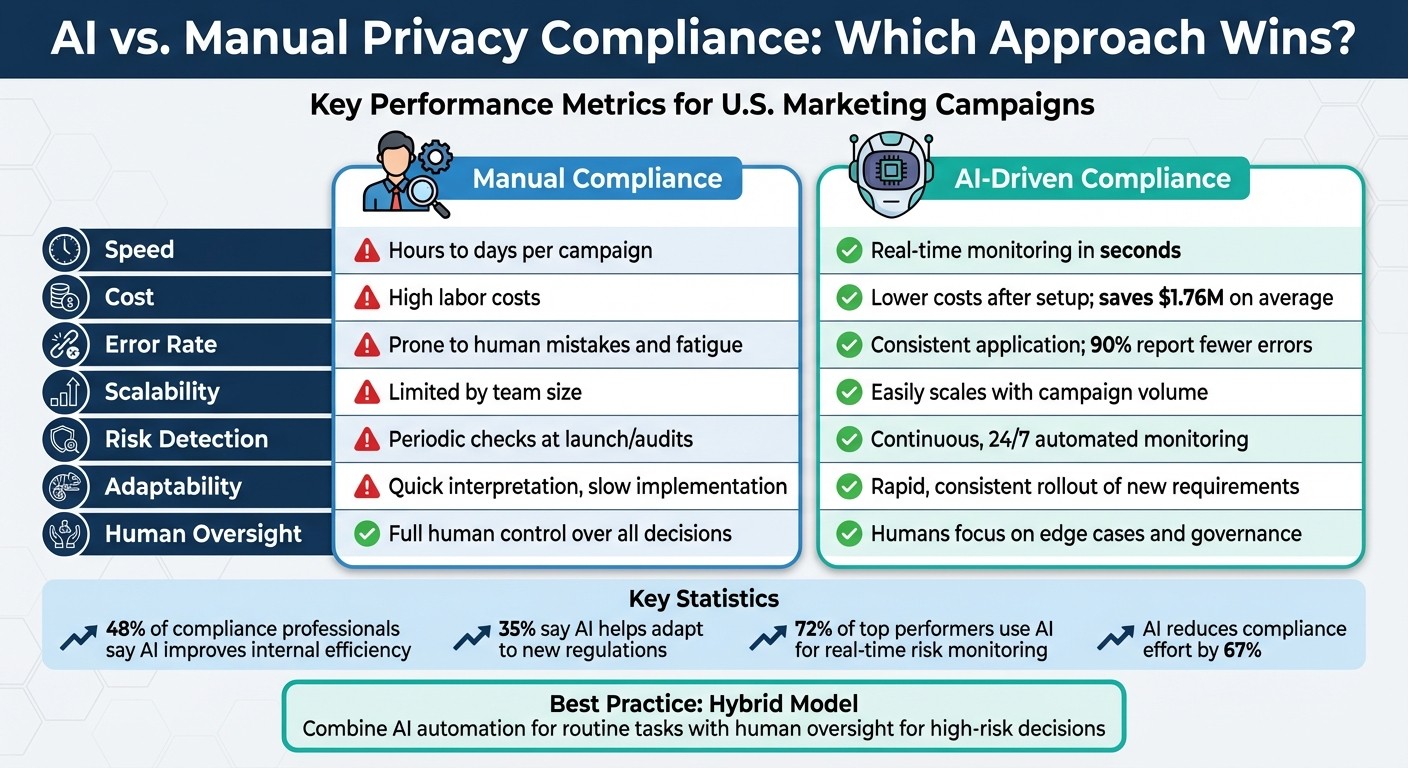
AI vs Manual Privacy Compliance: Speed, Cost, and Scalability Comparison
Privacy Compliance Requirements for Marketing Campaigns
Legal Requirements for U.S. Campaigns
In the U.S., marketing campaigns must navigate a maze of privacy regulations. At the core, businesses are required to clearly disclose what personal data they collect, why they collect it, and who they share it with. This information should be easy to understand and prominently displayed - no hiding behind dense legal language.
Consent management is non-negotiable. Under laws like CCPA and CPRA, you must provide a simple opt-out option and respect the consumer's choices. For SMS and voice campaigns, the rules are even stricter. The TCPA demands express written consent before sending marketing texts or robocalls to mobile phones. Keeping detailed records of when and how consent was given is crucial for compliance.
Another major requirement is data minimization. This means collecting only what's absolutely necessary for your campaign. For example, limit form fields to essential information, avoid gathering sensitive data unless there's a clear legal justification, and routinely delete outdated campaign data. The goal is to use the minimum amount of data needed to achieve the campaign's purpose.
Handling consumer rights requests is another critical aspect. Systems must be capable of locating relevant data, responding to requests like deletion or correction within 45 days, and maintaining audit logs of these actions. If someone requests their data be deleted, it must be removed from all marketing systems, audience segments, and even AI training datasets. Suppression lists must also be updated to prevent accidental re-targeting.
Finally, security measures are a must. Laws like CCPA and CPRA require "reasonable security procedures" to protect consumer data. This includes encryption (both during transmission and storage), role-based access controls, and monitoring for unusual data access. AI-powered security tools can help detect and contain breaches faster, potentially saving organizations millions in costs by meeting these regulatory standards [2].
Together, these legal requirements add complexity to managing multi-channel marketing campaigns.
Multi-Channel Campaign Challenges
Legal compliance is just one piece of the puzzle. Running campaigns across multiple channels introduces its own set of operational difficulties. One of the biggest hurdles is identity resolution - figuring out when different identifiers like email addresses, phone numbers, and device IDs all belong to the same person. Without accurate matching, you risk failing to honor an opt-out across platforms, which could lead to non-compliance.
Synchronizing consent preferences across various channels is another challenge. Each platform or vendor may store and interpret consent data differently. For instance, your CRM might log an email opt-out, but if that information doesn’t sync immediately with your SMS platform, ad networks, or CDP, you could unknowingly target someone who has opted out. This issue becomes even trickier in real-time campaigns that rely on immediate data updates.
The problem is compounded by fragmented vendor systems. Different tools often handle privacy settings in inconsistent ways. For example, one platform might interpret a "Do Not Sell" flag as blocking third-party cookies, while another only limits email list sharing. These inconsistencies can create compliance gaps that are hard to catch, especially as more states introduce privacy laws. States like Colorado, Virginia, Connecticut, Utah, Texas, and Oregon have all adopted frameworks similar to CCPA, making it increasingly difficult to keep every channel aligned with updated disclosures and consumer rights.
The complexity of managing multi-channel campaigns has led many organizations to explore automated solutions. According to a Thomson Reuters survey, 48% of compliance professionals believe AI can improve internal efficiency, while 35% think AI can help them stay on top of evolving regulations [1]. With the fast pace and high volume of modern campaigns, manual processes are no longer enough. Automated tools offer a way to close compliance gaps and keep up with the demands of multi-channel marketing. These challenges underscore the growing need for more flexible and efficient compliance strategies.
Manual Privacy Compliance in Campaigns
How Manual Compliance Works
Manual privacy compliance starts with a campaign intake form, where marketers detail their target audiences, data sources, channels, and any planned tracking or profiling. Legal or privacy teams then review this information to ensure it aligns with internal policies and laws like CCPA/CPRA, CAN-SPAM, and TCPA.
The process involves a meticulous review of campaign materials. Legal teams examine copy, creative assets, landing pages, and consent language to confirm that all required elements - such as disclosures, unsubscribe options, cookie banners, and profiling notices - are included. Audience lists are pulled from CRM systems or data warehouses, then manually filtered to exclude individuals who lack valid consent, have opted out, are minors, or reside in states with specific privacy laws.
Approval logs are maintained to track who signed off on each campaign version. Before launching, channel owners perform final checks using policy checklists to ensure suppression lists and frequency caps are correctly applied. Once the campaign is live, privacy-related inquiries, including access requests, complaints, or unsubscribe issues, are handled individually and reconciled with consent and suppression records.
Teams rely heavily on manual record-keeping, which must be updated as laws evolve. Channel-specific checklists for email, SMS, social media, and programmatic advertising help ensure compliance with requirements like visible unsubscribe mechanisms, honoring "Do Not Sell or Share" preferences under CCPA/CPRA, and proper disclosures for lookalike audiences. While thorough, these manual methods can slow processes and lead to inconsistencies.
Advantages of Manual Compliance
Despite its inefficiencies, manual compliance allows for nuanced judgment that automated systems may miss. Human reviewers can evaluate risks in cases where anonymized datasets might still endanger vulnerable groups or when sensitive topics - like health, immigration, or financial difficulties - require stricter scrutiny than the legal minimum. They can also balance brand ethics with legal requirements, sometimes choosing not to pursue campaigns that might feel manipulative, even if technically compliant.
Experienced legal and privacy professionals bring valuable insights to the table, interpreting ambiguous or emerging regulations by combining regulatory texts, enforcement trends, and industry standards. This approach encourages personal accountability, as specific individuals sign off on campaigns, which helps deter risky behavior and promotes thoughtful decision-making. Over time, this fosters a stronger understanding between legal and marketing teams, aligning on acceptable risks and long-term strategies. In industries like healthcare, financial services, or products for children, this hands-on approach reassures boards and regulators that privacy is actively managed by accountable professionals.
Drawbacks of Manual Compliance
One major downside of manual compliance is the delay it introduces. Campaigns can sit in legal review for days or weeks, slowing down time-sensitive promotions. Each new variation - whether it’s a subject line test, localized creative, or an added audience segment - requires another round of review. This reduces the efficiency of campaign execution and discourages experimentation, such as A/B testing.
When campaigns target multiple states with varying privacy laws, legal teams must manually verify compliance for each state’s rules. To avoid repetitive reviews, marketers often default to the strictest state standard, which can limit personalization and hurt campaign performance. In fast-paced environments like paid social or programmatic advertising, manual reviews may struggle to keep up, increasing the risk of skipped steps or missed opportunities due to delays.
Manual processes are also prone to human error. Mistakes like applying outdated suppression files, mismanaging data, or uploading incorrect audience lists can compromise compliance. Disclosures and consent language may be reused from older templates that no longer meet updated requirements under laws like CCPA/CPRA, especially when updates aren’t systematically communicated across teams.
The financial risks are significant. In 2023, the average cost of a data breach was about $4.45 million. Organizations using AI and automated security measures reported breach costs that were approximately $1.76 million lower than those relying mainly on manual methods [2]. A Thomson Reuters survey revealed that 48% of compliance professionals believed AI could boost internal efficiency, while 35% said it would help them adapt to new regulations - highlighting the challenges manual processes face in managing high volumes and rapidly changing rules [1]. These challenges underscore the potential benefits of exploring AI-driven compliance solutions.
AI-Driven Privacy Compliance in Campaigns
How AI-Driven Compliance Works
AI systems are transforming how campaigns adhere to U.S. privacy laws by automating compliance checks at every stage. These systems scan campaign assets in real time, cross-referencing regulations like CCPA/CPRA, CAN-SPAM, and TCPA. This means that from the moment an email list is uploaded, AI verifies each contact’s consent status instantly.
Using natural language processing, AI reviews ad copy, landing pages, and tracking parameters to identify missing privacy disclosures, unlawful claims, or sensitive data usage, such as health or financial information. If a user withdraws consent, the system immediately updates their record across all connected tools, ensuring they’re removed from active campaigns, retargeting lists, and email sequences.
What sets AI apart from manual audits is its ability to continuously monitor activity. Machine learning models establish patterns for normal data behavior, such as access times and audience creation processes. If unusual activity occurs - like large CRM exports during odd hours or unauthorized data merges - the system flags it as a potential issue. Additionally, AI ensures data encryption during transfers and checks compliance with cross-border data movement restrictions, alerting teams if data is sent to unapproved destinations.
Performance Advantages of AI
The efficiency gains from AI automation are hard to ignore. Tasks that used to take days, like reviewing creative assets or data usage, can now be completed in seconds[1]. Early adopters report that AI’s ability to flag risky language, improper data handling, and missing disclosures significantly reduces compliance violations that human reviewers might miss.
The financial benefits are just as compelling. Automating security with AI has been shown to cut the average cost of a data breach by about $1.76 million, thanks to faster detection and response times[2]. A Thomson Reuters survey revealed that 48% of compliance professionals see improved internal efficiency with AI, and 35% say it helps them keep pace with evolving regulations[1]. Additionally, 72% of top-performing organizations use AI to monitor risks in real time[6].
AI also enhances marketing performance. By making consent processes more transparent and user-friendly, companies have achieved a 20% increase in opt-in rates. This demonstrates that strong privacy practices don’t just protect businesses - they can also expand marketing reach[1].
For businesses without dedicated legal teams, these advantages are invaluable.
AI Compliance for Local Service Businesses
Local service businesses, such as janitorial companies, landscaping firms, and HVAC contractors, often lack the resources for extensive legal support. Yet, they still need to comply with email and SMS regulations while managing large-scale campaigns. AI offers a practical solution for these smaller operations.
Take Cohesive AI, for example. This platform integrates compliance directly into lead generation workflows. It sources leads from public business records, like Google Maps listings and government filings, ensuring outreach targets are business contacts. Cohesive AI uses standardized email templates that include identification and unsubscribe options, while also tracking campaign metrics and compliance records in one place. This eliminates the need for manual spreadsheets and scattered documentation.
When a contact opts out or requests no further communication, the system automatically suppresses them from all future campaigns. This ensures legal compliance while keeping operations efficient. For small teams, Cohesive AI replaces the need for manual list building, ad hoc personalization, and fragmented record-keeping, significantly reducing the risk of accidentally contacting someone who has opted out.
Ethical AI in Marketing: Marketers' Guide to Privacy, Policy, and Regulatory Compliance - Ruth Carter
AI vs. Manual Privacy Compliance: Direct Comparison
When you compare AI with manual privacy compliance, the differences are striking. Manual reviews can take hours - or even days - while AI systems can scan assets in mere seconds. Each approach comes with its own set of trade-offs, especially for U.S. marketing teams navigating complex regulations.
Interestingly, the choice between the two isn't always an either-or scenario. Many organizations are turning to a hybrid model, where AI handles routine checks and humans step in for nuanced judgment calls. This approach allows teams to allocate resources more efficiently while managing risks effectively.
To break it down further, the table below summarizes the key performance metrics of both methods, highlighting their strengths and limitations.
Comparison Table: Performance Metrics
Dimension | Manual Compliance | AI-Driven Compliance |
|---|---|---|
Processing Speed | Hours to days per campaign; requires coordination across teams [1][2] | Scans thousands of assets in minutes; real-time monitoring [1][2] |
Accuracy & Error Rate | Prone to human error, fatigue, and inconsistent interpretation; may miss patterns in large datasets [1][4] | Consistent application of rules; 90% of teams report fewer manual errors [1]; may miss nuanced context without retraining [4] |
Scalability | Scales with headcount; adding channels or campaigns needs more staff [1][3] | Scales with compute resources; low marginal cost to monitor additional campaigns once configured [1][2][3] |
Ongoing Cost | High labor costs for compliance analysts and legal reviews, especially for multi-state campaigns [1][3][4] | Upfront and subscription costs; reduces manual effort by over 60% and cuts breach costs by $1.76 million on average [2][3] |
Transparency | Decisions documented in memos or tickets; traceable to individuals; easier to explain to regulators [4] | Often functions as a "black box"; requires governance and tools to explain flagging decisions [8][4][5] |
Adaptability | Humans can interpret new state laws quickly, but implementation is slow and uneven [4][6] | Central updates to rule sets enable rapid, consistent rollout of new requirements across campaigns [1][2] |
Risk Detection | Reviews happen at launch or during audits; gaps between checks can leave changes unreviewed [1][2] | Continuous, real-time monitoring of data access and consent; detects patterns humans might miss [1][2] |
Human Oversight | Full human control over review, approval, and investigation [4] | Humans focus on oversight, defining thresholds, validating AI rules, and resolving edge cases [1][4][5] |
Nearly half (48%) of compliance professionals say AI boosts internal efficiency, and 35% credit it with helping them adapt to regulatory changes [1]. For businesses managing high volumes of email campaigns, AI can automatically sync opt-outs and enforce do-not-contact lists across templates - a task that's tough to handle manually at scale [1][2]. That said, 72% of marketers have encountered AI-related issues, such as biased or off-brand content, which emphasizes the ongoing need for human oversight [5].
This comparison helps organizations weigh the balance between risk and efficiency when deciding on their compliance approach. It also highlights the importance of tailoring strategies to align with specific operational needs.
Choosing Between AI and Manual Compliance
Selection Criteria Based on Risk
When deciding between AI and manual compliance methods, it’s crucial to consider factors like data sensitivity, regulatory exposure, operational scale, and how established your organization’s processes are. For example, if you’re handling sensitive data - think health records, financial details, or information about children - manual or hybrid oversight is often the safer choice. This is especially true under strict laws like HIPAA, GLBA, or state-specific privacy regulations, where non-compliance can lead to hefty fines [1][2]. The stakes are even higher when your campaigns involve stringent laws like California's CCPA/CPRA.
On the other hand, AI-driven monitoring works well for large-scale, continuous campaigns across email, SMS, social media, and programmatic ads. AI can scan for violations far more efficiently and consistently than human reviewers [1][2]. However, if your organization lacks mature governance structures, it’s wise to start with manual controls. Once policies, roles, and processes are firmly in place, you can gradually introduce AI to streamline operations [1][4].
For campaigns that rely on lower-sensitivity data, such as aggregated analytics or non-sensitive behavioral insights, AI can handle tasks like verifying consent status before personalizing content and monitoring for potential misuse [1][2][7]. In these cases, compliance officers still play a critical role in interpreting ambiguous situations, updating internal policies, and fine-tuning AI tools to align with evolving regulations [1][4][6].
Hybrid Compliance Model
Given the varying levels of risk, many organizations find a hybrid compliance model to be the most effective. This approach combines the strengths of both AI and human oversight. In a well-structured hybrid model, AI manages continuous, automated monitoring, while humans handle governance and edge cases. For example, AI tools can audit data handling, monitor access logs, and flag unusual activity - like spikes in data access or data being used outside its intended purpose. This can help reduce breach costs by an average of $1.76 million [1][2].
Meanwhile, privacy officers and legal teams focus on defining policies, reviewing high-risk campaigns, approving new data uses, and investigating flagged issues [1][2][4]. AI can review assets in real time against established rules, while humans address complex cases and audit flagged issues. Over time, feedback from these human reviews can be used to retrain AI systems and refine their rule sets [1][4][6]. This balanced approach minimizes the risks associated with AI, such as bias, while also addressing the limitations of manual processes, like slower response times and limited coverage [1][2][4][5].
How Cohesive AI Handles Compliance
For local service businesses, a hybrid approach becomes practical with platforms like Cohesive AI. This tool is particularly useful for industries like janitorial services, landscaping, HVAC, catering, and business brokerage. Cohesive AI automates outreach governance and record-keeping, ensuring compliance with U.S. laws by classifying contacts as business or consumer, enforcing communication rules, and respecting opt-out signals across campaigns [1].
The platform simplifies compliance by screening email content for required elements like identification and unsubscribe options. It also tracks consent and opt-outs while maintaining detailed audit logs that document who was contacted, when, on what legal basis, and with what content [1]. Human administrators define acceptable use policies and review sensitive segments or messaging, while the platform handles the scale and automation of campaigns. This setup allows local service businesses to grow their lead generation efforts without sacrificing compliance or needing to hire additional staff for manual checks.
Conclusion
AI and manual compliance methods each bring their own strengths to the table. Manual approaches excel in nuanced judgment and accountability, while AI shines in speed, consistency, and cost savings - estimated at $1.76 million with a 67% reduction in compliance effort [2][3]. However, neither method is flawless. AI may overlook subtle context or misinterpret situations, while manual processes often struggle to keep up with the demands of multi-channel campaigns, creating delays and inefficiencies.
A balanced, hybrid strategy offers the best solution. This approach is particularly effective for U.S. businesses, especially small to mid-sized ones. AI can handle routine tasks like scanning emails for missing unsubscribe links, verifying consent statuses, and monitoring data access patterns. Meanwhile, human oversight steps in for high-risk decisions, sensitive data issues, and navigating changing state laws. Companies that prioritize privacy as a core value often enjoy higher customer trust, stronger engagement, and better-performing campaigns [1][2][7].
For local service businesses, platforms like Cohesive AI simplify compliance by automating lead sourcing from public data and managing opt-out requests in line with U.S. laws such as CAN-SPAM and various state regulations [1]. The platform ensures legal alignment by standardizing email disclosures and maintaining audit logs, making it easier to scale outreach efforts. Business owners retain control by reviewing and approving sensitive campaigns, but the day-to-day compliance workload becomes far more manageable.
FAQs
What are the main benefits of using AI for privacy compliance in marketing campaigns?
AI makes privacy compliance in marketing much easier by providing real-time monitoring, consistent enforcement, and the ability to handle large-scale operations. It minimizes human error, saves time, and ensures marketing campaigns align with regulations like the CCPA and GDPR.
By taking over the heavy lifting of complicated compliance processes, AI frees up businesses to concentrate on creating impactful campaigns while staying within the boundaries of privacy laws. This approach not only strengthens customer trust but also helps businesses steer clear of expensive fines.
What’s the best way for small businesses to combine AI and manual processes for privacy compliance?
Small businesses can strike a smart balance by leveraging AI for repetitive privacy-related tasks like collecting data and tailoring outreach efforts, while keeping human oversight for trickier or more sensitive compliance matters. This blend of automation and manual review not only boosts efficiency but also helps minimize mistakes.
For example, AI tools can streamline lead generation and manage campaigns, freeing up time for businesses to concentrate on making sure critical decisions adhere to privacy laws. This combination of automation and human judgment ensures both precision and confidence in navigating privacy challenges.
What are the biggest challenges of managing privacy compliance manually in multi-channel campaigns?
Navigating privacy compliance in multi-channel campaigns can feel like an uphill battle. The mix of ever-changing privacy laws and platform-specific regulations demands a lot of time, effort, and expertise to ensure data is handled consistently and correctly.
Relying on manual processes only adds to the challenge. Human error is almost inevitable, and even a small mistake can lead to compliance gaps, exposing businesses to legal or financial risks. Balancing the need for accuracy and efficiency with staying compliant becomes a daunting task for many organizations.