AI Sales Scheduling for HVAC and Cleaning Businesses
Jan 1, 2026
Missed calls could be costing your HVAC or cleaning business thousands. AI-powered sales scheduling is here to fix that. Businesses lose up to 62.2% of inbound calls, and 85% of customers won’t call back if they hit voicemail. But with AI, you can respond instantly, book more jobs, and save time.
Here’s what AI scheduling can do for you:
Faster response times: AI replies in milliseconds, increasing booking rates by up to 900%.
Reduced no-shows: Automated reminders can cut no-show rates by 50%.
More revenue: Companies report 20–40% sales growth and up to $18,000 in extra monthly revenue.
Less admin work: Save 20+ hours a week with automated data entry and follow-ups.
If you’re tired of missed leads and scheduling chaos, AI could be your solution. Let’s dive into how it works and why it’s transforming HVAC and cleaning services.
Book More Jobs 24/7: AI Automation for HVAC Scheduling & Dispatch Excellence
Benefits of AI Sales Scheduling for HVAC and Cleaning Services
AI scheduling isn't just about convenience - it's about transforming how businesses operate. By cutting down on manual tasks, speeding up response times, and fine-tuning appointment management, it directly impacts your revenue. The key benefits? Less time spent on admin work, happier customers, and better use of your technicians' time. Here's how each one makes a difference.
Less Administrative Work
AI takes care of the repetitive tasks that eat up valuable time. For example, when a customer calls, the system can automatically capture their name, address, and service details, logging everything into your CRM without any manual input [4][3]. Even better, it handles multiple calls at once, eliminating voicemail backlogs and the chaos of juggling phones [8][4].
The time saved is substantial. Automated invoice generation alone can save up to 3 hours of work per day for administrative staff [3]. AI also filters out unqualified leads, cutting wasted time by 25% [1], and flags 37% of unconverted calls for follow-up [3]. With less time spent on admin tasks, your team can focus on building stronger customer relationships.
Better Customer Experience
Today’s customers expect quick responses, and AI delivers just that. With near-instant replies, long wait times become a thing of the past [2][4]. Plus, AI systems are available around the clock - even on holidays - so potential customers never end up stuck with voicemail [8][2].
The impact is impressive. Comfort Masters, an HVAC company, reported a 25% boost in booked service calls within three months of implementing AI for scheduling. Instant responses and automated reminders played a big role [4]. Similarly, Medbelle, a healthcare provider, saw a 60% improvement in scheduling efficiency, a 30% drop in no-shows, and a 25% rise in patient satisfaction after adopting AI tools [10].
Jeremy Altman, General Manager at Pride Air Conditioning & Appliance, shared his experience:
"We've had an exceptional experience with the AI CSR... It has turned customers around for us. We had a customer come in super upset after hours and by the end of the conversation, the customer was thanking the AI and saying 'I appreciate your help!'" [2]
AI also sends automated reminders via SMS or email, which can cut no-show rates by up to 50% [8]. Plus, these systems resolve 70% of customer questions in the first interaction, ensuring smoother scheduling and happier customers [4].
More Efficient Appointments
AI doesn’t just schedule appointments - it optimizes them. By analyzing factors like location and job type, it can recommend the best routes for technicians, reducing travel time and fuel costs [4][5]. During busy seasons, advanced capacity planning helps managers prioritize high-value jobs, like system replacements, over routine maintenance, ensuring the most profitable slots are filled [7].
Real-time calendar integration minimizes scheduling errors by 30%, making appointments run more smoothly [8][9]. Businesses that use AI to streamline customer interactions often see a 20% to 40% increase in sales [8][4]. These improvements set the stage for even more advanced scheduling strategies down the line.
How to Set Up an AI Sales Scheduling System
Integrating an AI scheduling system into your workflow can help solve common challenges, such as capturing leads quickly and cutting down on administrative tasks. For HVAC and cleaning businesses, this setup can often be completed in just a few hours.
Connecting AI with Your Current Tools
Start by linking your AI system to your existing CRM, like ServiceTitan, Jobber, Salesforce, or HubSpot. This connection allows lead data and job history to update automatically, eliminating manual data entry. Once the CRM is integrated, sync your technician calendars using tools like Google Calendar or Outlook. This step helps avoid double bookings and ensures team availability is managed effectively, even across time zones [11][12][14][15].
To make the most of your AI system, add AI-powered booking links or chat widgets to your website, Google Business Profile, and social media pages. These tools work 24/7 to capture leads, which is essential since 75% of HVAC customers prefer to book online [11]. Businesses that implement these features often see a 20–30% increase in scheduled jobs [11].
To ensure a smooth rollout, provide a short training session - just 1–2 hours - for your office staff and technicians. This training will cover how to view AI-booked appointments and update job statuses using mobile apps [11][14]. Investing this time upfront helps reduce confusion and ensures seamless handoffs when the AI escalates complex queries to a human team member [15].
Automating Lead Qualification
AI systems can automatically qualify leads, which speeds up response times and improves booking rates. Configure pre-screening questions to gather details about budget, service type, and urgency. Using Natural Language Understanding, the system can prioritize urgent issues (like "my furnace is leaking") over general inquiries (such as "how much for a checkup?") [14][15].
For a more strategic approach, implement the SPICED Framework into your AI scripts. This method identifies the lead's Situation, Pain, Impact, Critical Event, and Decision-making process, allowing your team to focus on high-value opportunities like full system replacements rather than minor repairs [15].
Additionally, AI can analyze email domains and estimate a company's Annual Recurring Revenue to gauge sales potential [16]. Leads identified as high-value can be routed directly to senior technicians or specialized sales reps, ensuring the right team members handle more complex or lucrative jobs [15][17].
Setting Up Reminders and Follow-Ups
Automated reminders are a game-changer when it comes to reducing no-shows. Program your AI to send notifications across multiple channels at key intervals, such as 24 hours and 1 hour before an appointment [11][13][15].
Follow-ups are just as crucial. Set your AI to send a summary email within an hour of booking, outlining the customer's situation, pain points, and next steps [15]. For leads that haven't yet booked, use automatic "nudge" messages to re-engage them [14]. Businesses that automate follow-ups often see a 35% boost in repeat business [11] and a 70% drop in unpaid or late invoices when payment reminders are included [11].
As SalesCloser.ai emphasizes:
"A lead is hottest immediately after they show interest. Every hour of scheduling delay increases the chance the lead will go cold or engage with a competitor." [15]
Measuring AI Sales Scheduling Performance
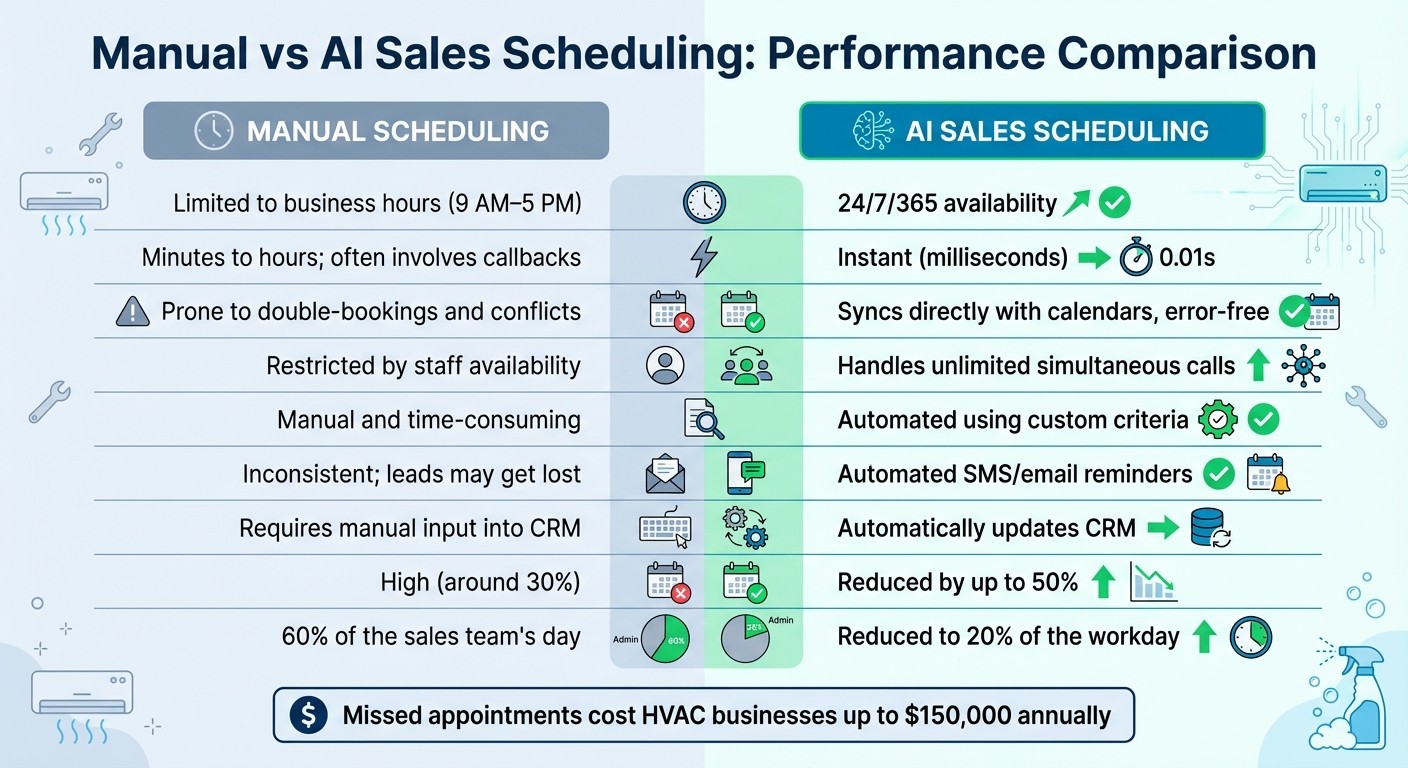
Manual vs AI Sales Scheduling: Performance Comparison for HVAC and Cleaning Businesses
Tracking performance is essential to ensure your AI scheduling system delivers on its promise of efficiency and revenue growth. Once the system is up and running, focus on metrics like appointment fill rates, reductions in no-shows, and time saved for your staff [18][3]. Consider this: missed appointments can cost an HVAC business up to $150,000 annually, while poor engagement may result in losing as much as 25% of potential sales [18].
Lead conversion rates are another key metric - the percentage of inquiries that turn into scheduled appointments. Additionally, monitor how many leads are captured after business hours [18][1]. Since 85% of callers won’t call back if they hit voicemail [9], an AI system that responds instantly (within milliseconds) can make a big difference in booking rates. Businesses using AI scheduling solutions have reported 35% fewer support tickets and a 40% reduction in email overload [19], allowing teams to focus on more strategic tasks.
From a financial perspective, keep an eye on cost per acquisition (CPA) and revenue growth. AI scheduling can reduce CPA by 31% [6], and recapturing missed calls can convert around 37% of those missed opportunities into appointments [3]. To maximize results, set up alerts for high-intent calls that don’t result in bookings, enabling your team to follow up quickly [3].
Metrics to Track
Focus on metrics that directly impact revenue and operational efficiency. For example, measure response times - AI systems respond in milliseconds compared to the minutes or hours typical of manual systems [18][1]. Automated reminders can reduce no-show rates by as much as 50% [8]. Also, evaluate the ratio of qualified to unqualified leads to ensure your technicians are dispatched only to high-value jobs [1][6].
Integration with your CRM (like ServiceTitan or HubSpot) is critical. It allows your AI system to automatically track lead sources and conversion data [18][3]. Use these insights to identify seasonal trends, such as increased demand for AC tune-ups in the spring, and adjust staffing or marketing budgets accordingly [18][6]. Regularly review AI-generated call summaries to uncover common customer questions and refine your system’s knowledge base [18][10]. Businesses adopting AI for customer interactions have seen sales increases ranging from 20% to 40% [18].
Manual vs. AI Scheduling Comparison
The advantages of AI scheduling become clear when compared to traditional methods:
Feature | Manual Scheduling | AI Sales Scheduling |
|---|---|---|
Availability | Limited to business hours (9 AM–5 PM) | |
Response Time | Minutes to hours; often involves callbacks | |
Error Rate | Prone to double-bookings and conflicts | |
Scalability | Restricted by staff availability | Handles unlimited simultaneous calls [18] |
Lead Qualification | Manual and time-consuming | |
Follow-ups | Inconsistent; leads may get lost | |
Data Entry | Requires manual input into CRM | |
No-Show Rates | High (around 30%) [8] | Reduced by up to 50% [8] |
Admin Workload | 60% of the sales team’s day [20] | Reduced to 20% of the workday [20] |
As My AI Front Desk puts it:
"Missed appointments are more than just an inconvenience; they're a direct hit to your bottom line... reaching into the tens of thousands [each year]." [18]
Ready to take your scheduling system to the next level? Up next, we’ll explore advanced strategies to optimize AI scheduling for HVAC and cleaning businesses.
Advanced AI Sales Scheduling Techniques
Elevate your scheduling game with AI-driven personalization, automation, and smart resource allocation. These advanced techniques go beyond basic scheduling to enhance customer satisfaction and streamline operations.
Personalized Appointment Recommendations
AI has taken scheduling to a new level by tailoring appointments based on customer history and urgency. For example, if a customer had their AC serviced last March, the system might suggest a spring tune-up this year to avoid the summer rush [4][21]. These tools also analyze technician skills, past performance, and real-time traffic conditions to assign the best appointment windows. The result? Businesses report sales increases of 20%–40% [3][4][8][21].
By leveraging natural language processing, AI can even detect urgency. For instance, if a customer mentions a "broken heater", the system identifies the issue and offers emergency slots [1][8]. This level of contextual understanding creates a seamless, personalized experience without requiring extra effort from your team.
Automated Rescheduling and Service Reminders
Modern AI systems simplify rescheduling through conversational tools like SMS, WhatsApp, email, and phone - available 24/7 [9][11][22]. A customer can text, "I need to move my Tuesday appointment", and the AI will check the calendar, suggest new time slots, and update the CRM instantly [4][9].
Automated reminders sent 24 hours and just hours before appointments can cut no-show rates by up to 50% [4][8]. This is a game-changer, considering that missed appointments cost the average HVAC company around $150,000 annually [4][8].
AI also boosts repeat business with seasonal reminders. By segmenting customers based on equipment type and service history, it sends targeted messages like, "Hi Mike, time for your fall furnace check?" [11][21]. With 75% of HVAC customers preferring online booking [11], these tools make it easier to keep schedules full year-round. Efficient rescheduling also lays the groundwork for managing complex, multi-technician operations effortlessly.
Managing Multiple Technicians with AI
Coordinating multiple crews used to be a logistical headache, but AI has made it simple. Jobs are now assigned automatically based on skills, location, and availability [23][24]. For example, if a commercial HVAC system needs a certified specialist, the system ensures the right technician is assigned, reducing follow-up visits and improving customer satisfaction [23][24].
Real-time route optimization is another game-changer. AI calculates the most efficient travel paths using GPS data, live traffic updates, and job urgency. HVAC companies using these tools report a 30% drop in emergency calls and a 20% improvement in service completion times [26]. On average, service professionals see their monthly revenue increase by more than 35% within the first year of adopting AI scheduling [23].
When cancellations happen, the AI instantly fills gaps by notifying waitlisted customers [25]. It also manages buffer times to account for travel and unexpected delays [27]. For critical situations, like a hospital HVAC failure, the system prioritizes emergency calls over routine maintenance automatically [23][28].
Color-coded calendars give dispatchers a clear visual of job types and urgency, while mobile apps keep technicians updated on any schedule changes in real time [27]. Starting with simple features like automated reminders and gradually adopting advanced tools like multi-technician route optimization can help your team adapt smoothly [26].
Conclusion
AI scheduling has become a game-changer for HVAC and cleaning businesses, tackling the critical issues of missed calls and inefficiencies that plague daily operations. Companies using these systems have reported impressive results: sales growth between 20% and 40%, a reduction in no-show rates by up to 50%, and savings of around $150,000 annually from missed appointments[4][8]. Considering that 85% of callers won’t call back after hitting voicemail[9], and leads are 900% more likely to engage if contacted within five minutes[29], every missed call represents a missed revenue opportunity.
To get started, zero in on your biggest scheduling challenge. Whether it’s handling after-hours inquiries, reducing no-shows, or managing technician assignments, prioritize that pain point and implement AI as the solution. Look for tools that sync effortlessly with your existing CRM and calendar systems to ensure a smooth transition.
There are plenty of success stories that highlight the potential of AI scheduling. For instance, Comfort Masters saw a 25% increase in booked service calls, while McCormick Heating and Cooling experienced an 80% boost in revenue by integrating AI strategically into their operations[4][5]. These examples demonstrate just how impactful this technology can be.
For local service businesses aiming to streamline their scheduling and lead management, Cohesive AI (https://getcohesiveai.com) offers a comprehensive solution to ensure no lead slips through the cracks.
With the U.S. HVAC market expected to hit $268.22 billion by 2034[1], the question is no longer if AI scheduling is worth adopting - but whether you’ll do it before your competition does. Capturing every lead and eliminating scheduling errors could be the edge your business needs to thrive.
FAQs
How can AI help HVAC and cleaning businesses improve response times and boost bookings?
AI-powered scheduling tools function like a round-the-clock virtual assistant, handling inquiries, qualifying leads, and booking appointments instantly. This automation removes the frustrating delays that might otherwise push potential customers toward competitors.
With these tools, response times shrink from hours to mere seconds, keeping leads engaged right away. They can also confirm appointments, send timely reminders, and sync with real-time availability, cutting down on no-shows and filling open slots seamlessly. This efficient approach can boost booking rates by over 40%, helping HVAC and cleaning businesses run more smoothly while driving up revenue.
How can HVAC and cleaning businesses set up an AI sales scheduling system?
Setting up an AI-powered sales scheduling system for HVAC or cleaning businesses can simplify your operations and save valuable time. Start by choosing a scheduling tool that works seamlessly with your business calendar and CRM. Look for one that supports multiple communication channels - like phone, SMS, and web - and includes features such as smart reminders to cut down on no-shows.
Once you’ve selected your tool, set up your scheduling workflow. Define the types of appointments you offer, their durations, and any pre-qualification questions you need to ask upfront. Sync the system with your calendar to avoid double bookings, and configure automated confirmations and reminders for your customers. Before fully rolling it out, test the entire process to ensure everything runs smoothly. Keep an eye on performance metrics like the number of booked meetings and no-show rates, and make adjustments as needed.
Automating your scheduling process not only reduces manual work and errors but also frees up your team to focus on turning leads into loyal customers.
How can AI reduce missed appointments and improve technician scheduling?
AI takes the hassle out of scheduling by handling automated confirmations and reminders for customers. This not only cuts down on no-shows but also keeps everyone on the same page. Plus, with real-time calendar updates and instant rescheduling options, managing appointments becomes smooth and stress-free.
For HVAC and cleaning businesses, AI goes a step further by matching technicians with the right jobs and fine-tuning routes. This smart allocation of resources boosts efficiency and keeps operations running like clockwork.