How AI Simplifies Government Filings Data Extraction
Dec 12, 2025

Government filings are a treasure trove of information for local service businesses like HVAC contractors, cleaning companies, and landscapers. These public records - covering business registrations, permits, and licenses - can pinpoint potential clients before competitors even notice. However, manually sifting through these records is slow and error-prone. That’s where AI comes in.
Key Takeaways:
AI tools like OCR and NLP can extract, organize, and validate data from filings in seconds.
Local businesses benefit by identifying leads early, such as new offices or contractors, and automating outreach.
Examples: A janitorial company used AI to find 300 new offices in one quarter, securing $40,000 in contracts while saving hours of manual work.
How I Automate Any PDF File By Extracting Text With AI
Types of Government Filings for Lead Generation
Local service businesses can tap into three main types of government filings to generate leads: business registrations, licenses and permits, and procurement listings. Each provides unique insights into businesses at various stages of operation.
Business Registrations and Incorporations
State registries are a treasure trove of real-time business activity. When a company files for incorporation or registers as an LLC, it creates public records that include details like the business name, owner or agent, address, industry classification (NAICS codes), and incorporation date. For instance, Delaware manages over 1 million active entities, updating its data daily [1]. With AI tools, these records can be scanned quickly for actionable insights, allowing businesses to act fast.
This is particularly valuable for service providers like HVAC companies or janitorial services, as new registrations often signal immediate needs. State portals like California BizFile or New York's Corporation and Business Entity Database allow users to filter by industry - such as "restaurants" for catering companies - helping them reach out to potential clients before competitors do [6].
Licenses and Permits
Professional licenses and building permits offer a glimpse into ongoing business activities. State licensing boards issue credentials for professions like contractors and HVAC technicians, while city and county offices manage building permits. These records typically include names, addresses, project details, and timelines. For example, a building permit for a commercial office remodel might indicate an upcoming need for landscaping services.
AI-powered tools can monitor these updates automatically, ensuring businesses never miss a lead. Platforms like BuildZoom aggregate permit data, while local resources like Chicago's Building Permits portal allow users to filter projects by type, making it easier to identify relevant opportunities [3].
Procurement and Vendor Listings
Government procurement sites, such as SAM.gov (System for Award Management), list businesses already working with federal, state, or local agencies. These listings often include vendor names, contract values, service categories, and contact details. SAM.gov alone features over 100,000 active vendors annually, many of them small businesses open to partnerships [2].
For example, a catering company might analyze vendor rosters to find event management contracts, identifying office buildings that could require ongoing food services. Similarly, business brokers might target janitorial subcontractors working with awarded vendors. Contracts exceeding $50,000 can signal businesses with budgets for additional services. State-specific platforms like California's Cal eProcure offer similar insights at the local level [2].
Setting Up an AI-Powered Data Extraction Workflow
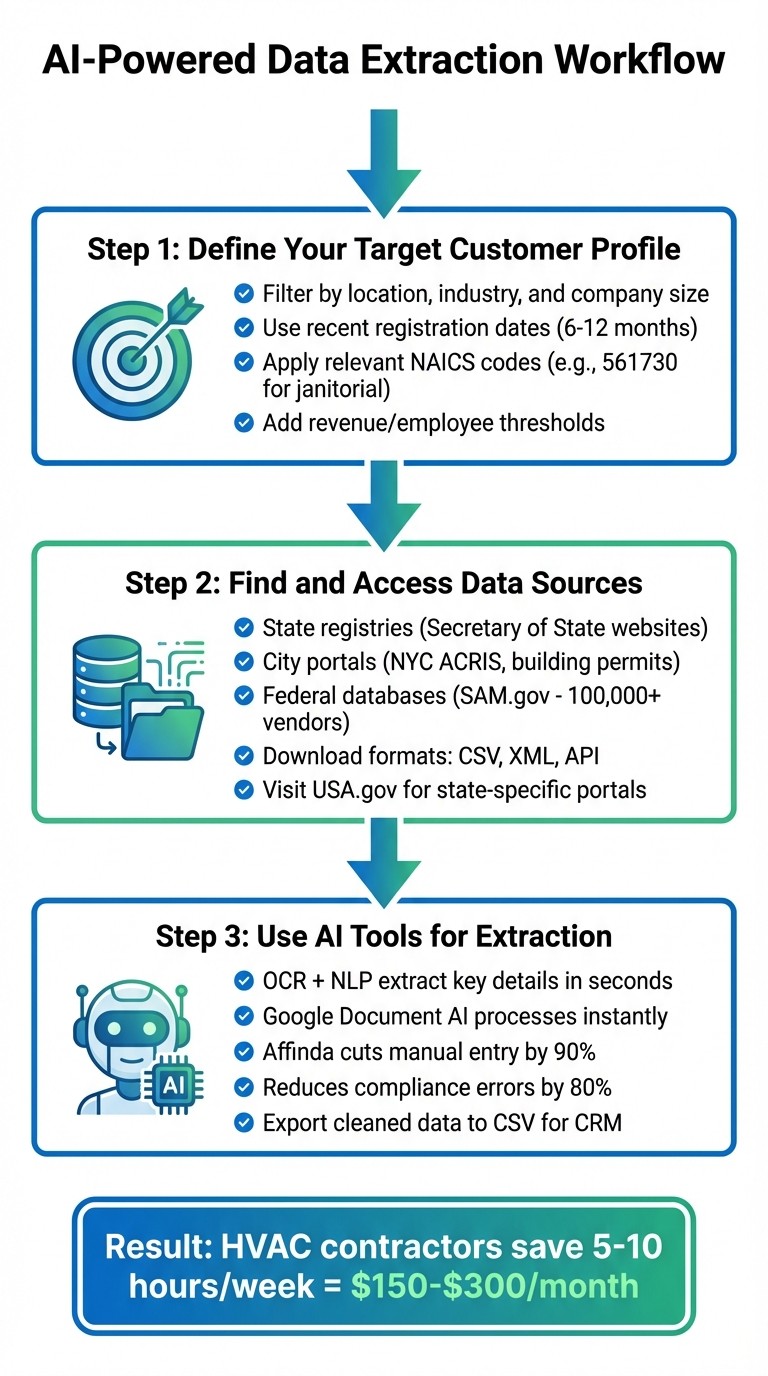
AI-Powered Government Filings Data Extraction Workflow for Lead Generation
Creating an efficient AI-driven workflow begins with a clear understanding of your audience, where to locate relevant data, and how to process it effectively. This process involves three key steps that turn raw government filings into actionable business opportunities.
Define Your Target Customer Profile
Start by narrowing down your focus using criteria like location, industry, and company size. For example, you can target businesses by filtering filings based on recent registration dates (within the past 6–12 months) and applying relevant NAICS codes. If you're looking to connect with janitorial services, for instance, you'd use NAICS code 561730. Adding revenue or employee thresholds can further refine your search, helping you zero in on smaller businesses that are more likely to benefit from your services.
Find and Access Data Sources
Government data in the U.S. is widely available through state registries, city portals, and federal databases. Begin with your state's Secretary of State website - California’s bizfile.sos.ca.gov for business registrations or Texas Comptroller’s site for reports that include owner contact details. At the city level, platforms like NYC’s ACRIS provide access to business license information, while federal platforms such as SAM.gov list vendors. Many of these portals allow for free public searches and offer data downloads in formats like CSV or XML, with some even supporting batch processing through APIs. To streamline your search, visit USA.gov’s business section for quick access to state-specific portals. Regularly downloading data ensures you stay updated with the latest filings. Once you’ve gathered your data, the next step is to transform it into structured information using AI tools.
Use AI Tools for Extraction and Normalization
AI tools like OCR (Optical Character Recognition) and NLP (Natural Language Processing) can quickly transform unstructured filings into organized, usable data. These tools can extract key details, such as owner names, addresses, and filing dates. For instance, Google Document AI processes filings in seconds without requiring any prior training, while platforms like Affinda have been shown to cut manual data entry by 90% and reduce compliance errors by 80% when managing large document volumes [3][7]. After extracting the data, machine learning models can standardize formats, such as dates and currency, and eliminate duplicates. Simply upload your filings to tools like Affinda or Google Document AI, define the fields you want to extract using natural language prompts, and export the cleaned data to a CSV file for seamless CRM integration. Platforms like Cohesive AI can further automate the workflow by combining government filings with Google Maps data, enabling precise and targeted outreach efforts.
Converting Extracted Data Into Leads
Turn structured filings into actionable sales leads by adding contact details, ranking prospects, and enabling tailored outreach.
Enrich and Score Leads
AI-powered enrichment tools can take your extracted filings and cross-check them with external databases to fill in missing information like email addresses, phone numbers, and owner names. For instance, StateCover Mutual utilized Affinda AI to cut down manual data entry by 90% while maintaining an impressive 99% accuracy rate [3].
Once enriched, AI scoring models can help rank these leads based on factors like recency, business size, and proximity. For example, a newly licensed HVAC contractor in your service area would score higher than an established business located 50 miles away. You can customize your scoring criteria - for instance, assigning 40% weight to recency, 30% to business fit, and 30% to filing type - to create a 1-100 scale that prioritizes the most promising prospects. In 2024, Daloopa's AI showcased this by extracting data from SEC 10-K/10-Q filings, slashing manual analysis time from hours to minutes, and auto-updating Excel models with custom schemas for enterprise lead scoring [9]. This streamlined process ensures your data is ready for precise, compliant outreach.
Personalize Outreach with AI
AI tools can craft highly personalized messages by embedding details from filings into email templates. For instance: "Congratulations on earning your new HVAC license in Austin! Our maintenance packages are designed to help you build strong client relationships quickly." These tools pull specific details - like business names, permit types, and locations - directly from the extracted data to tailor outreach to the recipient’s situation.
To ensure compliance with U.S. email laws under the CAN-SPAM Act, AI tools can automatically add essential elements like honest subject lines, a physical mailing address, clear sender identification, and a valid opt-out link. Platforms such as Cohesive AI use government filings to generate compliant, personalized emails for local businesses, automating campaigns while adhering to FTC guidelines. For $500/month, their Base Plan includes fully managed email deliverability and guarantees at least four interested responses per month [8].
Add Leads to Your CRM
Once your leads are enriched, scored, and personalized, the next step is to seamlessly integrate them into your CRM. Export the data in U.S.-formatted CSV or JSON files with standardized fields - such as business name, owner, filing date, score, and contact details - ensuring formats like MM/DD/YYYY for dates and $ for currency are used. Map key fields, including filing ID, score, and filing type, to your CRM for effective tracking and prioritization.
Leverage no-code tools like Zapier or Power Automate to directly funnel leads into platforms like Salesforce or HubSpot. Automated integrations simplify the process, enabling direct uploads to your CRM. Set up workflows to trigger immediate follow-ups for high-priority leads while nurturing lower-priority ones over time. To refine your targeting, tag leads by source (e.g., “Business Registration” or “Permit Filing”) and segment them by industry, such as janitorial, landscaping, or HVAC, to monitor conversion rates and optimize your approach.
Maintaining Quality and Compliance
When leveraging automated extraction and CRM integration, keeping quality and compliance in check is essential for effective lead generation. Regular quality checks and performance adjustments are key to ensuring accuracy and adhering to legal standards.
Verify Data Accuracy and Quality
Validation checks are your first line of defense against errors sneaking into your CRM. Set up rules to confirm the correct format for U.S. phone numbers, ZIP codes, and email addresses. Use cross-field logic to flag improbable data - like future business start dates or expired licenses marked as active. Also, make sure critical fields such as owner names and contact details are always included.
Advanced document processing tools can help by assigning confidence scores to extracted data and flagging uncertain records for human review. Aim for high accuracy, especially on critical fields. For example, vendors specializing in government document automation often achieve over 99% field-level accuracy on well-structured forms, provided models are fine-tuned and edge cases are reviewed manually [3][4]. For local service businesses, a 95% accuracy rate on essential fields like names, addresses, and contact details is a realistic and effective target. High data accuracy not only boosts operational efficiency but also ensures compliance with legal requirements.
Follow Legal and Ethical Standards
Even though public filings are accessible records, their use must comply with U.S. marketing and privacy laws. For email outreach, adhere to CAN-SPAM regulations: use truthful subject lines, include your physical mailing address, clearly identify the sender, and provide an opt-out option.
Configure AI tools to detect and exclude sensitive personal information, such as Social Security numbers or health-related data, which might occasionally appear in filings. Many government-focused platforms offer automated tools to identify and redact personally identifiable information, aiding in compliance [3][5]. Focus your data collection on business-specific details like company names, commercial addresses, professional emails, and phone numbers - information relevant to B2B outreach. Additionally, review state-specific laws regarding the commercial use of public records. Documenting your data sources, access methods, and intended uses can demonstrate good-faith compliance if questions arise. Once legal requirements are met, refine your scoring models to prioritize high-potential leads.
Adjust Filters and Scoring Models
Fine-tuning your lead scoring and filtering models is an ongoing process. Begin with a straightforward scoring system that assigns points based on key attributes visible in filings - such as recent filing dates, relevant NAICS codes, proximity to your service area, and license types that align with your ideal customer profile. For instance, a newly licensed HVAC contractor within 15 miles might score higher than an established business located 40 miles away.
Track how leads perform in your outreach campaigns and use this data to improve your scoring criteria. For example, analyze which filing types, business categories, and geographic areas yield the best open, reply, and conversion rates. Adjust filters and scoring weights as needed to focus on the most promising leads. Regular performance reviews - whether monthly or quarterly - can help you compare different lead cohorts and refine your rules effectively. This continuous feedback loop ensures your AI system remains targeted and efficient. Tools like Cohesive AI provide integrated data extraction and agile filter adjustments to maintain quality and compliance throughout the lead generation process.
Conclusion
AI-powered extraction has turned government filings into a reliable source of leads for local service businesses. By automating tasks like document classification, data extraction, and validation, an HVAC contractor can now wrap up work in under 30 minutes - a task that used to take 5–10 hours each week. This translates to saving about $150–$300 per month, freeing up time and money for more sales calls and service visits.
But the real game-changer lies in lead quality and precision targeting. Government filings, such as new business registrations, occupancy permits, and contractor licenses, are goldmines for identifying buyers with immediate needs. AI tools allow businesses to filter these records by ZIP code, business type, or permit category. For example, a janitorial company can pinpoint new offices that meet specific size criteria in targeted metro areas. This level of accuracy outshines generic directory lists, which often include outdated or irrelevant contacts.
Platforms like Cohesive AI make this process even more efficient by streamlining data extraction and personalized outreach. Take the case of a small commercial cleaning company in Texas: by leveraging AI-powered extraction, they identified over 300 newly opened offices in just one quarter. With targeted outreach, they secured $40,000 in new annual contracts - all while reducing their weekly list-building time from six hours to under 45 minutes.
Automation fuels scalability. Once your extraction models and business rules are set up, processing 500 filings a week isn’t much different from handling 5,000 - it mainly increases computational needs, not manual labor. Pair this with tools for automated lead scoring, campaign management, and CRM integration, and you’re ready to expand into new counties or states without bloating your sales team. This seamless integration between data extraction and lead management lays the groundwork for steady, scalable growth. With proper validation, legal safeguards, and ethical considerations in place, AI becomes a powerful tool for driving predictable revenue year after year.
Want to see these benefits firsthand? Start with a 30-day pilot program: focus on one county’s new business registrations, define your ideal customer profile, use an AI tool to extract and filter leads, and launch a targeted email campaign to 50–100 contacts. Track responses, meetings, and conversions to measure time savings and revenue growth before scaling up.
FAQs
How does AI make data extraction from government filings more accurate and efficient?
AI brings a new level of precision and speed to extracting data from government filings. By automating repetitive tasks, it reduces the chances of human error and ensures consistent, dependable results. Advanced algorithms can swiftly pinpoint and pull out specific data points, making the process both accurate and efficient.
This streamlined approach doesn’t just save time - it frees up resources for businesses to dive deeper into the data. Instead of getting bogged down in manual extraction, teams can focus on analyzing the information to uncover trends, spot opportunities, or even identify potential leads.
How does AI help local service businesses generate leads more effectively?
AI simplifies lead generation for local service businesses by taking over tedious tasks such as pulling data from government records and creating tailored outreach emails. It also handles email campaigns, enabling businesses to reach potential clients more strategically and with less effort.
This efficiency not only saves time and cuts expenses but also improves the quality of leads. For businesses like janitorial services, landscaping, and HVAC companies, this means a smoother path to growth and better opportunities to expand their client base.
How can businesses stay compliant when using AI for data extraction and outreach?
To stay within the bounds of data privacy laws like GDPR and CCPA, businesses must secure proper consent before collecting or using any personal information. This ensures compliance and builds trust with users. Additionally, selecting AI tools that emphasize privacy protections and secure data management is a smart move.
It's equally important to routinely review and update your policies to keep pace with changing regulations. Doing so not only safeguards your business but also upholds ethical standards in how you approach outreach and lead generation.