AI Trends in Multi-Location Service Scaling
Oct 29, 2025

Managing services across multiple locations is tough. Every location has unique challenges - different staff, local laws, and varying customer expectations. AI is now helping businesses tackle these issues by automating tasks, centralizing operations, and improving marketing efforts.
Here’s what’s happening:
91% of consumers rely on reviews, and 65% expect fast responses, making manual processes less effective.
AI tools save time by automating lead generation, data management, and personalized outreach.
For example, AI platforms like Cohesive AI can increase lead conversion rates by 20% while cutting repetitive tasks by 30–50%.
AI-based solutions are becoming a must-have for scaling multi-location services. Platforms like Cohesive AI simplify lead generation, offer affordable pricing ($500/month), and ensure consistent performance across locations. While manual methods still work for personal connections, they’re slower, costlier, and harder to scale. AI tools offer a faster, more efficient way to grow without adding extra staff or resources.
$150M Sierra: How They Scaled 6 Locations With AI
1. Cohesive AI
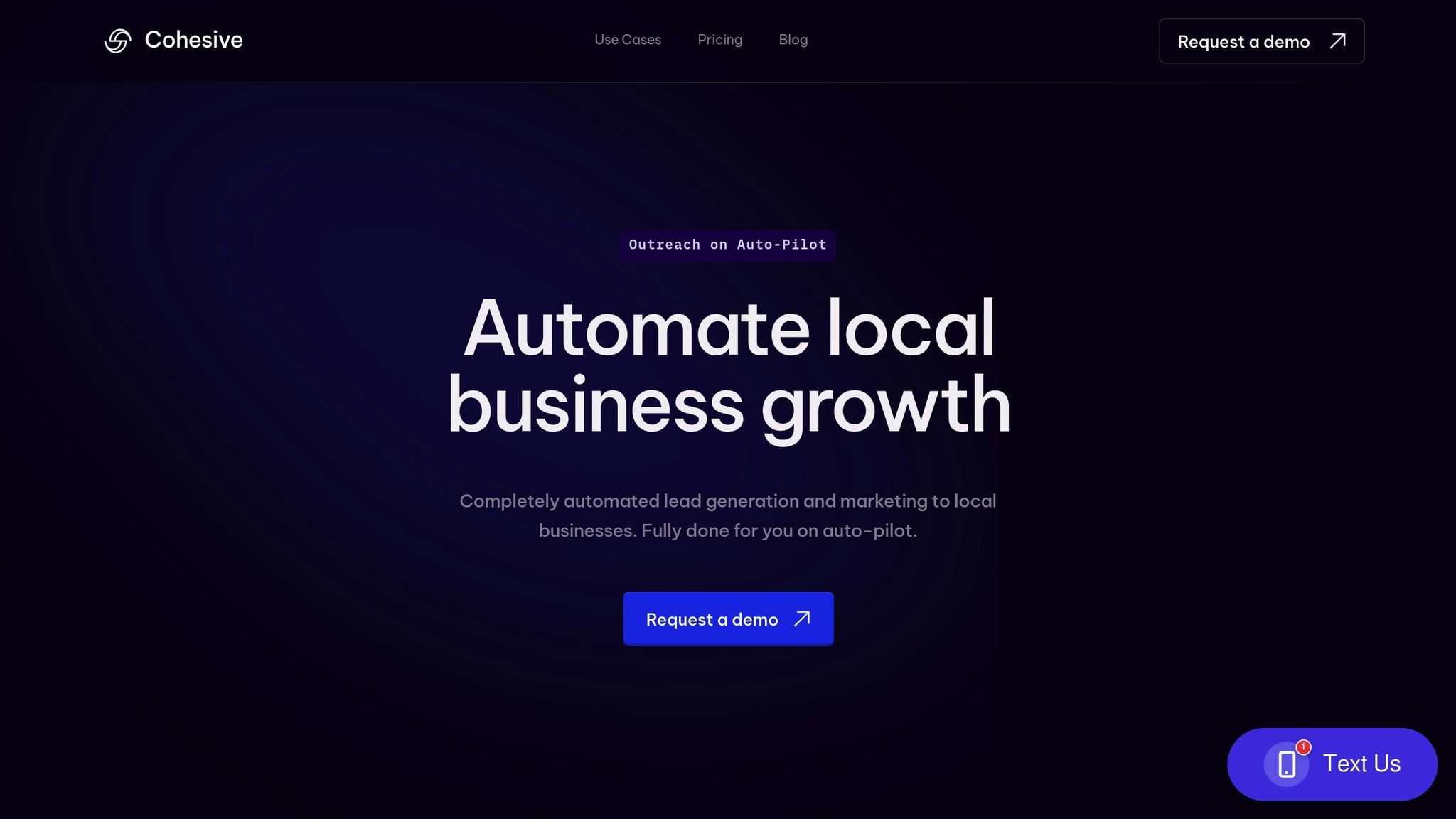
Cohesive AI is reshaping lead generation for multi-location service businesses by using advanced AI technology. It’s designed specifically for industries like janitorial services, landscaping, HVAC, catering, and business brokerage, offering a fully automated lead generation process from start to finish.
Streamlining Lead Generation
Gone are the days of manually searching for potential clients. Cohesive AI automates prospecting by pulling data from sources like Google Maps and government filings, identifying local business owners across multiple locations in one go. This means businesses can scale their outreach efforts without needing to hire additional staff.
In fact, AI agents can reduce repetitive tasks in areas like lead generation and customer service by 30–50% [2]. For businesses operating in multiple locations, this platform can manage prospecting across dozens of areas simultaneously, saving both time and effort.
What makes Cohesive AI stand out is its end-to-end automation. From identifying leads to delivering emails, the platform ensures a steady stream of potential clients for every location.
Smart Personalization
Cohesive AI takes personalization to the next level. It customizes emails based on business type, location, and owner details, making outreach feel relevant and trustworthy. This tailored approach is especially important as 73% of U.S. consumers now discover brands through social media rather than traditional search methods [1]. By combining personalization with automation, the platform not only saves costs but also enhances its appeal to diverse local markets.
Affordable Pricing
Cohesive AI operates on a straightforward pricing model: $500 per month with an additional $75 onboarding fee. This includes support for up to three active campaigns, email deliverability features, and built-in CRM integration. There are no long-term contracts, and the platform guarantees at least four interested responses per month - offering a free month if that benchmark isn’t met.
Compared to traditional lead generation agencies, this pricing structure eliminates hefty agency fees and reduces operational costs. Businesses can maintain a steady flow of leads while using their resources more efficiently.
Built for Growth
Scalability is another major advantage. Expanding into new territories or service areas doesn’t require hiring more staff or increasing resources. Cohesive AI’s automation handles data collection and outreach seamlessly across all markets, no matter how many locations are involved. Its ability to target any type of local business ensures efficient lead identification, while the centralized dashboard provides unified control over campaigns. At the same time, its personalization features allow for local adjustments, catering to the unique needs of each market.
2. Manual Lead Generation Methods
For years, traditional lead generation methods have been the backbone of many multi-location service businesses. While these approaches served their purpose in the past, they often reveal their limitations as businesses expand. These methods rely heavily on human effort and personal connections to find and engage potential customers across different markets. Compared to the efficiency of AI-driven tools, they can feel outdated and cumbersome.
Lead Generation Efficiency
Manual lead generation typically involves cold calling, door-to-door outreach, networking at local events, and researching online directories. While these strategies have their merits, they demand significant time and effort - challenges that become even more apparent as businesses grow.
Take cold calling, for example. It's one of the most widely used manual methods, yet it has an average success rate of just 2%. For businesses operating across multiple locations, this inefficiency multiplies, making it a tough strategy to sustain at scale [3].
Interestingly, over 60% of small and mid-sized local service businesses still depend on manual lead generation as their main way to attract new customers [3]. This reliance often comes down to familiarity rather than effectiveness, as many businesses stick to what they know instead of exploring newer, more efficient options.
Personalization Capabilities
One undeniable strength of manual methods is their ability to deliver personalized, high-touch outreach. When a salesperson meets a potential client face-to-face or makes a targeted phone call, they can adapt their message based on the situation and the immediate feedback they receive.
This personalized approach can help build trust with potential customers. However, it comes at a cost. The time and effort required for each interaction make it difficult to scale this strategy across multiple locations. For businesses with several branches, ensuring consistent personalization across all markets becomes a logistical and resource-intensive challenge.
Cost Effectiveness
The financial burden of manual lead generation becomes more evident as businesses expand. On average, generating leads manually can cost anywhere from $50 to $200 per lead, not including additional expenses like travel, printed materials, and hourly labor fees [3]. These costs can quickly add up when operating in multiple locations.
Beyond the direct expenses, there are also hidden costs to consider. When staff spend hours researching prospects or attending networking events, they’re not focusing on other revenue-generating activities. This lost productivity can have a ripple effect, especially when multiplied across several locations.
Scalability
Scaling manual lead generation is where this approach faces its biggest hurdles. Expanding into a new market means hiring more staff, gaining local market insights, and building relationships from scratch - tasks that are both time-consuming and resource-heavy.
Another challenge is inconsistent lead quality. Different locations may vary in their ability to generate leads due to differences in expertise, commitment, or local market conditions. While one branch might excel, another might struggle, leading to uneven growth across the business.
Manual methods also make it harder to maintain centralized oversight. Without a unified approach, businesses often encounter duplicated efforts and inconsistent results.
As consumer preferences shift toward faster, digital-first interactions, manual strategies have a hard time keeping up. What worked in a single local market may not translate well to a broader, multi-location operation. The need for speed and consistency in today’s competitive landscape highlights the inefficiencies of traditional methods, setting the stage for a comparison with AI-powered solutions in the next section.
Pros and Cons Comparison
When it comes to lead generation methods, each approach brings its own set of strengths and challenges, especially when scaling across different markets. With the rise of AI adoption in multi-location operations, businesses are increasingly weighing the pros and cons of traditional methods versus AI-driven solutions. Here's an overview of how these approaches stack up.
AI-driven tools, such as Cohesive AI, shine in areas where speed, consistency, and automation are critical. For example, Cohesive AI can scrape data from sources like Google Maps and government filings to generate personalized outreach campaigns - a stark contrast to the manual, time-consuming processes of traditional methods.
On the other hand, traditional methods still hold value for their ability to provide personal insights and build strong, localized relationships. However, they tend to be slower, require more resources, and come with variable costs that can complicate budgeting.
Cohesive AI offers a transparent pricing model at $500 per month, which includes a minimum of four monthly responses. This fixed cost simplifies budgeting and eliminates the unpredictability often associated with manual methods. Additionally, by automating repetitive tasks, AI solutions can reduce workloads by 30–50%, enabling teams to focus on strategic initiatives [2]. This efficiency becomes even more critical as businesses expand into new markets.
Criteria | Cohesive AI | Traditional Methods |
|---|---|---|
Lead Generation Efficiency | Automated, fast, precise local targeting | Manual, slower, less targeted |
Personalization Capabilities | AI-driven, highly tailored messaging | Limited customization, generic outreach |
Cost Effectiveness | Predictable $500/month with measurable ROI | Variable costs, less predictable ROI |
Scalability | Easily scales across multiple locations | Requires more staff and resources per location |
Brand Consistency | Centralized control ensures uniform messaging | Prone to inconsistencies |
Data-Driven Insights | Real-time analytics and performance tracking | Slower, manual data analysis |
Resource Allocation | Frees up staff for strategic tasks | High labor demand, less efficient |
Campaign Management | Can handle up to 3 automated campaigns at once | Managed manually, location by location |
Traditional methods often require a significant increase in staffing, training, and localized market development as businesses grow. In contrast, AI platforms maintain consistent operational costs whether targeting one city or fifty, making them a strategic choice for scaling efficiently.
That said, AI solutions do have their limitations. They depend heavily on the quality of the data they process and might miss subtle local nuances that a seasoned sales professional would catch. Over-automation also runs the risk of creating interactions that feel impersonal - something that can be a dealbreaker in industries where relationships are key.
Traditional methods still excel in situations where personal connections and deep local knowledge are essential. Face-to-face networking and personalized phone calls can foster stronger relationships, especially in markets where digital tools are less widely used.
Interestingly, with 73% of consumers now discovering brands through social media rather than traditional search, modern businesses are finding that AI-driven solutions are better equipped to manage social media campaigns and automate responses across platforms [1].
Conclusion
AI solutions have proven to be a game-changer for scaling multi-location services, leaving manual lead generation methods in the dust. Tools like Cohesive AI mark a major shift in how businesses manage lead generation and expand across different markets.
Relying solely on manual techniques could leave businesses struggling to keep up as automation becomes the standard. Cohesive AI, in particular, stands out with its straightforward pricing - $500 per month - for at least four qualified responses monthly, offering a clear alternative to the time and resource demands of traditional methods.
What sets AI apart is its scalability. While manual approaches require more staff as you expand, AI operates just as efficiently whether you're targeting a single city or dozens. This allows business owners to concentrate on delivering top-notch services instead of getting bogged down in lead management.
With the growing need for seamless multi-platform engagement and fast customer responses, AI is becoming indispensable. Platforms like Cohesive AI are paving the way for businesses to ensure steady growth and maintain strong customer connections across all locations.
FAQs
How does Cohesive AI improve lead generation for multi-location service businesses?
Cohesive AI takes the hassle out of lead generation for local service businesses by automating essential tasks. It pinpoints potential leads by gathering data from sources like Google Maps and relevant government filings. Then, it leverages AI to create personalized cold emails designed to engage local business owners. On top of that, it handles email campaigns to maintain consistent communication, making it easier for businesses to connect with suitable leads.
This automation replaces the need for traditional lead generation agencies, saving both time and money. Industries such as janitorial services, landscaping, HVAC, and catering can especially benefit from this streamlined approach, allowing them to focus on growing their businesses.
What does it cost to use Cohesive AI for lead generation, and how does it deliver a strong return on investment?
Cohesive AI offers a straightforward, month-to-month pricing model with no long-term commitments. This setup gives businesses the flexibility to ramp up their lead generation efforts without the stress of being tied to extended contracts.
The platform takes the hassle out of traditional lead generation by automating the entire process. Instead of relying on expensive agencies or time-consuming manual outreach, Cohesive AI uses advanced tools to save time and cut costs. It identifies high-quality leads, customizes outreach strategies, and optimizes email campaigns to help businesses connect with the right prospects quickly and effectively - all while ensuring a measurable return on investment.
How does Cohesive AI deliver personalized outreach while supporting scalability for multi-location businesses?
Cohesive AI uses cutting-edge artificial intelligence to create customized cold emails specifically designed for local business owners. Each email is carefully crafted to feel relevant and engaging, helping businesses make stronger connections. By automating the management of email campaigns, it simplifies outreach while maintaining a personal touch. This makes it easier for businesses to scale their efforts across multiple locations. Instead of relying on outdated lead generation methods, this approach helps target industries like janitorial services, landscaping, and HVAC with greater precision and efficiency.