AI vs. Manual Personalization in Geo-Targeted Emails
Aug 19, 2025
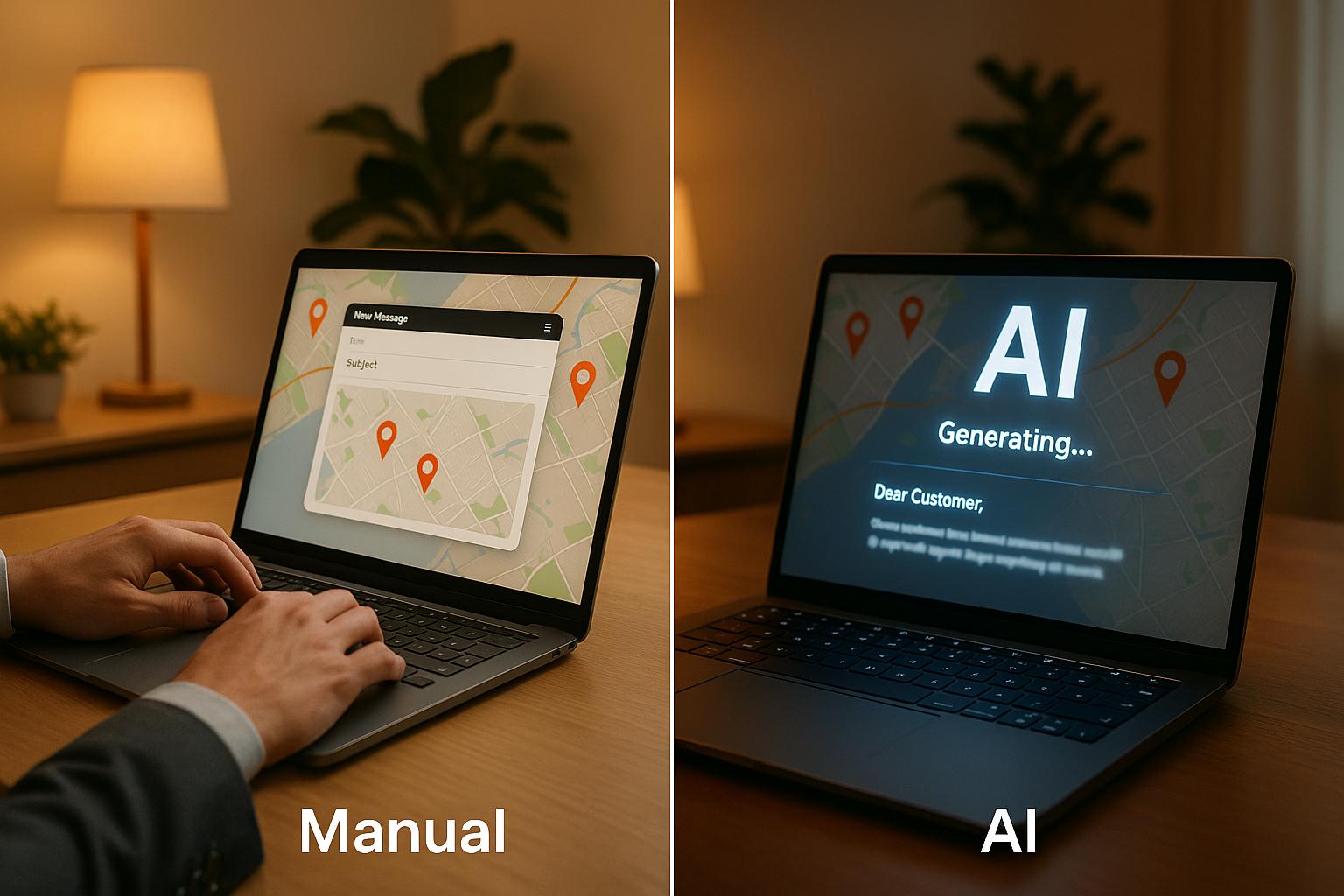
Geo-targeted email campaigns can help local service businesses connect with customers by tailoring messages to specific regions. The big question? Should you rely on AI-driven automation or manual personalization to craft these emails.
Here’s the short answer:
AI-driven personalization saves time, scales easily, and ensures consistent messaging across large audiences. It’s ideal for businesses expanding into multiple regions or handling high volumes.
Manual personalization offers a more customized touch, making it better for niche markets or industries requiring deep local knowledge. However, it’s time-intensive and harder to scale.
Key Takeaways:
AI uses data like weather, local trends, and customer behavior to quickly create targeted emails.
Manual methods rely on human insight to craft highly specific, locally relevant messages.
AI is better for efficiency and growth; manual works for precision and smaller campaigns.
A hybrid approach can combine the strengths of both.
Quick Comparison:
Factor | AI-Driven Personalization | Manual Personalization |
|---|---|---|
Scalability | Handles large volumes easily | Limited by time and resources |
Speed | Quick campaign setup | Slower due to manual effort |
Cost | Higher upfront, lower long-term | Labor-intensive, scales poorly |
Precision | Data-driven, may miss nuances | Captures specific local details |
Choosing the right method depends on your business size, resources, and goals. For rapid growth, AI is the clear choice. For smaller, specialized markets, manual might be the way to go.
How to Create Personalized Email Campaigns with AI-Powered Automation
AI-Driven Personalization in Geo-Targeted Emails
AI-driven personalization takes the hassle out of creating tailored messages for local service businesses. Instead of manually crafting emails for each location, AI processes relevant data to generate targeted campaigns. This approach is a game changer for businesses operating in multiple regions, allowing them to expand their reach without adding to their workload.
How AI Personalization Works
Cohesive AI simplifies the personalization process by automating data collection. It pulls information from sources like Google Maps and government filings to identify local leads. This automation replaces the traditionally tedious process of manual prospecting. Once the leads are gathered, intelligent algorithms create personalized cold emails that speak directly to the unique needs of each prospect.
Benefits of AI-Driven Personalization
One of the standout benefits of AI-driven personalization is how easily it scales. Local service businesses can run customized campaigns across multiple regions with minimal effort. This automation not only saves time but also ensures a consistent brand voice in all communications. Plus, the system generates valuable insights that help fine-tune messaging and boost campaign performance over time. These efficiencies make it easier to explore manual personalization methods in future campaigns.
Cohesive AI as a Solution
Cohesive AI tackles the common challenges of lead generation and email personalization for local service providers. By automating lead identification, it removes the need for manual prospecting. The platform’s AI creates messages that reference specific local details, ensuring relevance and better engagement.
What’s more, Cohesive AI allows businesses to run up to three campaigns at once, making it simple to test different outreach strategies without disrupting day-to-day operations. The pricing is straightforward: $500 per month with a $75 setup fee, on a month-to-month subscription with no long-term commitments. And here’s the kicker - if you don’t get at least four interested responses per month, they’ll credit you a free month.
Manual Personalization in Geo-Targeted Emails
Manual personalization relies on human effort and insight to create email campaigns tailored to specific local audiences. Unlike automated methods, this approach involves hands-on research, segmentation, and message creation, giving you full control over every detail of your outreach. While it demands more time and resources, it offers a level of precision and nuance that algorithms often can't match. Let’s dive into how this process works and weigh its strengths and challenges.
How Manual Personalization Works
The process begins with detailed research into local businesses, market trends, and unique regional factors. Prospects are then segmented based on these insights, and emails are crafted to include references that resonate with the local audience. For example, a heating and cooling company might create separate messages for customers in hot, arid climates versus those in areas with harsh winters.
Each email is written individually or in small batches, incorporating specific local details. A landscaping company, for instance, might mention drought conditions when addressing prospects in California, while focusing on snow removal services for contacts in Colorado.
Timing also plays a critical role. Emails are scheduled to align with local business hours or significant regional events. Unlike automated tools, this approach relies on human judgment to identify and leverage subtle local insights.
Strengths of Manual Personalization
One of the biggest advantages of manual personalization is its ability to capture local subtleties and references that automated systems might overlook. Every message is carefully reviewed, ensuring it aligns with local contexts and resonates with the audience.
This method shines in highly specialized or niche scenarios. For example, industries with complex regulations or unique local challenges benefit from the human ability to interpret nuanced factors that algorithms may miss.
Manual personalization also offers flexibility. If a significant local event occurs or market conditions change suddenly, your team can quickly adjust messaging without waiting for an automated system to catch up.
Challenges and Limitations
Despite its benefits, manual personalization comes with several challenges. It is labor-intensive and becomes increasingly difficult to scale as your target audience grows. Reaching a larger audience using this method can quickly become impractical.
There’s also the risk of inconsistent quality. When multiple team members handle different parts of a campaign, variations in research depth or writing style can result in uneven messaging and a fragmented brand voice.
Human error is another concern. Mistakes in names, local details, or company information can hurt your credibility and reduce response rates.
Finally, the cost is higher compared to automated methods. Skilled staff, extensive research, and time-intensive message creation all add up, especially as campaigns expand. These factors often push businesses to consider automation, which we’ll explore in the following section.
AI vs. Manual Personalization Comparison
Geo-targeted email campaigns thrive when they’re tailored to the audience. Building on earlier personalization techniques, this section compares AI-driven and manual personalization to help you decide which approach fits your business needs. Each method has its strengths and trade-offs, so understanding these differences is key.
Key Comparison Factors
Here’s a closer look at how AI and manual personalization stack up across several performance factors for local service businesses:
Factor | AI-Driven Personalization | Manual Personalization |
|---|---|---|
Scalability | Handles large volumes effortlessly with minimal effort | Limited by human resources, making scaling difficult |
Efficiency | Produces personalized emails quickly and at scale | Becomes slower as the campaign size increases |
Personalization Depth | Consistently data-driven but may overlook subtle local nuances | Captures local and cultural subtleties more effectively |
Real-Time Adaptation | Adjusts messaging dynamically based on new data | Requires manual updates and monitoring |
Resource Requirements | Higher upfront tech investment but lower long-term costs | Lower initial costs but increasing labor expenses as campaigns grow |
Impact on Engagement | Ensures steady engagement through optimization | Results depend heavily on team expertise and attention to detail |
These factors highlight not just performance differences but also cost implications. AI systems typically involve a higher initial investment but offer predictable and scalable costs over time. Manual personalization, on the other hand, may seem less expensive at first but becomes more costly as the workload increases.
When to Choose Each Approach
AI-driven personalization is your go-to when you need to reach a broad and diverse audience efficiently. For local service businesses expanding into new regions, AI excels at quickly adapting messages to different local contexts. It also works well for teams with limited email marketing experience, as it automates much of the process and ensures consistent results across large contact lists.
Manual personalization, however, shines in situations that demand a delicate touch. If your business involves highly specialized or sensitive relationships - where compliance or deep local knowledge is critical - this approach offers the precision you need. Boutique or premium service providers can also benefit from the handcrafted feel of manually tailored messages, reinforcing a sophisticated brand image.
For businesses with limited budgets for technology but plenty of staff time, manual personalization can be a practical starting point. Over time, as your audience grows, you can transition to AI for scalability and efficiency.
The complexity of your service area also matters. Businesses operating in regions with diverse cultural or regulatory environments may benefit from the oversight manual personalization provides. On the flip side, companies with ambitious growth plans will find AI’s scalability hard to beat.
Practical Considerations for Local Service Businesses
Choosing between AI and manual personalization is more than just a tech decision - it’s about addressing the specific challenges your business faces. Local service businesses often deal with unique hurdles that influence which approach will work best. Let’s break down the key factors and explore how these play out in different industries.
Factors Influencing the Decision
Budget constraints often dictate the initial approach. If your marketing budget is under $1,000 a month, manual personalization might seem like the logical choice. However, it’s worth considering the hidden cost: the time spent manually crafting emails or messages could be better used elsewhere.
Campaign scale is another critical factor. For smaller campaigns, manual methods might work fine. But as your business grows, the time and effort required for manual personalization can become overwhelming, leading to inconsistencies and rushed work.
Available resources go beyond money - they include your team’s expertise. If your team lacks experience in manual personalization, the learning curve can lead to mistakes and underperforming campaigns. AI can help bridge that gap by automating complex tasks.
Speed requirements can make or break your success in competitive local markets. Being the first to engage a potential customer often determines who wins the business. AI systems can launch targeted campaigns in hours, while manual approaches may take days or weeks to execute properly.
Growth trajectory should guide your long-term strategy. If you’re planning to expand from one city to several in the near future, starting with AI might save you the hassle of transitioning later. Switching methods mid-growth can be costly and disruptive.
Now, let’s see how these factors apply to specific local service industries.
Tailoring to Local Service Industries
HVAC businesses often experience seasonal spikes in demand, making quick outreach essential. For example, during extreme weather, AI can tailor messaging based on local weather data, ensuring timely communication with potential customers. In contrast, manual efforts might lag, missing these critical opportunities.
Landscaping companies face challenges tied to local conditions like climate, soil types, and regulations. While AI can integrate basic geographic data, manual personalization lets you address specific issues, like drought restrictions in California or snow removal rules in Minnesota. This hands-on approach can resonate more deeply with local clients.
Janitorial services often target specific industries or building types. AI excels at identifying patterns, such as medical facilities needing specialized cleaning or restaurants requiring daily service. On the other hand, manual personalization shines when focusing on a niche market where building personal relationships and understanding specific needs outweighs volume.
Business brokers handle high-value, trust-driven transactions. Here, the personal touch of manual outreach can make a big difference when connecting with business owners considering selling their companies. However, AI can still play a role by identifying the right prospects and providing insights into market trends and valuations.
For businesses looking to scale their outreach, platforms like Cohesive AI simplify the process by automating lead generation and personalization. At $500 per month, with a guarantee of at least four interested responses, it eliminates much of the uncertainty around ROI, a common issue with manual approaches.
Compliance is another critical factor, varying by industry and location. HVAC companies in states with strict licensing requirements must ensure their messaging reflects proper credentials. Janitorial services targeting healthcare facilities need to demonstrate knowledge of HIPAA regulations. AI systems can be programmed to address these compliance needs, but manual efforts may offer a more nuanced approach to sensitive topics.
Local market knowledge remains a powerful asset. For instance, a landscaping business owner in Phoenix might have deep insights into desert landscaping challenges that AI could overlook. However, when expanding into unfamiliar markets like Seattle or Miami, AI’s data-driven approach might provide better insights than relying solely on personal experience.
Ultimately, the choice depends on aligning your business’s current needs with its future goals. Small businesses with strong local ties and minimal growth ambitions may thrive with manual personalization. Meanwhile, businesses aiming for expansion across multiple markets or industries will likely find AI-driven solutions more scalable and efficient for the long haul.
Conclusion: Choosing the Right Approach for Your Business
Deciding between AI-driven and manual personalization comes down to what suits your business needs right now. Both methods have their merits for local service businesses, but the right choice depends on your resources, growth plans, and the demands of your industry. This decision directly shapes the success of your geo-targeted email campaigns.
Manual personalization works best in smaller, close-knit local markets where personal connections matter most. However, as your list of prospects grows, it may become too time-consuming to manage effectively.
On the other hand, AI-driven personalization shines when you need to scale quickly, break into new markets, or handle seasonal surges in demand. It ensures consistent and efficient outreach across a wider audience, making it a powerful tool for businesses aiming to expand.
Often, the best solution lies in blending both approaches. For example, you could use AI to identify prospects and handle basic personalization, then add manual touches for high-value leads. This hybrid strategy balances efficiency with the personal touch that many local businesses rely on.
Your growth timeline also plays a role in choosing the right method. If rapid expansion is on the horizon, AI can help maintain consistent execution as you scale. For slower, local growth, a more tailored manual approach may be better suited. Even a basic AI system can outperform a complex manual process if your resources are stretched too thin.
For businesses ready to explore AI-driven lead generation, tools like Cohesive AI offer an automated solution at $500 per month. With a guarantee of four interested responses, it minimizes financial risk while allowing you to scale. Plus, its month-to-month structure means you can test the waters without committing long-term.
Different industries have their own specific needs, as discussed earlier in this guide.
Ultimately, the most effective approach is the one you can execute consistently. Start with a strategy that matches your current capabilities and adjust as your business evolves. Whether you lean on AI, stick with manual efforts, or combine the two, the key is to take action now. By aligning your strategy with your goals and refining it based on market feedback, you’ll improve both your reach and your ability to connect with the right prospects.
FAQs
When should a business choose AI-driven personalization over manual methods for geo-targeted email campaigns?
AI-powered personalization shines in geo-targeted email campaigns, especially for businesses handling large-scale efforts. It uses real-time data to craft messages that are behavior-driven and tailored to diverse audiences. This approach is particularly valuable for industries dealing with vast customer data or areas where local trends shift quickly.
On the other hand, manual personalization is better suited for smaller campaigns that require deeply localized and detailed messaging. It’s a smart option when resources are tight or when the goal is to build meaningful, one-on-one connections with a specific group. Choosing between the two largely depends on the campaign’s size, the resources at hand, and the complexity of the data involved.
What challenges might arise when combining AI and manual efforts in geo-targeted email campaigns?
Using a mix of AI-powered tools and manual customization in geo-targeted email campaigns can be tricky to navigate. One major hurdle is ensuring that the AI-generated content matches your brand's voice while still feeling genuine to your audience. If this balance is off, it can damage trust and hurt engagement rates.
Another challenge lies in maintaining data quality. AI depends on precise, up-to-date information, and relying on outdated or incomplete data can result in emails that feel irrelevant or poorly timed. To avoid this, human marketers need to regularly monitor and refresh the data. On top of that, finding the right balance between automation and manual adjustments can take up a lot of time and effort, making it harder to keep campaigns consistent.
While this hybrid approach provides flexibility, it demands thorough planning and constant oversight to ensure it stays both effective and authentic.
How does using AI for geo-targeted email personalization support long-term growth compared to manual methods?
AI-powered personalization brings a whole new level of efficiency to local service businesses. It enables them to handle a growing number of customers without driving up operational costs. This means businesses can save time while maintaining consistent and top-notch personalized experiences, even as they expand.
Traditional, manual methods often struggle to keep up with increasing demand, leading to inefficiencies and mistakes. In contrast, AI evolves and fine-tunes its processes over time. By sending customized messages to the right people, businesses can strengthen customer engagement, improve loyalty, and achieve long-term growth.