How AI Improves Local Competitor Research
Jul 29, 2025
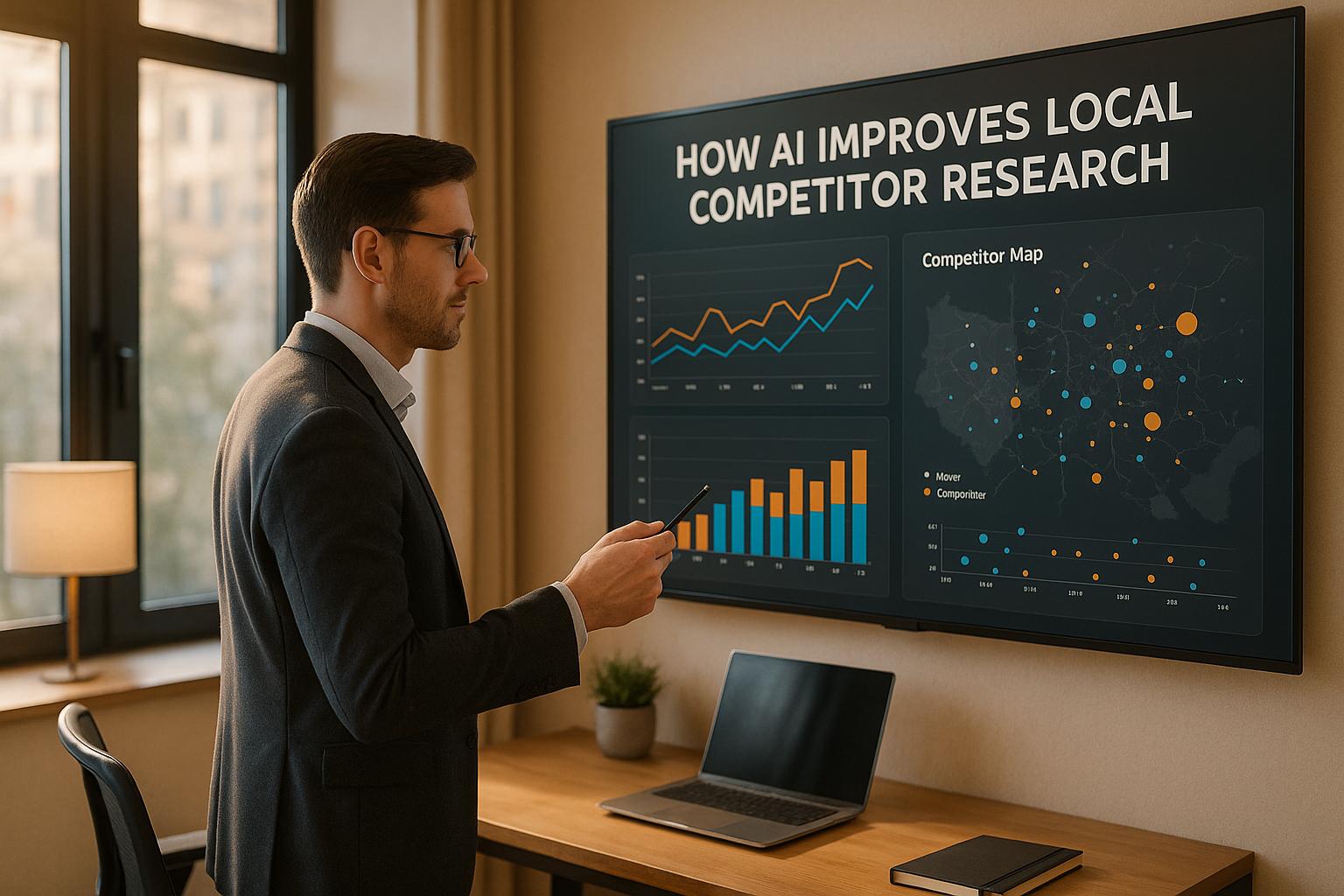
AI is transforming how local businesses conduct competitor research, making it faster, more precise, and actionable. Traditional methods often struggle with inefficiency, incomplete data, and limited insights. AI solves these problems by automating data collection, analyzing trends, and predicting competitor behavior.
Key Takeaways:
Faster Research: AI tools gather and analyze competitor data in minutes, including local search rankings, pricing, and customer sentiment.
Deeper Insights: AI monitors social media, reviews, and competitor websites to identify trends and customer preferences.
Predictive Analytics: AI forecasts competitor actions, helping businesses stay ahead by adjusting pricing, services, or marketing strategies.
Real-Time Tracking: AI continuously updates competitor data, ensuring businesses respond quickly to changes in the market.
For local businesses, AI is especially valuable in navigating the competitive landscape of local search, where 70% of organic traffic comes from the local map pack. By using AI, businesses can focus on making smarter decisions and improving their visibility, all while saving time and resources.
AI Methods for Local Competitor Analysis
Automated Data Collection from Local Sources
AI-powered tools make gathering competitor data from local sources incredibly efficient, often completing tasks in minutes. By leveraging web scraping, natural language processing (NLP), and entity recognition, these tools can pull details from websites, analyze text documents, and identify key information like company names, employee numbers, and service offerings [3].
Platforms like Google Maps are treasure troves of competitor data. They provide insights into business hours, customer reviews, photos, and contact details - all of which AI tools can extract quickly. In fact, in the United States, 73% of businesses and websites utilize Google Maps' API to strengthen their local visibility [2].
Document AI takes things a step further by simplifying the extraction of licensing, registration, and compliance data from government filings. A great example of this is the State of Hawaii Safe Travels program, which used Document AI to process travel and health information for visitors, supporting a safe reopening for tourism [1].
Additionally, AI tools can track competitor activity on platforms like LinkedIn, monitoring employee counts, company descriptions, and follower growth over time. These insights help uncover hiring trends, growth strategies, and even shifts in business direction [3].
Once data is collected, AI systems enable real-time tracking of changes in customer sentiment, refining competitor analysis even further.
Real-Time Monitoring and Sentiment Analysis
Real-time monitoring has revolutionized how local businesses keep tabs on competitors and customer reactions. AI systems continuously scan social media, review sites, forums, and websites, offering up-to-the-minute insights into competitor activities and customer sentiment [4].
Modern AI sentiment analysis is impressively advanced, capable of detecting subtle emotions like sarcasm and irony [4]. This level of understanding helps local businesses identify customer pain points and unmet needs more effectively.
The benefits of monitoring are clear: 77% of customers say they’re more likely to purchase from a brand that responds to their concerns on social media, and 76% report trusting companies with a strong online presence [4]. Multilingual support also plays a crucial role - 61% of consumers prefer engaging with brands in their native language, and 71% are more likely to buy from businesses that offer multilingual services [4]. AI monitoring tools ensure businesses don’t miss insights by analyzing sentiment across multiple languages. Additionally, 85% of companies report that AI-powered sentiment analysis has significantly improved their understanding of customer preferences and opinions [4].
Predictive Analytics for Competitor Behavior
AI doesn’t just stop at analyzing current data - it also predicts what’s coming next. Predictive analytics uses historical data and patterns to help businesses anticipate competitor actions and adopt proactive strategies [5].
For instance, major retailers have seen impressive results, with up to a 250% return on investment and notable profitability gains through predictive analytics. Companies that effectively utilize data analytics can increase profitability by 6% to 8% [6].
For local businesses, predictive analytics offers game-changing capabilities. It can forecast demand, identify high-value leads, and prioritize opportunities [5]. These systems can predict when competitors might expand their services, adjust pricing, or launch marketing campaigns based on past trends and market conditions. Even better, by analyzing competitor customer behavior, businesses can identify at-risk customers early and engage them with personalized marketing efforts. This ensures the right message reaches the right audience at the perfect time.
INSANE Competitor Research AI Agent (no-code)
How to Use AI in Local Competitor Research
Using AI for local competitor research starts with a structured plan that aligns with your business goals. This process builds on automated data analysis and predictive insights, ensuring your efforts are focused and effective. The first step? Setting clear objectives to guide your strategy.
Set Clear Goals for Competitor Analysis
The foundation of effective competitor research is having well-defined, measurable goals. These objectives will shape the tools you choose and the data you gather, ensuring everything aligns with your specific needs.
For example, instead of vaguely aiming to "understand competitors", get precise: "I want to track pricing changes for HVAC maintenance contracts in my city" or "I want to analyze customer sentiment about landscaping services in my area." This level of clarity ensures your research is actionable.
Local service businesses often focus on objectives like:
Monitoring pricing strategies
Analyzing customer reviews and ratings
Evaluating service offerings and packages
Spotting new competitors in the market
Understanding competitor marketing tactics
Each of these goals requires tailored data sources and monitoring methods, so having a clear focus from the start is essential.
Set Up AI Tools and Configure Local Data Sources
Once your objectives are clear, the next step is selecting and configuring AI tools to gather and analyze the right data. This involves three main tasks: choosing data sources, setting up AI agents, and implementing quality controls.
Start by selecting data sources. Use pre-built connectors to link your AI tools with platforms like Google Maps, social media, review sites, and analytics tools. These sources provide a mix of customer feedback, competitor activity, and market trends.
When evaluating AI tools, look for features like natural language processing, machine learning, and predictive modeling. Platforms with automated data organization, user-friendly dashboards, and customizable reports can make the process smoother. Ensure the tool can handle your specific needs, whether it’s monitoring social media or analyzing third-party research.
Configure AI agents carefully. Choose models that fit your goals and set parameters for data collection, analysis, and alerts. For instance, create a layered alert system to distinguish between urgent updates (like major competitor announcements), pricing shifts, and smaller changes. Tailor these alerts to your business priorities.
For local businesses, geographic targeting is crucial. Ensure your tools can filter data by location so you’re focusing on relevant trends in your service area, rather than being distracted by national data that doesn’t apply to your market.
Implement quality controls. Regularly verify the accuracy of your data by cross-checking key points, comparing pricing information across sources, and conducting quarterly reviews of your data sources. This ensures your insights remain reliable and actionable as you move forward.
Use AI Data in Business Decisions
Collecting data is just the beginning. The real value of AI lies in turning insights into actionable strategies that drive business improvements.
Work with your team to review AI findings and identify at least three specific actions you can take immediately. For example, if competitors are earning better reviews for response times, you might consider implementing a new customer communication system or adjusting your service scheduling.
Develop a detailed action plan that assigns responsibilities and deadlines for implementing these changes. This ensures that insights lead to real improvements rather than just sitting in a report.
Track the impact of your changes. Monitor how your new strategies affect key performance indicators, like customer satisfaction or revenue, to determine what’s working and what needs adjustment. Both successes and setbacks offer valuable lessons for refining your approach.
AI insights can also be integrated into daily operations. For instance:
Sales teams can use AI data to identify decision-makers and tailor pitches.
Marketing teams can refine advertising and messaging based on competitor analysis.
"We view the content and insights that we get [from AI] as a starting point to be refined by seasoned professionals."
Bryan Dohmen, Senior Director of Strategy, Hero Digital[8]
Benefits and Limits of AI in Local Competitor Research
Building on the earlier discussion of data collection and predictive analytics, it’s essential to weigh both the strengths and challenges that come with using AI for competitor research. While AI offers notable improvements over traditional methods, it also introduces certain challenges that require thoughtful navigation.
AI vs. Manual Research Methods
The contrast between AI-driven and manual competitor research lies in their speed, scope, and analytical depth. AI can process massive amounts of data across multiple platforms in mere seconds, delivering real-time insights that manual methods simply can’t match. This capability allows businesses to quickly adapt their strategies in response to market shifts.
AI also handles data on an impressive scale. Tasks that once required manually scouring news updates or monitoring website changes can now be automated. For instance, AI tools can evaluate online reviews, user forums, social media, and industry news simultaneously [9]. A practical example? AI systems can boost data processing efficiency by up to 90% [13], which is especially helpful for industries like HVAC services, where tracking competitor pricing across multiple businesses is crucial.
Aspect | AI-Driven Methods | Manual Research Methods |
|---|---|---|
Speed | Processes large datasets in seconds [10] | Requires days or weeks for thorough analysis [10] |
Scale | Monitors numerous competitors across platforms [9] | Limited to checking individual sources one by one [9] |
Data Processing | Handles tasks 90% faster [13] | Humans solve problems slower, one at a time [12] |
Insights | Recognizes patterns in large datasets [10] | Offers nuanced insights through creative thinking [10] |
Real-Time Monitoring | Provides continuous tracking with instant alerts [11] | Involves periodic checks and delayed insights [11] |
AI systems go beyond basic data collection - they can reveal hidden competitor weaknesses, anticipate shifts in product strategies, and even identify emerging opportunities in the market [9].
That said, manual research still has its place. AI is confined by the data and algorithms it’s trained on, while human researchers can identify creative keyword opportunities, adapt to sudden market changes, and better understand local nuances [10].
While AI’s efficiency is impressive, its use isn’t without hurdles.
Challenges of AI Implementation
Despite its advantages, using AI for local competitor research has its limitations. The quality of AI insights depends heavily on the underlying data. If the data sources are flawed, businesses risk basing their strategies on inaccurate or misleading recommendations [16]. This can lead to wasted resources and poor decision-making.
AI systems are also prone to errors, such as generating incorrect or nonsensical information, often referred to as "hallucinations" [15]. For example, a local service business relying on AI for pricing strategies might end up with faulty data, leading to pricing missteps.
Another issue is AI’s lack of context. It doesn’t fully grasp local market characteristics, seasonal demands, or cultural preferences as well as humans do [16]. For example, a catering company using AI might miss out on identifying important regional food trends or local events.
Over-reliance on AI can also pose risks. While AI can flag issues - like problems with a Google Business Profile - it can’t resolve them without human intervention [16]. Businesses must validate AI-generated insights to ensure they’re actionable and accurate.
Setting up AI tools is another hurdle. Many businesses underestimate the time and expertise required to fine-tune these systems, whether it’s configuring geographic targeting, setting alerts, or ensuring data accuracy.
Lastly, ethical concerns such as bias, transparency, and privacy warrant attention [14][15]. If an AI system is trained on biased data, it can skew analyses or reinforce stereotypes, leading to flawed conclusions.
"The best approach to using AI in local SEO is to view it as a powerful assistant rather than a replacement for human expertise." - David Hunter, CEO of Local Falcon [16]
This perspective highlights the importance of balancing AI’s strengths with human oversight. By blending AI’s speed and data-processing capabilities with human creativity and judgment, businesses can make informed and effective decisions. Combining these elements ensures that AI remains a tool to enhance - not replace - human expertise.
Case Study: Cohesive AI for Local Service Businesses
Let’s take a closer look at how Cohesive AI is reshaping competitor research and lead generation for local service businesses. Designed specifically for industries like janitorial services, landscaping, HVAC, catering, and business brokers, this platform simplifies the way businesses identify leads and assess competitors in their local markets.
Key Features of Cohesive AI
Cohesive AI stands out by automating data collection from sources like Google Maps and government filings. This eliminates the need for time-consuming manual research, making it easier to pinpoint local business owners who might need specific services.
What really sets the platform apart is its AI-powered cold email system, which creates personalized outreach messages. By analyzing data on each prospect, the system tailors emails to address their unique needs. For example, when targeting a restaurant for janitorial services, the AI might highlight cleaning challenges specific to food service operations.
Additionally, the platform includes automated email campaign management to ensure messages reach inboxes without getting flagged as spam. Businesses can run up to three campaigns simultaneously, allowing them to target various customer groups or service areas at the same time.
Another key feature is its ability to map out high-potential areas. Businesses can identify neighborhoods with a dense concentration of potential clients, spot underserved markets, and assess the level of competition in specific regions.
Benefits for Local Service Businesses
Cohesive AI offers significant time and cost savings compared to traditional lead generation methods. It ensures local service businesses can keep up with market research and outreach efforts, even during their busiest seasons.
For instance, industries like HVAC, where emergency calls can dominate daily schedules, benefit greatly from having an automated system that works in the background. Landscaping companies, often swamped during spring and summer, can maintain a steady stream of leads without pulling staff away from their primary tasks. This kind of operational efficiency not only saves time but also provides a more reliable revenue stream by keeping the sales pipeline active year-round.
By automating these processes, businesses can focus on delivering services while still growing their customer base. The predictable costs and consistent lead generation also help build confidence in adopting AI solutions.
Pricing and Transparency
Cohesive AI keeps things simple with a flat monthly fee of $150, plus a one-time $50 setup charge. There are no long-term contracts, and businesses can cancel or adjust their subscription as needed. This flexibility is especially useful for seasonal businesses that may only need enhanced lead generation during peak times.
The platform also guarantees at least two interested responses per month. If that target isn’t met, businesses receive a free month of service, adding a layer of accountability that’s often missing in traditional lead generation models.
What’s more, the pricing is straightforward - no hidden fees or surprise charges. For small businesses like HVAC companies or janitorial services, this transparency makes budgeting much easier compared to percentage-based or variable pricing systems.
Cohesive AI demonstrates how automation and AI can redefine lead generation and competitor analysis for local service businesses. By combining efficiency, affordability, and measurable results, it offers a modern solution to challenges that traditional methods often fail to address.
Conclusion and Key Takeaways
How AI Is Changing Competitor Research
AI has completely reshaped how local service businesses approach competitor research. It not only saves time but also provides insights that manual methods often miss. Instead of spending hours gathering and analyzing data, AI can process vast amounts of competitor information in minutes, delivering practical insights and even predicting competitor strategies [9].
Here's something to consider: 98% of customers find local business information online [18]. Plus, 36% of people check two review sites before choosing a local business, and 41% look at three or more [18]. That means understanding your competitors' online presence is more important than ever.
"AI helps you analyze competitors faster and smarter. It tracks their content, pricing, reviews, and campaigns in real time, spots hidden trends, and even reads customer sentiment - so you can make sharper decisions with less guesswork."
Anjali Budhiraja, Diploma from OCP ACADEMY[17]
AI doesn't just help you keep up; it helps you stay ahead by identifying market gaps, optimizing pricing strategies, and uncovering underserved areas. It also shifts businesses from reacting to competitors to predicting their next moves, enabling smarter, more proactive decision-making [9]. These capabilities are essential for businesses looking to maintain an edge in competitive local markets.
Steps to Start Using AI Effectively
To take full advantage of AI, local service businesses need a clear and strategic approach. AI has proven its ability to simplify competitor analysis, but the real value comes from turning those insights into meaningful actions. Start by identifying your key questions - like how your market share compares or how your services stack up against competitors - and gradually implement AI tools that address these priorities [7].
Look for AI tools that can pull data from multiple sources and automate analysis, providing regular updates without creating unnecessary complexity [9]. Training your team is just as important; they need to know how to interpret AI-generated insights and apply them effectively. You might also consider working with experts who specialize in local service industries. For instance, platforms like Cohesive AI are designed to meet the specific needs of businesses in fields like HVAC, landscaping, and janitorial services.
As you begin, remember that AI systems require fine-tuning. Review your results regularly - monthly is a good starting point - adjust your data sources, and refine the settings to get more precise insights over time. The question isn’t whether to use AI, but how quickly you can adopt it to gain a competitive advantage.
Start with a clear plan, choose the right tools, and commit to learning as you go. The businesses that succeed in the years ahead will be the ones that use AI to make faster, smarter decisions about their competitive strategies.
FAQs
How does AI make local competitor research faster and more accurate?
AI has revolutionized the way businesses conduct local competitor research by processing massive datasets in real time. Tasks that used to take days - or even weeks - can now be completed in just minutes.
With automated data collection and analysis, AI tools don’t just save time; they also reduce the risk of human error. The result? More accurate and actionable insights that empower businesses to make faster, smarter decisions. This kind of efficiency can be a game-changer, helping companies stay ahead in their local markets.
How can AI tools help with real-time monitoring and sentiment analysis in local markets?
AI tools play a key role in improving real-time monitoring and sentiment analysis for local markets by using natural language processing (NLP) and machine learning algorithms. These technologies allow businesses to keep tabs on customer feedback, social media chatter, and online reviews, providing a clearer picture of local competitors and market trends.
For instance, AI-driven platforms can track sentiment changes as they happen, spot patterns in customer behavior, and highlight emerging trends unique to specific areas. This gives businesses the ability to react swiftly, fine-tune their strategies, and maintain a competitive edge. By automating these tasks, AI shifts the focus from time-consuming data gathering to actionable insights, helping businesses make smarter, faster decisions.
How can local businesses make sure AI-generated insights are reliable and useful for competitor research?
To make sure AI-driven insights are dependable and useful, local businesses should focus on leveraging relevant, high-quality data that aligns with their specific industry and market needs. Cross-referencing AI outputs with manual research or trusted sources is a smart way to confirm their accuracy.
Equally important is establishing clear objectives for how these insights will be applied. Regularly reviewing AI performance, tracking outcomes, and addressing any inconsistencies can help businesses fine-tune their processes, ensuring the insights genuinely enhance their decision-making efforts.