AI in Drip Campaigns: Boosting Conversions
Aug 1, 2025
AI is transforming email drip campaigns, making them more effective by solving common issues like poor personalization, bad timing, and manual management. With AI, businesses can deliver tailored messages, send emails at optimal times, and automate adjustments based on user behavior. This leads to:
Higher Open Rates: Up to 50% more compared to older methods.
Increased Click-Through Rates: Improvements of 14.5%-59%.
Better Conversions: Up to 30% higher success rates.
For local service businesses - like HVAC, landscaping, or janitorial services - AI-powered email marketing simplifies lead generation and improves customer engagement. Tools like Cohesive AI offer automated solutions, including behavior-based triggers, personalized emails, and smart segmentation, starting at $500/month, with guaranteed results.
Switching to AI-driven campaigns saves time, reduces costs, and delivers measurable improvements in ROI, making it a clear choice for businesses aiming to grow.
How to create an email drip campaign using AI
Problems with Traditional Drip Campaigns
Traditional drip campaigns promise automation and efficiency, but they often create more headaches than solutions. For local service providers, these campaigns can feel generic, poorly timed, and labor-intensive, requiring constant manual tweaks. Let’s break down the key challenges.
Poor Personalization
One of the biggest flaws with traditional drip campaigns is their lack of tailored messaging. Too often, businesses send out one-size-fits-all emails, ignoring the unique needs or behaviors of their audience. Imagine a commercial property manager searching for janitorial services receiving the same generic email as a small retail shop owner - it’s not just ineffective; it’s a missed opportunity.
This problem usually arises from poor audience segmentation. Without tools to group leads based on their specific interests or actions, businesses lump everyone together and send irrelevant content. For example, traditional systems fail to adapt messaging based on actions like clicking on a specific service page or downloading a pricing guide. This blanket approach leaves potential customers feeling overlooked, leading to low engagement and fewer conversions.
Bad Timing and Frequency
When it comes to email campaigns, timing is everything. Unfortunately, traditional drip systems often miss the mark, sending emails when recipients are least likely to engage. For example, emails might land during peak work hours when prospects are too busy to even glance at their inbox.
"The best cold email campaigns have open rates over 40%. Sending emails at the right time is essential to ensure that they are opened and read by recipients. Timing plays a critical role in capturing the attention of your audience and increasing the chances of engagement." – Jeremy Chatelaine, QuickMail [1]
Frequency is another stumbling block. Some businesses bombard leads with daily emails, while others send messages so sporadically that recipients forget about them altogether. Research shows that 55% of email responses come from follow-up emails [1]. Yet, poorly timed emails - like those sent on Thursdays, which account for nearly a third of unsubscribes [1] - can harm your email list and reduce engagement.
Traditional systems struggle to find the right balance. Active leads who frequently open emails might benefit from more contact, but less engaged prospects could feel overwhelmed by too many messages. Without the ability to adjust frequency based on engagement, campaigns risk alienating their audience.
Manual Campaign Management
Beyond timing and personalization, manual campaign management adds another layer of complexity. Running these campaigns by hand means drafting, scheduling, and monitoring emails, which can quickly overwhelm busy service providers.
Optimization is another casualty of manual management. Automated campaigns, like win-back emails, boast impressive metrics - 42.5% open rates, 18.27% click-through rates, and 10.34% conversion rates [2]. But manually managed campaigns rarely achieve this level of performance because they lack consistent testing and refinement. Business owners often don’t have the time to experiment with subject lines, adjust sending schedules, or fine-tune content.
On top of that, manual management means constantly updating contact lists, removing unsubscribes, tracking responses, and following up on leads. Without automation, valuable prospects can slip through the cracks as business owners juggle these tasks alongside their daily responsibilities. And when an email flops or triggers complaints, making manual adjustments delays the chance to improve and reconnect with the audience effectively.
How AI Fixes Drip Campaign Problems
AI has revolutionized how businesses manage drip campaigns, tackling challenges like generic messaging, poor timing, and the burden of manual adjustments. Instead of relying on trial and error, AI uses data-driven insights to deliver the right message to the right person at the right time. This shift enables highly targeted content and real-time campaign improvements.
AI-Driven Personalization
AI takes personalization to a whole new level - far beyond simply adding a recipient's first name. By analyzing a wide range of data points, it can automatically segment audiences with precision. For example, a commercial property manager seeking janitorial services might receive messaging tailored to their operational needs, while a small retail shop owner would get a completely different approach. AI learns from user behavior and preferences, ensuring follow-ups are relevant and tailored to individual actions.
It doesn’t stop at messaging. AI customizes tone, images, and even descriptions to align with each recipient’s specific profile. For instance, an HVAC company could highlight energy-saving benefits for small businesses on tight budgets, while emphasizing advanced climate control systems for high-end commercial properties.
AI also adjusts content dynamically based on factors like location, purchase history, or even local weather conditions. Imagine an HVAC provider automatically sending out heating maintenance reminders when temperatures drop in a specific region, or a landscaping business promoting seasonal services based on current weather trends.
The payoff is clear: personalized email campaigns generate 6x higher transaction rates compared to generic ones, and AI-powered campaigns boast 50% higher open rates than traditional methods [4].
Better Send Times
One common flaw of traditional drip campaigns is that emails are sent at times convenient for the business - not the recipient. AI solves this by analyzing engagement patterns to pinpoint the best times to reach each subscriber [3]. This means emails land in inboxes precisely when recipients are most likely to open and engage [5].
AI doesn’t just optimize timing at the individual level. It also fine-tunes send times across entire segments and campaigns. For example, urgent offers can be sent to subscribers who respond quickly to time-sensitive messages, while longer, relationship-building content is timed for when recipients are more likely to read in-depth material. AI even detects early signs of fatigue - like declining engagement - and adjusts the frequency of emails to re-capture attention.
The results speak volumes: businesses using AI automation report up to 14.5% higher open rates and 59% higher click-through rates [4]. These improvements lay the groundwork for real-time campaign adjustments that drive even better performance.
Automatic Campaign Adjustments
AI doesn’t just optimize personalization and timing - it takes things further by adapting campaigns in real time. One of AI’s biggest strengths is its ability to adjust strategies automatically, without requiring constant human oversight. By analyzing historical and ongoing data, AI identifies what works best for individual subscribers [4] and applies those insights across campaigns.
For example, if a prospect shows interest in a specific topic, AI can adjust follow-up messages to focus on that area. Highly engaged prospects who frequently open emails might receive more frequent updates, while less active leads are sent messages spaced out strategically to reignite their interest.
The system is constantly learning. If certain subject lines or content formats perform better for specific audience segments, AI incorporates these findings into future campaigns. It can even shift sending schedules if engagement tends to drop on certain days.
This level of automation pays off. Businesses using AI-driven email marketing report a 41% increase in revenue from their campaigns [4]. By eliminating the delays and errors of manual management, AI enables businesses to focus on their core services while their email campaigns continue to improve and generate qualified leads.
AI Drip Campaign Strategies That Boost Conversions
Discover how AI-driven strategies can turn basic automation into campaigns that truly connect with users. These techniques focus on understanding and responding to user behavior, creating personalized experiences that lead to higher conversions.
Behavior-Based Triggers
The best drip campaigns don't simply follow a set schedule - they adapt to user actions. AI-powered behavior-based triggers monitor what users do and send tailored messages at just the right time.
AI goes beyond the obvious by spotting patterns in user behavior that might escape human notice. For instance, it can predict when a customer might churn by analyzing drops in engagement or identify when someone is ready to make another purchase based on their browsing habits [6]. This predictive power allows businesses to send proactive messages, addressing potential issues or seizing opportunities before they're missed.
These triggers ensure your content is not only timely but also relevant, increasing user engagement and driving results.
Content Optimization with AI
When it comes to crafting effective emails, AI takes the guesswork out of the equation. From subject lines to calls-to-action (CTAs), AI fine-tunes every element based on what resonates most with your audience.
Subject lines, for example, are critical - 47% of people open emails based solely on the subject line [7]. AI automates A/B testing, analyzing multiple variables at once to identify what works best, saving time and boosting open rates. One marketer even reported a tenfold improvement in A/B testing outcomes after using generative AI for email marketing [8].
AI also enhances CTAs by analyzing audience data and suggesting personalized options that match each recipient's position in the buying journey. Whether it’s identifying upsell opportunities or refining email timing, AI continuously learns and adapts to maximize engagement.
Smart Segmentation and Targeting
AI takes segmentation to a whole new level, building on user behavior and optimized content to create highly targeted campaigns.
Traditional segmentation often relies on basic demographics, but AI digs deeper. It analyzes browsing habits, engagement history, location data, and more to form detailed audience groups [9]. By categorizing users based on factors like signup source, activity level, and preferences, AI creates segments that better predict purchasing behavior.
The results speak for themselves: segmented drip campaigns see higher open rates and conversions [9][10]. In fact, 77% of marketing ROI comes from campaigns that are segmented, targeted, and triggered [10].
"To get maximum value from your marketing budget, get to the heart of your customers' shopping motivations by splitting your market into subgroups – then you'll be in a stronger position to serve your customers' unique needs."
– Yieldify [10]
AI doesn't stop there. It continuously refines these segments by analyzing new engagement data, ensuring that subject lines, send times, and CTAs are perfectly tailored to each group. Businesses using segmented email campaigns have seen open rates increase by 14.3% and revenue skyrocket by up to 760% [10].
Cohesive AI: AI-Powered Drip Campaigns for Local Service Businesses
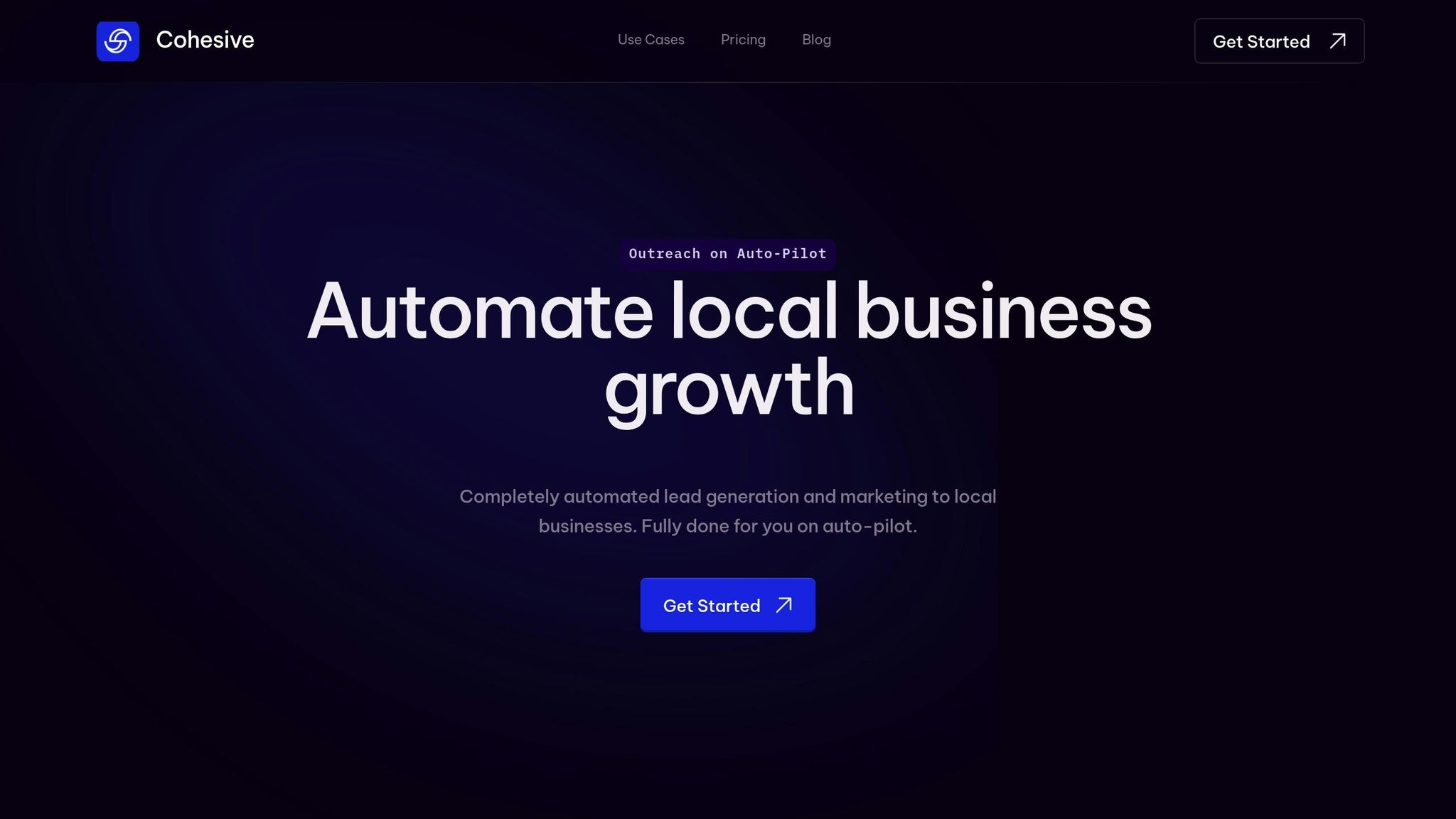
Cohesive AI leverages artificial intelligence to streamline and personalize drip campaigns, specifically addressing the challenges faced by local service businesses. For many small business owners, juggling lead generation, crafting custom messages, and managing email sequences can feel like an uphill battle, especially when their main focus is on delivering quality services. Cohesive AI steps in to tackle these pain points, offering a solution that replaces generic messaging and inefficient manual processes with a smarter, automated approach.
By integrating tools like behavior-based triggers, content optimization, and intelligent segmentation, Cohesive AI delivers a fully managed platform that can replace traditional lead generation agencies. With pricing starting at $500 per month, the service guarantees at least four interested responses - or you get a free month as a credit.
Automated Lead Sourcing
The old-school methods of lead generation - like relying on outdated databases or purchasing expensive, low-quality lists - often produce lackluster results. Cohesive AI does things differently. It uses tools like Google Maps and government filings to identify high-quality, targeted leads [12].
This isn't just a basic directory search. The platform digs deeper, analyzing local business trends and identifying companies that align with your ideal customer profile. It even verifies contact details for key decision-makers. For instance, a landscaping business could find property management firms that recently expanded, while an HVAC contractor might target businesses moving into larger spaces needing upgraded climate control systems.
By continuously gathering fresh data, Cohesive AI ensures a steady flow of untapped prospects - ones who haven’t already been bombarded by generic cold outreach.
AI-Personalized Cold Emails
Generic cold emails often go straight to the trash. Cohesive AI changes the game by crafting messages tailored to each prospect’s unique situation, drawing on details like their business focus, industry challenges, and local market conditions [11].
The platform’s AI creates hyper-relevant messaging. For example, it might highlight local construction projects that could benefit a janitorial service or reference seasonal weather trends that impact HVAC needs. This localized, tailored approach makes emails stand out in a crowded inbox.
And the results speak for themselves. Businesses using AI for email marketing see a 22% increase in open rates and a 32% boost in click-through rates [11]. Even better, personalized emails can drive conversion rates up by 10% [11]. Plus, 77% of marketers report higher email engagement after adopting AI personalization [11].
Fully Managed Email Campaigns
Running drip campaigns requires careful timing, consistent monitoring, and constant fine-tuning. Cohesive AI automates these tasks, taking the burden off business owners and ensuring campaigns run smoothly [12].
The platform allows for up to three campaigns at a time, each designed for different customer segments or service offerings. Emails are sent when local business owners are most likely to check their inbox, and advanced deliverability monitoring ensures messages avoid spam folders.
Campaigns also adapt based on recipient behavior. For example, prospects engaging with specific content receive follow-ups tailored to their interests, while those showing signs of purchase intent are prioritized for quicker action.
This hands-off system eliminates the need for dedicated marketing staff or expensive agencies. With flexible, month-to-month pricing and no long-term contracts, Cohesive AI lets local service businesses scale their lead generation efforts to match their workload or seasonal needs.
Measuring AI Drip Campaign Results
When it comes to AI-powered drip campaigns, tracking results is not just an afterthought - it's the backbone of continuous improvement. Without measuring key metrics, you're essentially navigating without a map, missing critical opportunities to fine-tune your campaigns and boost your return on investment.
"It isn't enough to measure the final outcome alone. You also need to track intermediate metrics to understand where consumers might be getting stuck - essentially bottlenecks in the marketing funnel." - Sunil Gupta, Harvard Business School Professor [13]
By focusing on the right metrics, you can uncover AI's impact and pave the way for smarter, more effective campaigns.
Key Performance Indicators (KPIs)
Even though only 23% of marketers feel confident about tracking the right KPIs [13], these metrics are essential for evaluating and improving campaign performance.
Open rates and click-through rates (CTR): These metrics reveal how well your subject lines and content resonate with your audience. Low open rates might indicate poor timing or lack of engagement, while high CTRs suggest compelling content and strong calls-to-action. AI-powered personalization can significantly enhance these numbers. For instance, a SaaS company achieved a 20% boost in email open rates by using personalized subject lines, and AI-generated ads led to a 25% increase in CTR [15].
Conversion rates: This is the ultimate measure of success - the percentage of recipients who take the desired action. For example, cart abandonment emails average a 17.12% conversion rate, while automated welcome emails achieved a 3% conversion rate in 2022 [14].
Revenue per email: This metric helps you understand the financial return of each message. According to DMA research, email marketing delivers an average return of $42 for every dollar spent [14].
Bounce rates and unsubscribe rates: These metrics offer insights into the quality of your email list and the relevance of your content. High bounce rates often signal the need to refine audience segmentation or improve content strategy [14].
Case Studies
Real-world examples highlight the transformative power of AI in marketing. A retail company reduced its Customer Acquisition Cost by 20%, while an e-commerce brand saw a 30% increase in sales. A B2B company improved sales efficiency by 30%, and a subscription service enhanced Customer Lifetime Value by 18%, all through AI-driven segmentation [15].
Before and After Results Comparison
The following table illustrates how AI-driven campaigns outperform traditional methods across key metrics:
Metric | Traditional Methods | AI-Powered Methods | Improvement |
|---|---|---|---|
Conversion Rates | Baseline | 20–30% higher | Up to 30% increase |
Cost Per Lead | Baseline | 30% lower | 30% reduction |
Customer Acquisition Cost | Baseline | 30–40% lower | Significant cost savings |
Forecasting Accuracy | 10–30% error rate | 5–10% error rate | 50–67% fewer errors |
Marketing ROI | Baseline | ~25% higher | 25% increase |
"Tracking the right AI metrics can boost success by 1.7×. The key is to focus on measures that directly impact your bottom line." - Dialzara Team [16]
One standout example is Green Thumb Landscaping, a small business with just 15 employees. By adopting AI-powered scheduling and invoicing tools, they reduced weekly scheduling time from 4 hours to 1 hour, saving $900 in labor costs over six months. Late payments dropped from 30% to 10%, improving cash flow by $2,400 annually. Their total 12-month ROI hit 123% [16].
The secret to effective measurement lies in setting clear baselines before implementing AI tools. From there, consistently track both quantitative metrics like revenue and conversion rates, as well as qualitative improvements such as customer satisfaction and operational efficiency. This approach ensures you're always optimizing for success.
Conclusion: Higher Conversions with AI
Switching from traditional drip campaigns to AI-powered marketing marks a shift toward smarter, more efficient strategies that deliver real results. Studies show that AI-driven personalization can increase email open rates by up to 26% and click-through rates by as much as 14% [18]. On top of that, businesses using AI for segmentation and targeting have reported conversion rates up to 50% higher compared to manual methods [17].
For local service providers - like janitorial, landscaping, and HVAC companies - this shift couldn’t come at a better time. Traditional methods often rely on tedious manual tasks and lack the ability to tailor messages to individual prospects. AI changes the game by automating the entire process, from sourcing leads through tools like Google Maps or government filings to crafting cold emails that feel personal and relevant.
Take Cohesive AI as an example. For $500 per month, the platform guarantees four interested responses, making it a practical solution that combines efficiency with accountability.
The real power of AI lies in its ability to learn and adapt in real time, optimizing campaigns dynamically based on recipient behavior. This not only improves results but also strengthens ROI over time.
Sticking with manual processes means settling for generic messaging, while AI ensures the right message reaches the right person at just the right moment. For local service businesses looking to scale their lead generation, AI-driven drip campaigns offer a clear competitive advantage.
FAQs
How does AI optimize the timing and frequency of drip email campaigns?
AI takes drip email campaigns to the next level by analyzing subscriber behavior - like past interactions and engagement patterns - to find the perfect timing for sending emails. This means emails are sent when they're most likely to be opened and clicked, boosting overall engagement.
What’s more, AI doesn’t stop there. It constantly tests and fine-tunes the campaign schedule using real-time data. This ensures that each recipient gets emails at intervals that are most likely to grab their attention. Achieving this level of precision and flexibility is nearly impossible with traditional methods.
How does AI improve personalization in drip campaigns for local service businesses?
AI takes personalization in drip campaigns to the next level by analyzing customer behavior and preferences through predictive analytics. This allows businesses to create dynamic, customized content that speaks directly to each recipient. Even better, AI can process real-time data to tweak messages based on user interactions, ensuring communication stays timely and relevant.
With tools like generative AI, businesses can produce unique, highly personalized messages at scale. This is a game-changer for industries like HVAC, catering, and landscaping, where tailored communication can make a big difference. By delivering this level of customization, companies can forge stronger connections with potential clients and see higher conversion rates.
What are the most important KPIs to track for AI-powered drip campaign success?
To gauge how well your AI-powered drip campaigns are performing, pay close attention to key metrics such as open rates, click-through rates (CTR), and conversion rates. These numbers give you a clear picture of how engaged your audience is and how successful your campaigns are at driving action. Beyond engagement, tracking revenue generated, customer acquisition cost (CAC), and customer lifetime value (CLV) helps you assess the financial return on your efforts.
Don't overlook retention rates and other engagement metrics - they’re essential for understanding how effectively your campaigns are nurturing leads over time. Regularly reviewing these KPIs allows you to fine-tune your AI strategies, making adjustments to improve personalization, timing, and overall results.