AI vs. Traditional Lead Generation for Niche Markets
Nov 16, 2025

Finding leads in niche markets is tough. When your target audience is small and specific, every lead matters. Traditional methods like cold calling, direct mail, and networking have been the go-to strategies for years. But they’re expensive, time-consuming, and hard to scale.
Enter AI-driven lead generation. AI tools automate tasks like data collection, segmentation, and personalized outreach, offering faster results and lower costs. For example, AI can cut lead qualification time from days to minutes and boost conversion rates by up to 300%.
Here’s the key difference: Traditional methods excel at building personal relationships but struggle with efficiency. AI methods are faster, cheaper, and more precise but lack the human touch. Many businesses now combine both approaches - AI for efficiency and traditional methods for relationship-building.
Quick Comparison
Criteria | Traditional Methods | AI-Driven Methods |
|---|---|---|
Targeting Accuracy | Moderate | High |
Scalability | Limited | Very High |
Cost Per Lead | $50–$100 | $20–$40 |
Personalization | Generic | Hyper-personalized |
Qualification Speed | 5–7 days | Minutes |
Relationship-Building | High | Moderate |
24/7 Availability | No | Yes |
Data Insights | Limited | Extensive |
Takeaway: Use AI to handle repetitive tasks and scale outreach. Rely on traditional methods for high-value, personal connections. Combining both could be your best strategy for niche market success.
The Most Profitable AI Lead Gen Agency Niches (2025)
Traditional Lead Generation: What Works and What Doesn't
For years, businesses in niche markets have leaned on tried-and-true methods to attract customers. While these traditional approaches have laid the groundwork for success, they also reveal some clear inefficiencies in today’s fast-paced, competitive environment. Below, we’ll explore these methods, their strengths, and the challenges they bring.
Common Traditional Lead Generation Methods
Referrals remain a go-to strategy for many niche businesses, especially in local service industries. For instance, when a happy janitorial client recommends your services to a property manager, that referral carries built-in trust, making it easier to convert the lead into a paying customer.
Networking events and trade shows provide hands-on opportunities to connect with potential clients. An HVAC contractor might meet prospects at a local business expo, or a catering company could showcase its offerings at a wedding fair. These events bring together a concentrated audience, allowing for direct, face-to-face engagement.
Cold calling is another long-standing practice, particularly for B2B service providers. While many consider it outdated, cold calling can still deliver results if the caller demonstrates a strong understanding of the industry and targets the right prospects.
Direct mail campaigns also hold a place in traditional lead generation. A well-crafted postcard from a cleaning service, for example, can grab the attention of property management companies, offering a tangible way to stand out in today’s digital-heavy world.
Benefits of Traditional Lead Generation
These methods may require significant effort, but they excel at building trust and creating personal connections - a crucial factor in niche markets. Meeting someone at a trade show or receiving a referral from a trusted source establishes credibility right from the start, something that’s hard to replicate with purely digital strategies.
In-person interactions and high-touch engagement are particularly effective when targeting specialized audiences. Referrals and face-to-face meetings often carry a sense of authenticity that resonates, especially in local or highly specific markets where digital data may be limited.
Problems with Traditional Lead Generation
Despite their strengths, traditional methods come with notable challenges. High costs are one of the biggest hurdles. For example, generating leads at a trade show can cost around $811 per lead in the United States, a price tag that’s often out of reach for small businesses with tight budgets[3].
Time investment is another major issue. These methods demand extensive effort, from conducting research and scheduling follow-ups to attending multiple meetings. On average, it can take 5–7 days to qualify a lead, with costs ranging from $50 to $100 per lead[3].
Scalability is limited as well. A landscaping contractor, for instance, can only attend so many networking events or make a finite number of cold calls in a week. This reliance on human effort creates bottlenecks that are tough to overcome without pouring in additional resources.
Another downside is the lack of precise targeting. Cold calling typically yields a low 2% conversion rate, while direct mail campaigns for B2B efforts see response rates around 4.4% - but often at a higher cost per contact[3]. Geographic and timing constraints, such as the infrequency of trade shows or the location-specific nature of networking events, further complicate lead generation efforts.
Finally, the manual nature of these methods makes it hard to measure return on investment accurately. Unlike digital tools, traditional approaches lack detailed analytics, making it difficult to track performance or optimize campaigns over time.
While these limitations don’t render traditional methods obsolete, they do highlight the need for more efficient, scalable solutions. Many niche businesses are now exploring modern strategies, such as AI-driven tools, to combine the personal touch of traditional methods with the efficiency of advanced technologies.
AI Lead Generation: New Methods for Niche Markets
The shift from manual outreach to automation is transforming how businesses approach lead generation in niche markets. AI is stepping in to automate the process with a level of precision and scalability that manual methods simply can’t match.
How AI Lead Generation Works
AI-driven lead generation platforms streamline the entire process, cutting down on the manual work that traditional methods demand. Here’s how it typically works:
Data Collection: AI pulls data from a variety of sources like Google Maps, government filings, and social media. This ensures businesses have access to up-to-date, accurate information about potential prospects.
Segmentation: Once the data is collected, AI organizes prospects into categories based on location, industry, size, and even specific behaviors. This level of detail allows businesses to identify micro-segments that might be overlooked using traditional methods.
Personalized Outreach: Using natural language processing (NLP), AI analyzes each prospect’s unique context to craft messages that feel personalized and relevant. This ensures the tone and content connect with the target audience.
Campaign Management: AI doesn’t stop at outreach - it handles follow-ups, qualifies leads, and engages prospects in a way that feels natural. Only the most promising leads are passed on to sales teams for conversion.
AI Advantages for Niche Markets
AI’s benefits are particularly striking in specialized markets where traditional methods often fall short. For instance, AI tools can cut lead qualification time from days to minutes, while boosting conversion rates by up to 300% in just hours [2].
Precision targeting is another major advantage. By analyzing massive datasets, AI can pick up on buying signals and behavioral patterns that lead to better results. To put this into perspective, AI-driven approaches often achieve conversion rates between 15% and 30%, compared to the 1–3% range typical of traditional methods [2].
A fintech startup offers a great example of this in action. They implemented an AI-powered lead generation tool on their website, which engaged visitors in natural conversations and asked tailored qualifying questions. This strategy didn’t just trim down their lead volume by 40% - it also doubled the quality of leads accepted by their sales team, resulting in a 2.5× boost in sales-ready prospects [3,9].
Platforms like Cohesive AI are taking these advantages even further by tailoring solutions specifically for local service businesses.
Cohesive AI: AI Lead Generation for Local Service Businesses
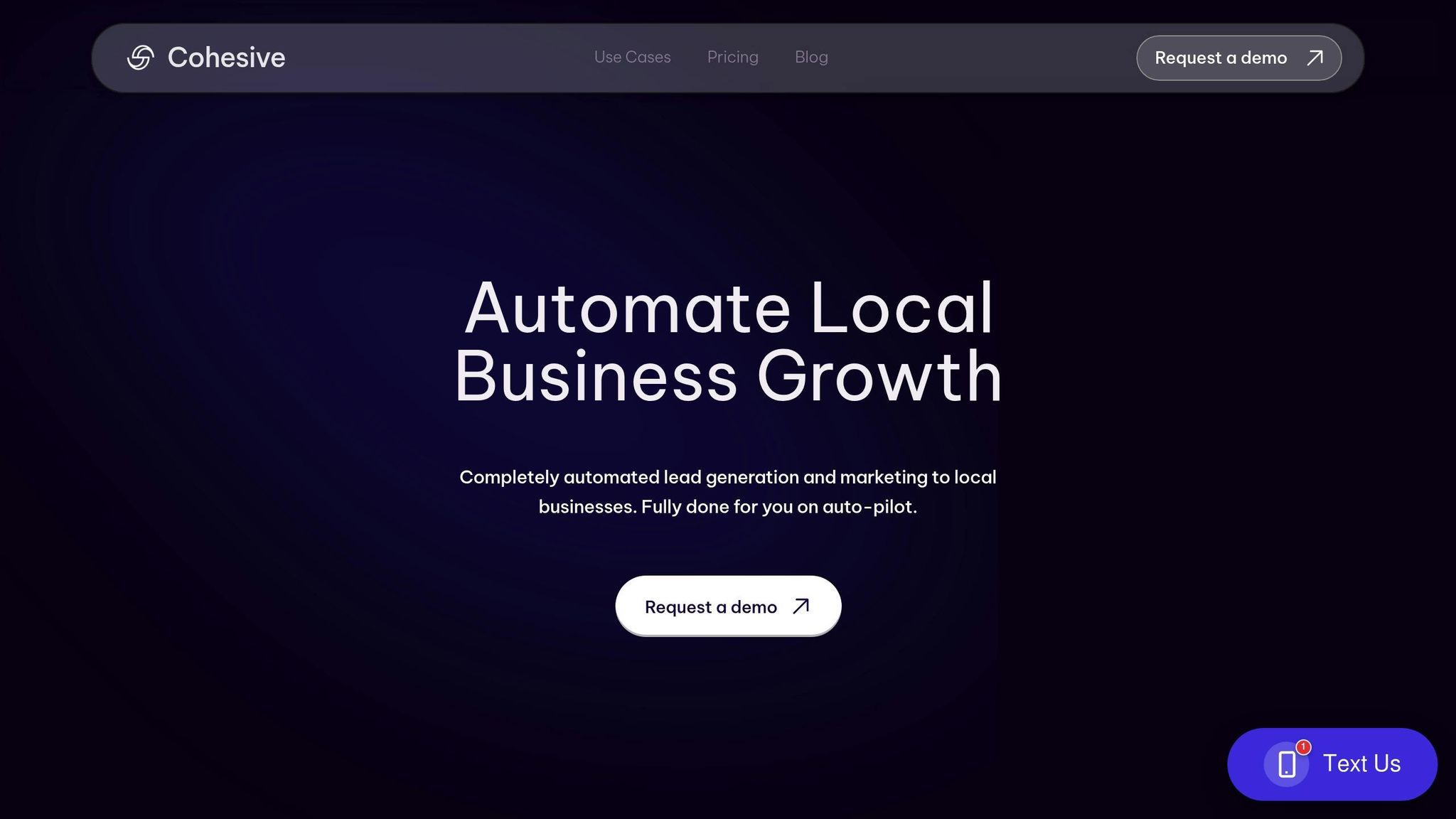
Cohesive AI focuses on helping local service businesses - like janitorial services, landscaping, HVAC, catering, and business brokerage - overcome the challenges of scaling beyond word-of-mouth referrals and traditional networking.
Here’s how the platform works:
Data Collection for Local Niches: Cohesive AI constantly scrapes sources like Google Maps and government filings to provide up-to-date prospect data for specific industries and geographic areas.
Personalized Messaging: The platform uses AI to create outreach emails tailored to each prospect’s business type, location, and industry needs. These messages show a clear understanding of the prospect’s challenges and offer solutions that feel relevant and specific.
Automated Campaign Management: From the first contact to follow-up sequences, Cohesive AI automates the entire outreach process. It also tracks engagement metrics, manages email deliverability, and schedules follow-ups based on how prospects interact with the campaign.
Integrated CRM and Automation: With built-in CRM and marketing automation features, businesses can manage the entire customer journey - from the first touchpoint to conversion - without juggling multiple tools. This ensures a smooth transition between marketing and sales teams.
Cohesive AI’s pricing is straightforward. The Base Plan costs $500 per month, with a $75 onboarding fee. This plan supports up to 3 campaigns simultaneously and includes 12,000 research credits and 7,200 data credits per month [4]. There are no long-term contracts; businesses can operate on a month-to-month basis, giving them the flexibility to test and scale their lead generation efforts without hefty upfront investments. This setup allows companies to maintain the personal touch that’s crucial for success in niche markets.
AI vs Traditional Lead Generation Comparison
Building on our earlier discussion of traditional and AI-driven approaches, this section dives into a direct comparison of their core strengths and limitations. For businesses operating in niche markets - where every lead matters - understanding these differences is crucial for optimizing outreach efforts. Here's a side-by-side breakdown of how these methods stack up across key criteria:
Criteria | Traditional Methods | AI-Driven Methods |
|---|---|---|
Targeting Accuracy | Moderate | High |
Scalability | Limited | Very High |
Cost Per Lead | $50–$100 | $20–$40 |
Personalization | Generic | Hyper-personalized |
Qualification Speed | 5–7 days | Minutes |
Relationship-Building | High | Moderate |
24/7 Availability | No | Yes |
Data-Driven Insights | Limited | Extensive |
This table highlights the distinct advantages and constraints of each approach, helping you align your lead generation strategy with your business goals.
Pros and Cons of Each Method
The effectiveness of lead generation methods varies significantly depending on the metrics you prioritize.
Traditional methods shine when it comes to building meaningful, personal relationships. Sales teams leverage their industry knowledge and direct interactions to establish trust face-to-face. However, these methods often fall short in terms of scalability and come with higher costs per lead, making them less efficient for broader outreach.
On the other hand, AI-driven platforms excel in speed and scalability. They can sift through and qualify leads in minutes, cutting down the time required for manual processes. These systems also use advanced data analysis to deliver hyper-personalized outreach, identifying subtle buying signals and behavior patterns that humans might miss. Additionally, they operate at a lower cost per lead, making them an attractive option for businesses looking to maximize efficiency.
That said, traditional methods still hold a distinct advantage in industries or scenarios where relationship-building is paramount. High-value transactions often require the human touch, as trust and personal connections play a critical role. These methods are particularly effective for complex sales that demand in-depth industry expertise.
Which Method to Choose When
Deciding between AI and traditional lead generation methods comes down to your market dynamics and business objectives.
Traditional methods are ideal for situations like:
Targeting small, high-value audiences where personal relationships are key.
Industries or services where trust and expertise heavily influence buying decisions.
Markets such as luxury services, business brokerage, or other relationship-driven sectors.
Instances where limited data availability makes AI tools less effective.
Prospects who prefer human interaction over automated communication.
AI-driven approaches work best when:
Your outreach needs to scale across large, diverse markets.
Speed in lead qualification and response gives you a competitive edge.
Sufficient data is available to fuel AI analysis and decision-making.
Cost efficiency is a top priority.
Automating repetitive tasks can free up time for more strategic efforts.
For example, local service businesses - like janitorial, landscaping, and HVAC companies - can greatly benefit from AI-driven tools like Cohesive AI. These industries typically operate in large, fragmented markets rich with data sources such as Google Maps or government filings. AI platforms can seamlessly gather business information, craft personalized outreach emails, and automate entire campaigns, enabling businesses to reach hundreds or even thousands of potential clients efficiently.
Many companies are finding success with a hybrid approach, combining the strengths of both methods. AI tools handle the heavy lifting of initial outreach and lead qualification, while traditional methods step in to nurture relationships and close deals with high-value prospects. This blend of automation and personal interaction ensures both efficiency and a human touch where it matters most.
Ultimately, the right lead generation strategy depends on your market's characteristics. Smaller, relationship-focused niches often benefit more from traditional methods, while larger, data-rich markets are better suited for AI-driven automation. Up next, we’ll explore how to choose the best lead generation method for your specific niche market.
How to Pick the Right Lead Generation Method
Choosing the best lead generation strategy isn't just about deciding between AI and traditional methods. It’s about finding the approach that fits your market conditions, resources, and business goals. To make the right choice, you’ll need to consider audience behavior, data availability, and resource allocation.
Understanding Your Audience and Available Data
Your audience's behavior and the data you have access to play a huge role in picking the right method. For example, if your target audience is highly active online, leaving behind a trail of digital signals, AI can use this data to fine-tune its targeting. On the other hand, less digitally engaged audiences often respond better to referrals or in-person networking.
Data quality is also a deciding factor. AI thrives on rich, reliable data sources. For local service businesses targeting other businesses, tools like Google Maps or government filings provide a wealth of information that AI can process efficiently. This makes AI especially useful for industries like janitorial services, landscaping, or HVAC, where publicly available business data is abundant.
The level of digital engagement varies across industries. For instance, tech-savvy B2B audiences often have strong online presences, making them ideal for AI-driven outreach. But for audiences in more traditional sectors or older age groups, personal interactions like phone calls or face-to-face meetings may work better.
The availability of data also impacts AI’s effectiveness. Markets with detailed business directories, active social media profiles, and other rich data sources allow AI tools to deliver better targeting and higher conversion rates. In contrast, when data is sparse, traditional methods - though slower and more costly - might be the better option.
Matching Budget and Resources to Goals
Your budget and resources will heavily influence which lead generation approach makes the most sense. AI and traditional methods come with very different cost structures, so it’s important to weigh your financial constraints against your goals.
Cost per lead is a key factor. AI-driven methods often deliver leads at $20–$40 each, while traditional methods can range from $50–$100 per lead. For businesses with tight margins, this gap can be a dealbreaker. However, AI platforms also require upfront investments, such as onboarding fees and monthly subscriptions, which need to be factored into your decision.
Labor costs also differ significantly. Traditional methods rely heavily on human resources - qualifying leads could take a salesperson 5–7 days. Meanwhile, AI systems can do the same work in minutes, saving both time and money. This efficiency makes AI particularly appealing for businesses looking to scale quickly.
Scalability is another critical consideration. If your business plans to grow rapidly, AI can handle thousands of leads simultaneously without the need for additional staff. Traditional methods, however, face scaling challenges, as they require more people and higher overhead costs to expand.
Finally, think about technology investment. While AI platforms come with setup fees and ongoing maintenance costs, traditional methods often require partnerships with agencies or significant internal resource allocation, which can add up over time.
Using AI to Solve Niche Market Problems
Once you’ve considered your audience and budget, it’s time to look at how AI can tackle challenges specific to niche markets. Local service providers, for example, often face issues like limited targeting options and difficulty scaling their efforts. AI platforms are designed to address these hurdles directly.
Traditional lead generation agencies often offer one-size-fits-all solutions, which don’t always meet the needs of niche businesses. These businesses typically need to identify other companies within specific geographic areas that meet precise criteria - a process that can be slow and expensive when done manually.
AI tools like Cohesive AI simplify this process by automating data collection from sources like Google Maps and government filings. They streamline lead identification and outreach, personalize messages at scale, and manage campaigns automatically. This eliminates the need for traditional agencies and solves many of the inefficiencies associated with manual methods.
For example, AI platforms can automate data collection, saving hours of manual research. They enable personalized outreach at scale, allowing businesses to send tailored messages to hundreds of prospects without extra effort. Additionally, campaign management features handle follow-ups, track responses, and qualify leads automatically.
Industries like janitorial services, landscaping, and HVAC benefit significantly from these capabilities. For instance, AI tools can identify office buildings, property managers, or facility managers as potential leads with precision that manual methods simply can’t match. They can even scrape government filings to uncover business ownership changes or new registrations - triggers that signal potential opportunities.
AI platforms also integrate seamlessly with CRMs like HubSpot and Salesforce, streamlining workflows and improving decision-making. By eliminating data silos and offering predictable monthly pricing, these tools provide a more efficient and transparent approach to lead generation compared to traditional methods.
Conclusion: What's Next for Niche Market Lead Generation
The comparison between AI and traditional lead generation shows a clear transformation in niche markets. AI-driven platforms are proving their value, delivering up to 25–30% higher conversion rates while cutting manual work by 40% [1]. For local service businesses like janitorial services, landscaping, and HVAC companies, these efficiency gains are becoming hard to overlook.
Looking ahead, the key isn’t about choosing between AI or traditional methods - it’s about blending the strengths of both. AI excels at data processing, lead qualification, and personalized outreach on a large scale. Meanwhile, human sales teams shine when it comes to building trust, managing nuanced conversations, and closing deals. Together, this hybrid approach balances efficiency with the human touch.
The numbers back this up. Businesses using AI-powered lead generation report customer acquisition cost reductions of up to 30% and response rates of 25%, compared to just 10% with traditional methods [1]. For instance, one software company shortened its sales cycle by 30% and boosted revenue by 25% after adopting AI-powered targeting [1]. Another business saw a 140% increase in conversions while reducing lead volume by 60% [2].
AI is evolving rapidly, becoming more adept at personalization and prediction. These platforms are learning to identify buying signals earlier, anticipate customer needs, and deliver messages that resonate on a deeper level. For niche markets, this means reaching the right prospects at the perfect time with tailored messaging - something manual methods simply can’t match at scale. This reinforces the idea that combining AI’s precision with the relational strengths of human professionals is the winning formula for niche market success.
Local service businesses are at the forefront of this shift. Industries like janitorial services, landscaping, and HVAC are finding that AI can pinpoint local leads with accuracy that manual efforts often miss. Automated tools can even analyze government filings to uncover changes in business ownership or new registrations, revealing opportunities that might otherwise stay hidden.
The competitive edge belongs to those who adopt this hybrid model early. By pairing AI’s efficiency with the relationship-building skills of human teams, businesses can outpace competitors relying solely on traditional or automated methods. For niche market businesses ready to embrace this shift, the strategy is straightforward: let AI handle lead identification and qualification, then leverage human expertise where it counts most. This approach combines the scale of automation with the trust-building power of personal connections - exactly what’s needed for niche markets to thrive.
FAQs
What’s the best way to combine AI tools and traditional methods for generating leads in niche markets?
To achieve success in niche markets, businesses can combine AI-powered tools with time-tested lead generation strategies. AI platforms tailored for industries like local services can handle tasks such as identifying potential clients, customizing outreach efforts, and managing email campaigns. This automation not only saves time but also ensures accuracy by honing in on specific target audiences.
Meanwhile, traditional approaches - like networking, referrals, and face-to-face interactions - bring a personal touch that fosters trust and builds stronger relationships. By blending the precision and speed of AI with the relationship-building strengths of traditional methods, businesses can create a well-rounded strategy to attract and convert leads more effectively.
What are the benefits of using AI-driven lead generation for local service businesses over traditional methods?
AI-powered lead generation brings speed, precision, and customization to the table - qualities that traditional approaches often fall short on. By automating tasks like finding local businesses, creating personalized cold emails, and running email campaigns, it streamlines the process and cuts down on tedious manual work.
For industries like janitorial services, landscaping, HVAC, and catering, AI tools can quickly pull relevant leads from sources like Google Maps or public records. This allows businesses to focus their outreach on the right audience, boosting conversion rates while moving away from outdated, labor-intensive methods.
What should businesses consider when choosing between AI-powered and traditional lead generation methods for niche markets?
When weighing the choice between AI-driven and traditional lead generation methods, businesses need to take a close look at efficiency, cost, and personalization. AI tools excel at automating time-consuming tasks like pinpointing potential leads and creating tailored outreach strategies. This not only saves time but also reduces the need to spend heavily on lead generation agencies.
For businesses in specialized markets - think local service industries like janitorial services, landscaping, or HVAC - AI solutions can be a game-changer. These tools can pull data from public sources and customize communication to fit the target audience. This combination of precision and automation is especially useful for companies aiming to simplify their lead generation efforts without losing the personal touch.