CAN-SPAM Compliance for Local Service Providers
Oct 28, 2025
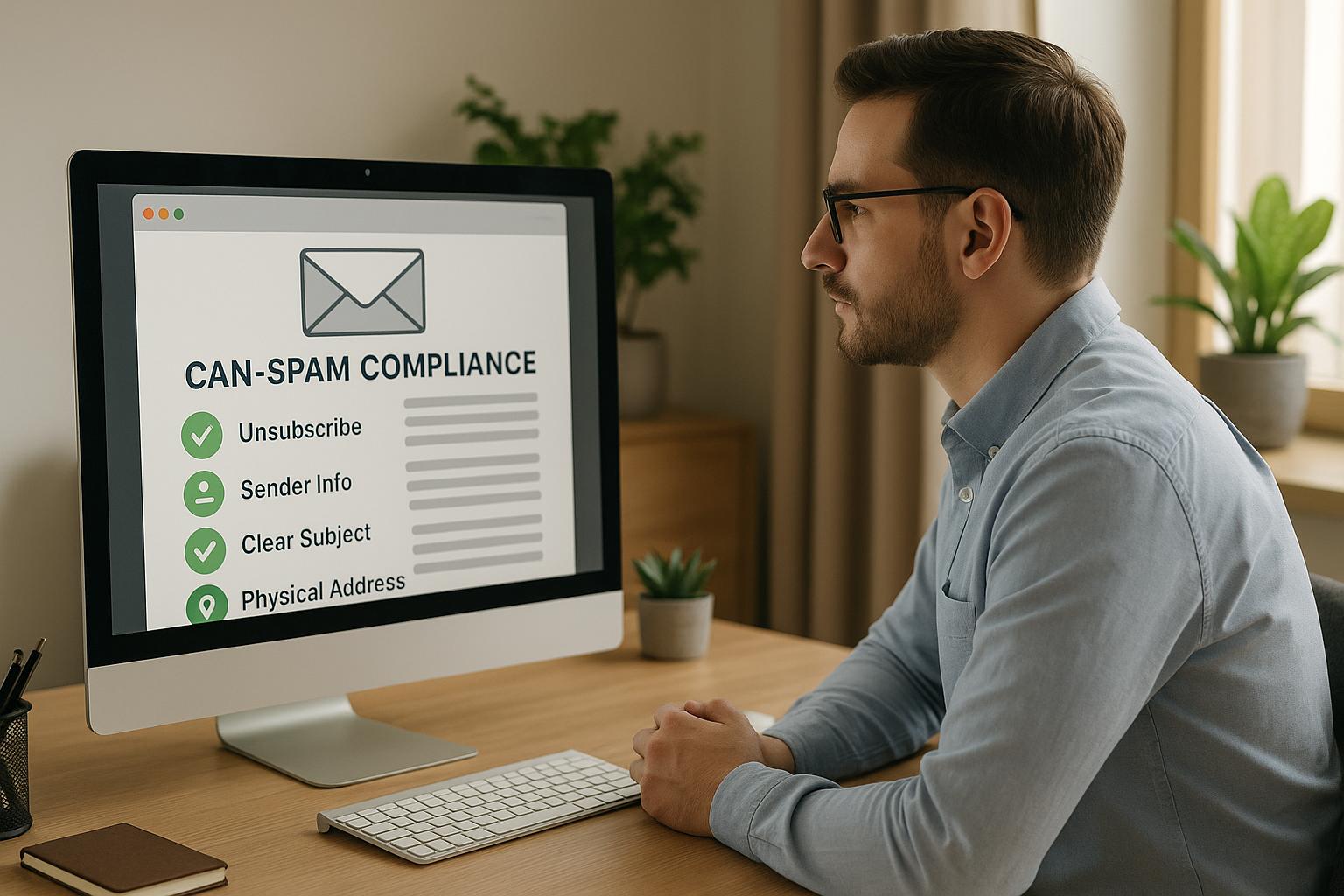
Email compliance is non-negotiable in 2025. Failure to follow the CAN-SPAM Act can lead to fines of up to $53,088 per email and damage your reputation. This federal law requires commercial emails to include clear sender information, truthful subject lines, a valid physical address, and an easy-to-use unsubscribe option. Ignoring these rules risks legal penalties and email delivery issues.
Here’s what you need to know:
Key Requirements: Accurate sender details, honest subject lines, visible unsubscribe links, and a valid address.
Opt-Out Rules: Process unsubscribe requests within 10 business days and maintain suppression lists.
State Laws: Privacy laws like CPRA and VCDPA add stricter requirements, making compliance across states more complex.
Third-Party Risks: You’re responsible for vendors’ actions. Missteps by partners can cost your business.
Automation Tools: AI-driven platforms simplify compliance, handle opt-outs, and ensure email authentication (SPF, DKIM, DMARC).
With the FTC using AI to detect violations, staying compliant is more critical than ever. Invest in the right tools and processes to protect your business while building trust with your audience.
6 Legal Requirements You NEED to Comply With to Send Marketing Emails | CAN-SPAM Act Explained!
CAN-SPAM Compliance Requirements
Staying compliant with CAN-SPAM laws isn’t overly complex, but every detail counts. Overlooking even a single requirement can turn a routine email into a costly mistake. Below, we’ll break down what every email must include and how to manage compliance tasks to keep your campaigns within legal bounds.
Required Elements for Email Campaigns
To meet CAN-SPAM standards, every commercial email must include five key components. Missing any of these could result in fines of up to $53,088 per violation [1][4].
Accurate sender information: Your "From" and "Reply-To" fields must clearly show who’s sending the email. For example, if your business is ABC Janitorial Services, that name - and only that name - should appear. Misleading sender details are not allowed.
Truthful subject lines: The subject line must accurately reflect the email's content. For instance, using a subject like "Quick question about your office cleaning" while pitching services would be considered deceptive.
Clear identification of advertisements: If your email promotes your business, it must be clear to the recipient. While the word "advertisement" isn’t always required, the intent of the message should be unmistakable.
A valid physical address: This can be your business address, a P.O. Box, or another registered address where you can receive mail. The address must be current and functional.
An easy-to-use unsubscribe link: Every email must include a visible, simple way for recipients to opt out. Ideally, unsubscribing should take just one click - no logging in or navigating through multiple pages. For example, a landscaping company should place a clear "Unsubscribe" link at the bottom of every marketing email, ensuring it works immediately.
Additionally, email authentication protocols such as SPF, DKIM, and DMARC are now essential in 2025. These technical measures help verify your identity as the sender and improve deliverability with platforms like Gmail and Yahoo [1].
Managing Opt-Out Requests and Suppression Lists
When someone opts out of your emails, you have 10 business days to process their request and remove them from your list [1][2]. Keep in mind, this timeline excludes weekends and holidays.
Your unsubscribe link must remain active for at least 30 business days after the email is sent [2]. This ensures recipients have ample time to opt out, even weeks after receiving your message.
Maintaining suppression lists is critical. Once someone opts out, their email address must never be contacted again. Selling or sharing these addresses is strictly prohibited [2]. If you work with contractors or third-party tools - like an HVAC company might - you must ensure everyone involved respects your suppression lists.
Beyond managing opt-outs, regular list maintenance is essential. This includes removing invalid email addresses, hard bounces, and contacts that consistently show no engagement. Using tools like Cohesive AI can automate much of this process, but it’s still your responsibility to confirm everything is functioning as it should.
2025 Compliance Updates
The rules for email compliance have tightened further in 2025. The FTC now employs AI and machine learning to identify CAN-SPAM violations, particularly in subject lines and sender domains [1]. This means violations are more likely to be flagged automatically, increasing the importance of strict adherence.
Third-party liability has become a significant concern. If vendors, affiliates, or partners send emails on your behalf, you’re still responsible for ensuring their compliance [1]. Any mistakes they make could result in penalties for your business. This makes thorough vetting of third-party vendors more important than ever.
For example, in August 2024, Verkada faced a record $2.9 million fine for violations, illustrating the financial risks of non-compliance [4]. Businesses must take these updates seriously to avoid similar consequences.
Additionally, state privacy laws like California’s CPRA and Virginia’s VCDPA now intersect with CAN-SPAM regulations. Ignoring opt-out or data deletion requests can lead to enforcement actions at both the federal and state levels [1].
Email service providers are also stepping up enforcement. Many now use real-time compliance dashboards and may suspend or throttle accounts with high complaint or bounce rates [1]. Non-compliance doesn’t just risk legal trouble - it could also limit your ability to reach customers.
The bottom line? In 2025, email compliance is more critical than ever. With AI-driven enforcement, stricter rules for third parties, and overlapping state laws, businesses must adopt thorough systems to ensure every email meets every requirement. There’s no room for shortcuts.
CAN-SPAM Compliant Email Outreach Methods
Creating a compliant email outreach system is entirely possible when you use structured processes and the right technology to simplify compliance tasks. Sticking to rigorous compliance practices not only protects your campaigns but also builds trust with your audience by adhering to legal standards.
Building and Managing Compliant Email Lists
Avoid using purchased or scraped email lists - they're a recipe for compliance trouble and can put your campaigns at risk[1]. Instead, focus on gathering email addresses through trusted methods that provide clear records of consent.
Express consent can be obtained via web forms, in-person meetings during service appointments, or networking events. Be sure to document the details: the timestamp, opt-in method, and consent specifics[3]. If you're relying on implied consent (like from previous service interactions), keep thorough records of the relationship to ensure you're operating within the rules.
To safeguard your email delivery, implement authentication protocols like SPF, DKIM, and DMARC. These help validate your emails and prevent spoofing. Also, keep your lists clean by routinely removing hard bounces and updating suppression lists whenever someone opts out.
Automation tools, such as Cohesive AI, can help manage these tasks by documenting consent, maintaining suppression lists, and ensuring your authentication protocols are up to date. This reduces the chance of human error and keeps your campaigns on the right side of compliance.
Once your email list is in good shape, the next step is to ensure recipients can easily opt out if they choose to.
Creating Simple Opt-Out Processes
Make the unsubscribe process as straightforward as possible. A single-click unsubscribe option that processes requests within 10 business days is ideal[1]. Include a clearly visible unsubscribe link in every email, so recipients can opt out without jumping through hoops. Automated systems can handle these requests instantly, protecting your reputation and reducing potential complaints.
It's also important to regularly test your opt-out process. This ensures that unsubscribe requests are processed correctly and that no technical issues interfere with recipients' ability to opt out.
With your list management and opt-out processes in place, the next focus should be on tracking and refining your campaigns.
Tracking Campaign Performance and Compliance
Keep a close eye on metrics like complaint rates and bounce rates. High complaint rates - more than 0.1% of recipients marking emails as spam - can lead to email providers restricting your deliverability[1]. Similarly, high bounce rates often indicate issues with the quality of your email list.
Regularly audit your email practices to ensure compliance. Each email should include accurate sender information, truthful subject lines, clear commercial intent, a valid physical postal address, and a working unsubscribe link. Document these audits and any corrective actions you take to create a solid compliance record.
Many email service providers offer real-time compliance dashboards that can alert you to potential issues before they escalate. When working with third-party vendors, confirm they follow your compliance standards, as you're ultimately responsible for any non-compliant activity. A stark reminder of this is the August 2024 case involving Verkada, which faced a $2.9 million fine for compliance violations[4].
Common Compliance Challenges for Local Service Providers
Navigating compliance requirements and implementing effective outreach methods can be tricky for local service providers. Overlooking these challenges can put your email campaigns - and your business - at risk.
Dealing with Multiple Regulations
The regulatory landscape has grown more complicated as federal CAN-SPAM rules increasingly overlap with state-specific privacy laws like California's CPRA and Virginia's VCDPA. While CAN-SPAM operates on an opt-out model, state laws often demand stricter privacy measures, such as data deletion rights and more transparency in data collection practices[1][2].
Courts and regulators are also broadening their interpretation of email violations, viewing them through a wider privacy framework. Ignoring opt-out requests or failing to honor data deletion rights could lead to enforcement actions on multiple fronts[1]. Simply adhering to CAN-SPAM is no longer enough.
For local businesses operating across state lines, this creates unique challenges. For example, a landscaping company serving both California and Texas must comply with CPRA’s rigorous privacy standards for California clients while following federal CAN-SPAM rules for Texas customers. To simplify compliance, the safest route is to apply the strictest standards across all your operations. This ensures you meet the highest legal requirements regardless of customer location.
With overlapping regulations, it’s crucial to clearly disclose your data collection practices in every email and to honor opt-out requests within 10 business days, as outlined in the compliance rules.
Working with Third-Party Vendors and Tools
Third-party vendors and email marketing tools often create compliance blind spots for local service providers. Even if a vendor causes a violation, your business remains liable for any CAN-SPAM infractions tied to your name[1]. This has caught many small business owners off guard.
Regulators are cracking down on businesses that attempt to shift blame to vendors when non-compliant emails are sent on their behalf[1]. Ultimately, you’re responsible for every email tied to your brand.
Before partnering with any vendor, thoroughly review their compliance policies. Make sure they use accurate header information, provide clear opt-out mechanisms, and process unsubscribe requests within the required timeframe[2][3]. Regularly auditing and monitoring vendor practices is not just a good idea - it’s essential for protecting your business.
Many email service providers (ESPs) now offer real-time compliance dashboards to flag issues like excessive complaints or high bounce rates[1]. If your ESP suspends or throttles your account due to non-compliance, it could take weeks to recover, disrupting your campaigns. This makes vendor selection and ongoing oversight critical to your compliance strategy.
Platforms like Cohesive AI can help mitigate these risks by offering built-in compliance tools, such as automated suppression list management and consent documentation. These features reduce the chance of vendor-related compliance missteps.
Compliance Mistakes and How to Avoid Them
Avoiding common compliance errors is key to minimizing risks. Here’s a quick guide to help you stay on track:
Correct Compliance Step | Common Mistake |
|---|---|
Use email lists with documented, organic consent | Using purchased or scraped email lists |
Vet vendors and oversee emails sent on your behalf | Overlooking third-party compliance issues |
Process unsubscribe requests within 10 business days | Delaying opt-out processing |
Offer clear and visible unsubscribe options | Hiding or making unsubscribe links hard to find |
Take full responsibility for all emails tied to your brand | Shifting blame to vendors or partners |
Ensure accurate and truthful header information | Using misleading subject lines or headers |
Include a valid physical postal address in all emails | Omitting physical address details |
One of the costliest mistakes you can make is assuming compliance issues will resolve themselves. For instance, in August 2024, security camera company Verkada paid $2.9 million in penalties for CAN-SPAM violations[4]. Even well-established companies are not immune to the financial fallout of non-compliance.
The FTC is now using artificial intelligence and machine learning to detect potential violations at scale. These tools analyze subject lines, sender domains, and complaint patterns to flag risky practices[1]. Businesses relying on questionable tactics are more likely than ever to get caught, making strict adherence to compliance rules the only safe path forward.
To protect your business, conduct regular audits, document your processes, and keep your suppression lists up to date. Every email you send should include these essentials: accurate sender information, truthful subject lines, clear commercial intent, a valid physical postal address, and an easy-to-use unsubscribe link.
Using Technology for CAN-SPAM Compliance
Navigating compliance requirements can feel overwhelming, but technology simplifies the process, especially for local service providers. With the FTC now utilizing AI and machine learning to identify violations on a large scale, having the right tools in place is no longer optional - it’s a safeguard for your business. By combining traditional compliance practices with modern automation, technology makes staying compliant more manageable.
How AI Tools Help with Compliance
AI-powered platforms take the heavy lifting out of CAN-SPAM compliance by automating key tasks. For instance, these tools ensure sender information and headers are accurate across all campaigns, avoiding errors in the "From" and "Reply To" fields that could lead to violations. They also automatically include required elements like visible unsubscribe links in every email template, handling opt-out requests seamlessly without manual input.
A standout example is Cohesive AI, a platform designed to simplify compliance for local service providers. It pulls data from public sources to identify local leads and uses AI to customize cold emails while verifying compliance elements automatically. For industries like janitorial services, landscaping, HVAC, and catering, this means that even as messages are personalized, compliance standards remain intact. This balance not only engages recipients more effectively but also reduces the risk of spam complaints by ensuring transparency in sender details and subject lines.
On the technical side, automated configuration of SPF, DKIM, and DMARC protocols ensures sender legitimacy. SPF specifies which IP addresses can send emails on behalf of your domain, DKIM adds a digital signature to prevent tampering, and DMARC provides instructions to ISPs on handling unauthenticated emails. Without these safeguards, even fully compliant emails risk being flagged or sent to spam.
Reducing Compliance Risks with Automation
Building on AI capabilities, automation takes compliance a step further by reducing manual errors and increasing campaign accuracy. For example, when a recipient opts out, automated systems instantly add their email address to a centralized suppression list, halting all future communications. This ensures compliance across all campaigns without the risk of accidental contact.
For local service providers juggling multiple campaigns - like a landscaping company managing outreach for commercial maintenance, seasonal services, and one-time projects - automation ensures that an opt-out from one campaign applies universally. This unified approach prevents the serious mistake of contacting someone who has already unsubscribed.
Real-time monitoring tools further enhance compliance. Many email service providers now offer dashboards that flag potential issues, such as high bounce rates or excessive complaints. If an account faces suspension or throttling due to non-compliance, it could disrupt all campaigns for weeks. Automated monitoring allows businesses to address problems quickly before they escalate.
Automation also provides critical protection during audits or investigations. Platforms log details such as how contact information was obtained, what permissions were granted, and timestamped records of compliance activities. This detailed audit trail can serve as evidence if the FTC investigates a complaint.
Another challenge technology addresses is oversight of third-party vendors. Automated systems maintain a master suppression list that all vendors must adhere to, ensuring opt-out requests are respected consistently. Centralized monitoring tools track email activity across vendors, reducing the risk of non-compliance from external partners.
With penalties reaching up to $53,088 per email [4] and the FTC’s growing reliance on AI for enforcement, automation isn’t just about efficiency - it’s essential for staying compliant. By reducing human error, ensuring proper documentation, and maintaining oversight, technology minimizes risks and supports adherence to CAN-SPAM requirements. Leveraging both AI and automation allows local service providers to focus on growing their business while staying on the right side of the law.
Summary and Next Steps
Adhering to CAN-SPAM regulations isn’t just about avoiding fines - though those can reach a staggering $53,088 per email for violations [4]. It’s about creating a sustainable email outreach strategy that delivers results while keeping your business compliant with the law.
With the FTC now using AI to detect violations on a large scale [1], compliance has shifted from being a "nice-to-have" to an absolute must for local service providers. Fortunately, modern technology makes it easier to stay compliant while enhancing the effectiveness of email campaigns.
Compliance Checklist Review
Here are the essential elements to review for compliance:
Accurate sender details
Truthful subject lines
A valid physical address
A working unsubscribe link
Another crucial component is maintaining a centralized suppression list. This goes beyond simply honoring opt-out requests - it ensures that individuals who have unsubscribed are not contacted again, regardless of the campaign or vendor. Consumers have the right to opt out of any electronic communication, whether they’re current customers, leads, or subscribers [2].
Regular audits are also vital. These should cover all campaigns to ensure compliance, monitor complaint rates, and verify that any third-party vendors you work with are meeting your standards. The stakes are high: in August 2024, Verkada faced a record $2.9 million CAN-SPAM fine for failing to adhere to email marketing regulations [4].
Compliance Element | Requirement | Penalty Risk |
|---|---|---|
Opt-out processing | Within 10 business days | Up to $53,088 per email |
Sender identification | Accurate, non-deceptive | FTC enforcement action |
Physical address | Must be included | Compliance violation |
Subject lines | Truthful, not misleading | FTC investigation |
By addressing these core elements, you can build a strong foundation for compliant email outreach. From there, technology can help you scale while staying on the right track.
How Technology Supports Compliance
Compliance doesn’t have to be overwhelming. Advanced tools now integrate these requirements into every part of your email campaigns. For example, the FTC’s use of AI to identify violations has pushed email providers to enforce stricter standards like SPF, DKIM, and DMARC authentication [1]. This is where platforms like Cohesive AI come in.
For $500 per month with a $75 setup fee, Cohesive AI automates lead generation from sources like Google Maps and government filings while ensuring every email meets compliance standards [5]. This is especially useful for industries like janitorial services, landscaping, HVAC, and catering, where outreach to local businesses is key. The platform handles suppression lists, processes opt-out requests, and maintains detailed audit trails - critical if you ever face an investigation.
It also simplifies technical aspects of email deliverability, such as authentication protocols now required by major providers like Gmail and Yahoo for high-volume senders [1][5]. Automation ensures that unsubscribes are applied across all campaigns, eliminating the risk of accidentally contacting someone who has opted out.
Investing in compliance technology is a smart move. A single campaign sent to 1,000 non-compliant addresses could rack up over $53 million in penalties [1]. For most local businesses, even a fraction of that would be devastating, making the cost of these tools a small price to pay for peace of mind.
Beyond avoiding fines, compliance technology can boost your email performance. Emails that meet authentication standards are more likely to land in inboxes. Clear opt-out options reduce complaints, and professional practices build trust with recipients. Over time, this leads to better engagement, stronger relationships, and more consistent growth.
The bottom line? Choose platforms that prioritize compliance as a core feature, not an afterthought. With the FTC ramping up enforcement and email providers tightening requirements, compliance needs to be seamlessly integrated into every part of your email strategy.
FAQs
What happens if local service providers don’t comply with the CAN-SPAM Act?
Failing to follow the CAN-SPAM Act can have serious financial and legal consequences for local service providers. Each violation can result in fines of up to $50,120, and if multiple emails fail to meet the standards, those penalties can add up fast. On top of that, businesses might face legal action from the Federal Trade Commission (FTC) or even private lawsuits.
To steer clear of these issues, make sure your email campaigns meet all CAN-SPAM guidelines. This includes having a clear way for recipients to opt out, avoiding misleading subject lines, and ensuring your sender information is accurate. These steps not only keep you compliant but also help establish trust with your audience.
How can local service providers ensure compliance with federal CAN-SPAM regulations and state privacy laws like CPRA and VCDPA?
To ensure compliance with federal CAN-SPAM regulations and state privacy laws like the California Privacy Rights Act (CPRA) and the Virginia Consumer Data Protection Act (VCDPA), local service providers should prioritize a few essential practices:
Get clear consent: Make sure recipients have explicitly opted in to receive your emails, especially when operating in states with stricter privacy requirements.
Include mandatory details in every email: Always feature a clear subject line, your business's physical address, and an easy-to-find option for recipients to unsubscribe from future emails.
Stay up-to-date on legal changes: Privacy laws differ by state and can change frequently. Keeping informed is crucial to avoid compliance issues.
Leveraging AI-driven tools can help streamline compliance efforts by automating tasks like email personalization, managing opt-outs, and verifying that campaigns meet legal standards. However, it’s always wise to consult a legal expert for advice tailored to your business.
How can AI-driven technology help local service providers stay compliant with CAN-SPAM regulations in email marketing?
AI-powered platforms make managing CAN-SPAM compliance much easier by automating essential parts of email marketing. These tools can assist in finding local business leads, creating tailored email content, and running campaigns smoothly - all while helping to minimize compliance risks.
For local service providers, these solutions ensure that emails follow legal guidelines, like including clear opt-out mechanisms and accurate sender details. By handling these tasks, businesses can concentrate on building relationships with potential clients without worrying about regulatory missteps.