Ultimate Guide to Cross-Channel Campaigns
Jul 29, 2025
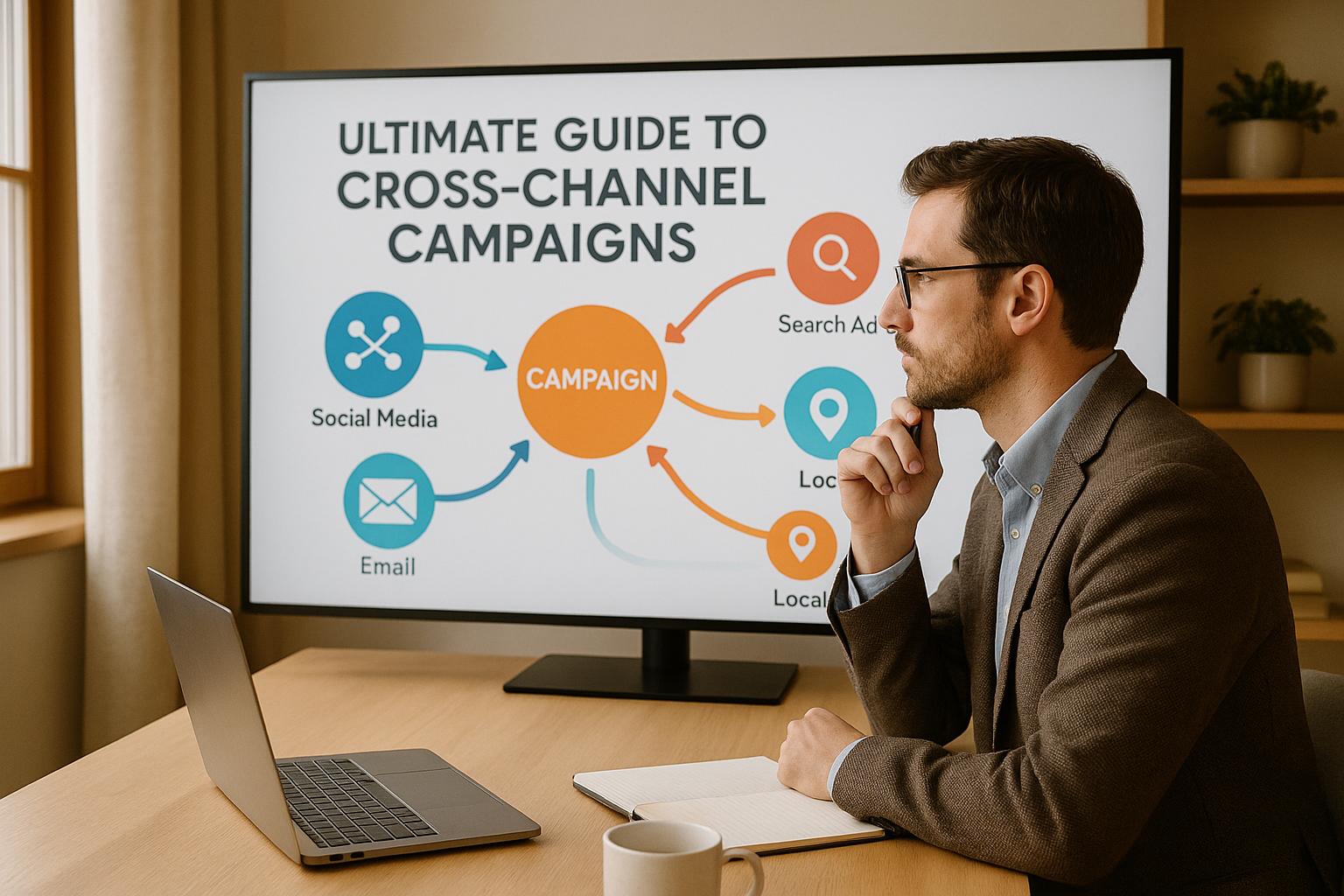
Cross-channel campaigns connect marketing efforts across platforms like email, social media, SMS, and ads to create a unified customer experience. Unlike multi-channel marketing, which treats each platform separately, cross-channel campaigns integrate them to ensure consistent messaging and personalized interactions. This approach is particularly effective for local service businesses like HVAC, landscaping, and janitorial services, helping them increase customer lifetime value, retention rates, and purchases.
Key Takeaways:
What It Is: Cross-channel marketing links platforms for a seamless customer journey.
Why It Works: It boosts customer engagement with personalized, consistent messaging.
Who Benefits: Local businesses targeting specific audiences with limited resources.
Challenges: Data silos, lack of personalization, attribution issues, and limited resources.
Solutions: Use tools like AI-driven platforms to automate, personalize, and manage campaigns.
By integrating efforts, tracking performance metrics like ROI and CAC, and refining strategies over time, businesses can see higher conversions and better customer relationships.
Mastering Cross-Channel Marketing For A Seamless Customer Journey
Core Elements of Cross-Channel Campaigns
Creating effective cross-channel campaigns hinges on three essential components that work together to establish meaningful connections with customers. These elements serve as the foundation for any marketing strategy aimed at local service businesses.
Planning, Messaging, and Audience Segmentation
The first step is to develop a strategic plan that maps out every customer interaction. This involves creating buyer personas and journey maps to pinpoint key touchpoints along the way.
Using a centralized calendar can simplify scheduling across platforms, ensuring consistency. For example, an HVAC company might coordinate an email campaign about winter maintenance with matching social media posts and SMS reminders.
"Cross-channel marketing keeps your message consistent across platforms, creating a seamless experience for your audience. It means better engagement, higher conversions, and a more cohesive brand presence." - Nathaniel Miller, Head of Marketing at HarvestIQ [1]
Audience segmentation transforms generic outreach into personalized communication. Instead of sending the same message to everyone, businesses can tailor their campaigns to specific groups based on factors like industry, company size, or past interactions. For instance, a janitorial service might craft unique messages for restaurant owners and office building managers, addressing their distinct needs.
Take a landscaping company as another example: they might use emails to share detailed project descriptions, social media to showcase before-and-after photos, and SMS to send quick appointment reminders.
"In my opinion, the key challenge here is to keep your messaging consistent on every platform while also balancing that with customizing your campaign for every platform." - Ruslan Halilov, Chief Marketing Officer at BlueDotHQ [1]
Once the groundwork for planning and segmentation is laid, automation tools come into play to ensure smooth execution.
Automation Tools for Managing Campaigns
Running multi-channel campaigns manually can overwhelm local service businesses, especially those with limited resources. Automation tools simplify this process by connecting various channels and ensuring consistent messaging.
Modern tools take care of everything from generating leads to executing campaigns. They can integrate with CRM systems to track and document interactions, making it easier to craft personalized content [1].
For example, Cohesive AI offers a solution for local services like janitorial, landscaping, and HVAC companies. It uses AI to scrape data from Google Maps and government filings, personalizing cold emails. For $150 per month plus a $50 setup fee, it promises at least two interested responses each month.
Content management platforms further enhance efficiency by enabling teams to schedule promotions and collaborate seamlessly. Emails, social media posts, and SMS reminders can all be launched at the optimal times without the need for manual intervention [2].
The real strength of automation lies in its ability to scale personalization. Instead of generic messages, AI-driven tools can address specific customer pain points. For example, a facility management company might send tailored messages to restaurant managers focusing on health code compliance, while office building owners receive content about cost-effective maintenance solutions.
Following Communication Laws and Regulations
Automating campaigns is only part of the equation; staying compliant with communication laws is equally critical. Following regulations like the Telephone Consumer Protection Act (TCPA), the CAN-SPAM Act, and CTIA guidelines helps protect businesses from hefty fines and builds customer trust [9].
Violating these laws can be costly. Each email that breaches the CAN-SPAM Act could result in penalties of up to $53,088 [4]. TCPA violations carry fines ranging from $500 to $1,500 per infraction, with lawsuits increasing 79% in early 2023 compared to the previous year [8][10].
Securing explicit consent is the cornerstone of compliance [7]. Businesses must obtain clear permission before sending marketing messages and maintain detailed records to defend against complaints [8].
Time restrictions also play a role. The TCPA prohibits text messages before 8:00 AM or after 9:00 PM in the recipient's local time zone [8]. Additionally, opt-out mechanisms must be straightforward and immediate. New TCPA rules taking effect on April 11, 2025, will expand opt-out options, require confirmation texts, and shorten processing times to 10 business days [5]. Businesses must ensure their systems can handle various opt-out requests consistently across all channels [5].
To stay compliant, businesses can implement strategies like using double opt-in processes for website subscriptions, regularly cross-checking contact lists with the National Do Not Call Registry, and consulting with compliance experts before launching campaigns [6][8].
Main Channels for Local Service Lead Generation
Local service businesses have a variety of effective channels for connecting with potential customers. Each channel brings its own strengths, and when used together, they can create a powerful lead generation strategy. Let’s take a closer look at some of these key methods.
Email Marketing
Email remains one of the most cost-effective tools for reaching customers directly. Unlike social media, where posts can easily get buried in feeds, email provides a direct and personal way to communicate. It’s especially useful for building long-term relationships with potential clients.
For example, a landscaping business could send out seasonal updates: spring maintenance tips, summer project ideas, and winter preparation reminders. By consistently offering helpful information, the business stays top-of-mind when customers are ready to hire.
Personalization plays a huge role in email success. In fact, 76% of consumers feel frustrated when businesses fail to make their messages personal[11]. To avoid this mistake, many local businesses segment their email lists based on factors like past services or customer preferences.
Take Emerald Landscape Solutions in Hiddenite, NC, for instance. They combined targeted email campaigns with social media outreach by encouraging followers to join their newsletter. By sharing valuable content, they not only increased brand awareness but also generated a steady stream of leads in their community[12].
Email is also great for follow-ups. Imagine an HVAC company that sends a sequence of emails after an initial consultation. These emails could explain their services, share customer reviews, and address common questions - helping hesitant prospects move closer to making a decision. Tools like Cohesive AI can simplify this process by automating tasks like personalization and campaign management, all for a predictable monthly cost.
SMS and Text Messaging
SMS is another powerful way to connect, offering quick and highly engaging communication. It’s ideal for appointment reminders, urgent updates, and time-sensitive promotions.
Timing and relevance are critical for SMS campaigns. For example, a plumbing company might send out tips for frozen pipe prevention when temperatures hit freezing, while a janitorial service could promote emergency cleaning during flu season. This channel works particularly well for appointment-based services, like HVAC tune-ups or plumbing repairs, where timely reminders can reduce no-shows and improve efficiency.
By addressing customer needs in real time, SMS helps businesses build trust and reliability with their audience.
Social Media and Digital Advertising
Social media platforms like Facebook and Instagram are invaluable for showcasing work, building trust, and expanding reach. With search engines now the top source for brand discovery - beating out traditional TV ads[13] - a strong online presence is crucial.
These platforms are ideal for visual storytelling. Think before-and-after photos, time-lapse videos, or behind-the-scenes glimpses that highlight expertise and build credibility. Nearly half of consumers are more likely to choose local businesses with a strong online presence[13].
For instance, Leak Stoppers Plumbing in Asheville, NC, uses educational content and videos to attract organic traffic and generate leads within their community[12].
Digital advertising takes things a step further by allowing precise geographic targeting. A janitorial company might focus on office managers in nearby areas, while a catering business could zero in on event planners within specific zip codes. This level of precision ensures that marketing budgets are spent reaching the right audience.
Online reviews also play a huge role in local service marketing. Over 99% of customers read reviews, and nearly half trust them as much as personal recommendations[13]. Encouraging happy clients to leave reviews can create powerful testimonials that influence new customers.
Combining organic social media efforts with paid ads creates a well-rounded strategy. Organic posts help businesses build relationships and showcase their expertise, while targeted ads expand their reach to new audiences. Plus, detailed analytics from ad platforms allow businesses to measure success and tweak campaigns for better results.
How to Coordinate Cross-Channel Campaigns
Bringing your marketing channels together under one strategy can make your campaigns more effective and efficient. Instead of treating each channel as a separate effort, think of them as pieces of a larger puzzle. This approach ensures your messages are consistent and your resources are used wisely. Below, we’ll explore how to centralize planning, use AI for personalization, and track performance to make real-time adjustments.
Centralized Campaign Planning
Centralized planning ties all your channels together, ensuring a unified message across platforms. Whether it's email, SMS, or social media, every piece of content should work together to tell the same story. This consistency creates a seamless experience for your audience, no matter where they interact with your brand.
A great way to achieve this is by creating a master campaign calendar. This calendar helps you align themes and timelines across channels while tailoring each message to fit the strengths of the specific platform. For example, a landscaping business promoting spring cleanup services might use detailed emails to explain the services, SMS for quick appointment reminders, and social media to showcase before-and-after photos of their work. By coordinating the timing of these messages - from the initial announcement to follow-up reminders - you can keep your audience engaged without overwhelming them.
Using AI and Automation for Personalization
AI tools can turn mass messaging into personalized conversations that resonate with your audience. Instead of sending the same message to everyone, AI allows you to customize content based on customer behavior, location, or preferences.
For instance, tools like Cohesive AI can analyze public data to identify potential leads and craft personalized cold emails. Automation can then trigger follow-ups, such as sending an SMS after an email goes unanswered, ensuring timely and relevant interactions.
Dynamic content takes personalization a step further by tailoring messages in real time. Imagine an HVAC company using email automation to recommend heating services to customers in colder regions while suggesting air conditioning solutions to those in warmer climates. Behavioral triggers can also enhance engagement - like sending a personalized SMS when someone visits your website’s pricing page. Once these personalized interactions are in place, continuous tracking can help refine your approach even further.
Tracking and Adjusting Campaign Performance
To keep your campaigns on track, monitor performance daily and make adjustments as needed. Waiting for lengthy reports can slow you down, but unified analytics dashboards let you see what’s working in real time.
These dashboards provide insights into which touchpoints are driving conversions, helping you make quick decisions about budget allocation and strategy shifts. For example, a B2B company using cross-platform attribution discovered that pairing email campaigns with social media ads led to higher conversion rates, inspiring a more integrated approach to their marketing efforts [14].
Regularly analyzing customer data is crucial for improving your campaigns. If SMS open rates drop, experiment with different sending times or message formats. A/B testing can also help you identify what resonates most with your audience - try tweaking email subject lines, social media call-to-action buttons, or SMS timing to optimize engagement [14].
Cross-channel attribution provides a clearer picture of the customer journey. You might find that prospects often see a social media ad first, engage with an email next, and finally convert after receiving an SMS reminder. Understanding this sequence allows you to refine the entire process instead of focusing on just one channel.
Tracking performance also helps you allocate your budget more effectively. If email consistently generates more qualified leads than social media ads, you might shift more resources to email. AI-powered tools can further streamline this process by automatically adjusting bids, refining audience targeting, and reallocating budgets based on real-time data [14].
The goal isn’t to get everything perfect right away - it’s about ongoing improvements driven by measurable results. By continuously analyzing and refining your strategy, you’ll create campaigns that not only perform better but also connect more meaningfully with your audience.
Measuring and Improving Cross-Channel Campaigns
Achieving success in cross-channel marketing hinges on your ability to measure performance effectively and refine your strategies over time. Without proper tracking, you risk wasting both time and resources. To stay on track, focus on clear metrics, leverage reliable tracking tools, and use the insights to guide improvements.
Tracking Performance Across All Channels
Once you’ve planned and personalized your campaigns, the next critical step is precise tracking. Centralized dashboards are invaluable here - they bring together data from email, SMS, and social media, giving you a complete view of how your campaigns are performing.
A standout method for tracking is multi-touch attribution models, which assign credit to every channel involved in a customer’s journey [20]. For instance, a customer might first see a Facebook ad, later open an email, and finally act on an SMS reminder. Unlike single-touch attribution, which credits only the final step, multi-touch models provide a more accurate picture of each channel's role.
When setting up your tracking system, make sure your tools can monitor multiple channels on a unified platform [20]. This simplifies reporting and helps you identify trends across touchpoints. Use unique tracking URLs for each channel and enable conversion tracking with tools like Google Analytics and Facebook Pixel to gain deeper insights [21].
Important Metrics for Campaign Success
To truly gauge your campaign’s effectiveness, focus on metrics that reflect your business impact rather than superficial ones like social media likes. Metrics tied to revenue and customer acquisition are far more telling.
Metric Category | Key Measurements | What It Tells You |
|---|---|---|
Revenue Impact | ROI (Email: 300-500%, Social: 150-300%, Content: 200-400%, PPC: 200-350%), CAC, CLTV | Financial performance and long-term profitability |
Engagement Quality | Conversion rates, click-through rates, response rates | How well your messaging connects with your audience |
Channel Effectiveness | Cost per lead by channel, lead quality scores | Which channels deliver the best value for your spend |
For local service businesses, Customer Acquisition Cost (CAC) is especially critical. Calculate CAC by dividing your total campaign spend by the number of new customers acquired. For example, if a $500 campaign brings in 10 new customers, your CAC is $50. Compare this figure to your average Customer Lifetime Value (CLTV) to ensure your efforts are profitable.
Track these metrics on a monthly basis and establish ROI targets for each channel [15]. Use the insights to fine-tune your campaigns and improve results over time.
Ongoing Campaign Improvement
Refining your campaigns is an ongoing process, and A/B testing is one of the most effective tools for improvement. Test high-impact elements like email subject lines, SMS timing, and social media visuals to see what resonates most with your audience.
For example, one case study showed that email revenue grew over 50% through A/B testing, even without increasing email volume [17]. Real-time monitoring is equally important - set up alerts for indicators like email deliverability, spikes in SMS opt-outs, or sudden drops in website traffic. This allows you to make quick adjustments before issues escalate [16].
Predictive analytics can take your optimization efforts to the next level. By analyzing historical data, you can anticipate customer behavior and fine-tune future campaigns. For example, if certain customer segments are more responsive to SMS messages during specific times, adjust your schedule to maximize engagement [19].
"Over half of marketing leaders (62% of those surveyed) confirm that their company has already invested in AI", according to Hubspot [18].
AI-powered tools are proving to be a game-changer for businesses committed to data-driven marketing. However, the technology is only as good as the data it’s fed. Forrester Research reports that 37% of marketing budgets are wasted due to poor data management [16]. To avoid this, focus on collecting clean, actionable data and empower your team to act on the insights.
Regular audience segmentation is another key to success. By grouping customers based on behavior, location, or purchasing habits, you can create more tailored messaging [19]. For instance, a landscaping company might segment customers by property size, service history, or seasonal needs to craft campaigns that feel personalized and relevant.
Local service businesses can also use platforms like Cohesive AI to streamline their efforts. These tools combine lead generation with performance analytics, making it easier to gather data and unify insights across channels. With regular optimization, your cross-channel campaigns can become more aligned and effective over time.
Conclusion
Cross-channel campaigns have become a game-changer for local service businesses aiming to thrive in today’s competitive market. Businesses utilizing three or more channels experience a 287% higher conversion rate [23], while those adopting data-driven marketing achieve 5–8x the ROI compared to less strategic approaches [23]. By integrating efforts across multiple platforms and grounding them in unified insights, businesses can see the impressive results highlighted here.
With the average customer engaging with six marketing channels before making a purchase and 50% regularly interacting with more than four [22], relying on just one channel limits your reach and impact. For instance, email marketing delivers an impressive $42 return for every dollar spent [22], while SMS marketing boasts six to eight times higher engagement rates [22]. When used together, these channels amplify each other’s strengths, creating a compounded effect.
Key Points Summary
Here’s a recap of the core elements for building effective cross-channel campaigns:
Strategic Planning: Dive into your audience’s behavior, map out their journey, and craft messaging that feels seamless across platforms. While maintaining your brand’s voice, tailor your approach to fit the nuances of each channel.
Channel Selection: Start with one key platform - like Google My Business for local visibility - before branching out to other spaces where your audience is most active. Avoid spreading your efforts too thin.
Automation and Personalization: Tools like Cohesive AI can simplify campaign execution, ensuring your messages reach the right audience at the right time without the hassle of manual intervention.
Continuous Improvement: Regularly monitor performance metrics to refine your campaigns. Treat them as evolving systems, adjusting based on real-time data to stay aligned with your business objectives [25].
Next Steps for Local Service Providers
To put these strategies into action, begin by identifying your target audience and the platforms they frequent. Create a customer journey map to visualize every interaction, from initial awareness to post-service follow-up [24][3]. With 90% of customers expecting consistent brand interactions across channels [22], maintaining cohesive messaging and branding is non-negotiable.
Simplify your efforts by leveraging tools designed for cross-channel marketing. For example, Cohesive AI integrates lead generation with campaign management, allowing you to maintain consistency across email and other platforms without juggling multiple systems.
Start with a pilot project to test your approach, analyze the results, and scale up based on clear performance metrics. Optimized cross-channel campaigns can improve budget efficiency by 15–20% [26], making them a smart investment for both customer acquisition and long-term growth. Your audience is already engaging across various platforms - meet them there with coordinated, personalized messaging that leads them to choose your services.
FAQs
How can local service businesses run effective cross-channel campaigns on a tight budget?
To make the most of cross-channel campaigns with limited resources, local service businesses should zero in on automation and focus on high-impact channels. Begin by figuring out where your audience spends the most time - whether that's social media, email, or local directories. Once you know, align your messaging across these platforms to deliver a seamless and consistent experience.
Using budget-friendly tools, like AI-powered platforms, can simplify tasks such as lead generation, personalized emails, and campaign management. These tools save both time and money while keeping your efforts efficient. On top of that, strategies like local SEO, participating in community groups, and tapping into organic social media can help you widen your reach without breaking the bank.
Keep an eye on your campaign performance and tweak as needed to get the best results. Even small changes can lead to noticeable improvements in your return on investment over time.
What mistakes should I avoid when using automation tools for cross-channel marketing?
When leveraging automation tools for cross-channel marketing, it's important to steer clear of a few common pitfalls that can derail your efforts:
Ignoring data quality: If your data is messy or outdated, your targeting can go off the rails, leading to irrelevant messages that frustrate rather than engage your audience.
Overdoing automation: Automating everything without properly segmenting your audience can make your campaigns feel robotic and disconnected, ultimately lowering their impact.
Disjointed platforms: When your tools don't integrate smoothly, it can lead to inefficiencies and create a fragmented experience for your customers.
To get the most out of your automation tools, prioritize clean, reliable data, craft a well-thought-out strategy, and make sure your platforms work in harmony. These steps can help you create campaigns that feel connected and resonate with your audience.
How can businesses stay compliant with communication laws when running cross-channel campaigns?
To ensure compliance with communication laws during cross-channel campaigns, businesses need to follow key regulations such as the Telephone Consumer Protection Act (TCPA) and the Federal Trade Commission (FTC) Act. These laws are designed to prevent deceptive practices and mandate that opt-out requests are respected across all communication channels. A critical part of compliance is processing opt-out requests quickly - typically within 10 business days - and having reliable systems in place to handle them efficiently.
It's also important to keep an eye on changes in state privacy laws, as new regulations can introduce additional restrictions on how businesses interact with their audience. Regularly reviewing legal requirements and updating your processes accordingly not only helps you avoid fines but also strengthens the trust your customers have in your brand.