AI vs. Traditional Lead Generation: Key Differences
Nov 29, 2025
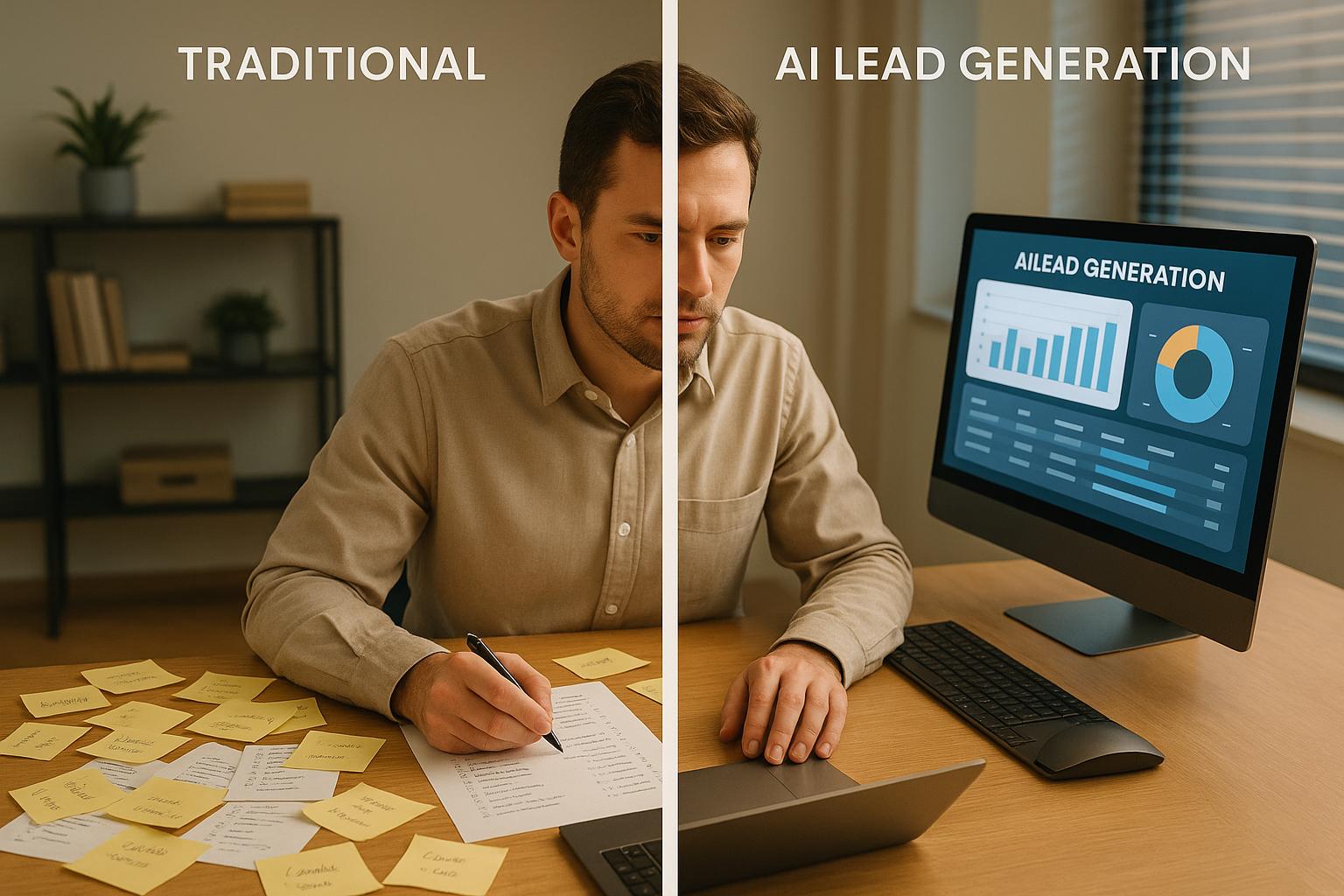
AI-powered lead generation outperforms traditional methods in cost, efficiency, and results. Here's why:
Cost: AI reduces the cost per lead from $50–$100 to $20–$40, saving businesses thousands annually.
Efficiency: AI qualifies leads in minutes, compared to 5–7 days, and automates repetitive tasks, cutting manual work by 40%.
Scalability: AI handles thousands of leads without needing additional staff, unlike traditional methods that scale with higher costs and resources.
Results: AI boosts conversion rates to 15–30%, compared to 1–3%, and response rates to 25%, significantly increasing ROI.
Quick Comparison
Feature | Traditional Methods | AI-Powered Methods |
|---|---|---|
Cost Per Lead | $50–$100 | $20–$40 |
Lead Qualification | 5–7 days | Minutes |
Conversion Rate | 1–3% | 15–30% |
Scalability | Requires more staff | Automated, fixed cost |
Response Rate | ~10% | Up to 25% |
For local service businesses, AI tools like Cohesive AI offer a cost-effective way to generate leads, personalize outreach, and manage campaigns automatically. At $500 per month, they provide a scalable solution that delivers better results than traditional methods. If you're spending too much on leads or struggling with low conversion rates, AI is worth exploring.
16 Insane AI Lead Generation Systems for 2025 (with PROOF!)
Traditional Lead Generation: How It Works
Traditional lead generation relies heavily on manual effort and personal outreach. For years, local service businesses have leaned on these tried-and-true methods to connect with potential customers. While they’re familiar and straightforward, these approaches often come with challenges that can strain daily operations and limit long-term growth. These manual strategies lay the groundwork for the more scalable, automated methods discussed later.
Common Traditional Methods
Cold calling:
Sales teams spend countless hours dialing prospects to introduce services and qualify leads. However, it’s a tough game - about 82% of cold calls go unanswered
[6].
Direct mail campaigns:
This involves sending physical promotional materials like postcards, brochures, or letters to specific addresses. For instance, a janitorial company might send flyers to offices within a 20-mile radius, followed by calls or emails. While effective for some, these campaigns require upfront costs for design, printing, and postage, with response rates typically hovering around 10% or less
Print advertising:
This includes ads in local newspapers,
Yellow Pages listings, and industry directories. While these channels provide visibility, they rely on prospects taking the initiative to reach out, making them a more passive approach.
Networking events and trade shows:
Events like local chamber meetings or trade shows offer opportunities to meet potential clients face-to-face. For example, a landscaping business owner might distribute business cards and build connections at a home and garden expo. However, these events involve costs like travel, booth fees, and staff time.
Manual lead qualification:
After initial contact through these methods, sales reps typically research each prospect, verify contact details, and assess fit - all manually. This process is not only time-consuming but also prone to errors.
Benefits of Traditional Approaches
Building personal connections:
In industries where trust is key, nothing beats a friendly phone call or a handshake at a networking event. These personal interactions can establish credibility, especially when the service involves entering someone’s home or managing critical facilities.
Ease of implementation:
Many small businesses have built their customer base using these methods. They’re straightforward, requiring minimal technical expertise or specialized tools. Plus, in-person interactions allow for immediate feedback, helping sales teams adjust their pitch on the spot.
Challenges for Local Businesses
Time-intensive and resource-heavy:
Cold calling alone demands dedicated staff, with conversion rates typically falling between 1–3%
[1]. Given these low rates, the effort required can be substantial.
Limited scalability:
Traditional methods are tied to human capacity. To expand their reach, businesses need to hire and train more staff, which can quickly drive up costs
[1].
Decreasing effectiveness:
Modern buyers are more informed than ever, with access to endless online resources. Generic messaging often falls flat, leading to lower engagement rates
Slow lead qualification:
Manual processes can take 5–7 days to determine if a lead is worth pursuing
[1]. This delay gives competitors a chance to swoop in. On top of that, the average first response time can stretch to 12 hours or more [6], creating missed opportunities.
High cost per lead:
Traditional methods are expensive, with costs ranging from $50 to $100 per lead
[1]. For example, a local HVAC company might need 50 leads to land a single customer at a 2% conversion rate. That adds up to a customer acquisition cost of around $5,000 - before factoring in additional sales expenses.
Operational challenges:
Managing multiple campaigns manually is not only time-consuming but also error-prone. Lead information often gets scattered across various systems, making it tough to track performance accurately. Add in staff turnover, and businesses risk losing valuable knowledge about what works best.
AI-Powered Lead Generation: How It Works
AI-powered lead generation has completely changed the game by automating tasks that used to take hours of manual effort. Instead of sales teams spending endless hours combing through directories or making cold calls, AI systems now gather data from a wide range of sources - social media, website analytics, customer interactions, and even databases like Google Maps and government filings. Machine learning algorithms then step in to analyze this data and decide the best course of action [3]. The result? A system that can juggle a huge number of leads while still delivering personalized outreach.
The real advantage lies in how fast and precise these systems are. Traditional methods rely on human judgment and manual research, which can be slow and inconsistent. AI platforms, on the other hand, analyze massive amounts of data in minutes to spot patterns that indicate which leads are most likely to convert. They don’t just work faster - they get smarter over time, fine-tuning their targeting and messaging strategies. This makes it easier to see why AI is outperforming traditional methods in areas like cost, scalability, and lead quality.
Key Features of AI-Powered Lead Generation
Automated Data Collection and Lead Identification
AI tools excel at pulling information from sources that would take humans ages to sift through. These platforms identify potential leads by analyzing multiple factors - like business type, location, and industry trends - and then compile detailed profiles automatically. This eliminates the need for manual data entry and ensures a comprehensive view of each prospect.
AI-Driven Lead Scoring
Using machine learning, these systems analyze historical data to spot behaviors that signal purchase intent - things like repeated email opens or visits to pricing pages. What used to take days of manual effort can now happen in just minutes [1].
Personalization at Scale
AI doesn’t do one-size-fits-all. It tailors messages based on buyer behavior and preferences [2]. For example, a janitorial service might receive messaging that speaks directly to the challenges of managing local facilities, something traditional methods struggle to achieve.
Real-Time Analytics and Optimization
AI platforms constantly track campaign performance, analyzing which messages and strategies are working. Unlike traditional campaigns, which often need weeks of manual tweaking, AI adjusts targeting and messaging instantly to improve results over time.
Instant Engagement and Routing
With AI-powered chatbots and virtual assistants, businesses can engage leads immediately, qualifying and routing high-intent prospects in under five minutes. Compare that to the typical 12-hour response time of traditional methods, and the difference is clear [6].
Advantages Over Traditional Methods
The gap between AI-driven and traditional lead generation methods is striking. For instance, a fintech startup that adopted an AI agent for inbound inquiries saw a 40% jump in qualified leads and cut response times by 60% in just six weeks [6]. Similarly, a software company shortened its sales cycle by 30% and boosted revenue by 25% after implementing AI-powered targeting [2].
These results come from key advantages. By automating lead research and outreach, AI reduces manual work by up to 40%, freeing sales teams to focus on higher-value tasks. Traditional methods typically see response rates around 10%, but AI strategies can push that number to 25%, with lead quality scores improving by as much as 40% [2]. AI also slashes the cost per lead from $50–$100 to $20–$40 [1].
Scalability is another big win. Traditional approaches are limited by human capacity - scaling up usually means hiring and training more people. AI platforms, however, can handle massive lead volumes without needing additional resources. They also integrate seamlessly with CRM systems, automatically updating lead information and simplifying campaign management [6][2].
Cohesive AI: A Solution for Local Service Businesses
Cohesive AI is a prime example of how AI-powered lead generation can help local service businesses thrive. Designed for industries like janitorial services, landscaping, HVAC, catering, and business brokerage, this platform automates the process of finding local business prospects. It starts by scraping Google Maps to locate businesses that meet specific criteria - such as industry, location, and size - and then gathers contact details from government filings, building detailed profiles along the way.
The platform uses machine learning to craft personalized cold emails tailored to each business’s unique characteristics and local market conditions. For example, a janitorial service targeting office buildings would receive messaging that’s entirely different from one focused on medical facilities. Cohesive AI handles everything from the initial email to follow-up sequences, response tracking, and engagement monitoring. It even ensures high deliverability and integrates smoothly with CRM systems.
At $500 per month, plus a one-time $75 setup fee, Cohesive AI offers a cost-effective alternative to traditional lead generation agencies, which often charge thousands of dollars monthly. Supporting up to three campaigns at once, the platform guarantees at least four interested responses per month, offering a free month if this target isn’t met. This ensures that local service businesses can consistently generate high-quality leads without overburdening their teams.
Cost and ROI Comparison
Understanding the costs and returns of different lead generation methods is crucial for any business aiming to grow. The financial gap between traditional techniques and AI-driven solutions is striking, extending well beyond the monthly subscription fees.
Upfront and Ongoing Costs
Traditional lead generation methods come with hefty and often escalating expenses. For example, hiring sales representatives for cold calling costs between $30,000 and $60,000 annually per person, plus $50 to $300 per month for phone systems and CRM tools. Direct mail campaigns? They’ll set you back $0.50 to $2.00 per piece, with meaningful results often requiring 5,000 to 10,000 mailers. Attending events adds another layer of expense, with registration fees ranging from $500 to $5,000, not including travel costs and the time staff spend away from their primary responsibilities.
Many businesses also turn to lead generation agencies, which typically charge a $1,000 to $5,000 monthly retainer or take 20% to 30% commission on every closed deal. And here’s the kicker: these costs scale directly with volume. Want to double your leads? You’ll need to double your budget, whether that’s for more staff or a larger agency retainer. This creates a rigid overhead structure that doesn’t adjust based on lead quality.
AI-powered platforms, on the other hand, flip this cost model on its head. These tools typically cost between $500 and $3,000 per month, depending on the features and lead volume. The key difference? Costs remain stable regardless of how many leads are processed. Whether you’re handling 100 leads or 10,000, the pricing doesn’t balloon, eliminating the scaling problem that burdens traditional methods.
For instance, platforms like Cohesive AI offer a straightforward pricing structure tailored for local service businesses: $500 per month with a one-time $75 setup fee. This includes automated lead scraping, AI-driven email personalization, and full campaign management - all for a fraction of the cost of hiring a single sales rep or working with a traditional agency. These cost efficiencies directly translate into better ROI, as outlined below.
ROI and Cost-Per-Lead Analysis
AI-powered strategies significantly reduce costs per lead compared to traditional methods. While traditional approaches cost $50 to $100 per lead, AI solutions bring this down to $20 to $40 - a 50% to 60% reduction [1]. For a business generating 100 leads each month, this means spending $2,000 to $4,000 with AI versus $5,000 to $10,000 using traditional methods. Over the course of a year, that’s a savings of $36,000 to $96,000.
But the real game-changer lies in the improved outcomes. AI-powered lead generation boosts conversion rates to 15% to 30%, compared to just 1% to 3% with traditional methods [1]. For a business generating 100 leads per month, this means landing 15 to 30 deals instead of just one to three - a 10x increase in sales.
Speed also plays a critical role. Traditional lead qualification can take 5 to 7 days, during which leads often go cold or competitors swoop in [1]. AI platforms, however, qualify leads in minutes - sometimes in under five. For example, a fintech company using AI-driven behavioral triggers and sentiment analysis saw a 40% jump in qualified leads and cut response times by 60% in just six weeks [6]. For local service businesses, this speed advantage is crucial. Imagine a homeowner with a burst pipe - they’re going to hire the first plumber who calls them back, making a quick response a direct driver of revenue.
The long-term benefits of AI are just as compelling. Businesses using AI-powered targeting have seen conversion rates increase by 25% to 30%, with average order values rising by 15% [2]. One software company shortened its sales cycle by 30% and boosted revenue by 25% after adopting AI lead targeting [2]. For local service businesses, these improvements translate directly into higher earnings. A landscaping company generating 50 qualified leads monthly at a 20% conversion rate (10 jobs) versus 2% (1 job) with traditional methods can expect an additional nine jobs per month. At $5,000 to $10,000 per job, that’s $45,000 to $90,000 in extra monthly revenue - or up to $1,080,000 annually.
Traditional methods also come with hidden costs that eat into ROI. Sales staff spend 30% to 40% of their time on administrative tasks instead of selling, while 35% annual turnover in sales roles requires constant recruitment and training. AI platforms eliminate these inefficiencies with automation, consistent lead scoring, and real-time analytics that keep campaigns optimized.
Cost and Returns Comparison Table
Metric | Traditional Methods | AI-Powered Methods |
|---|---|---|
Cost Per Lead | $50–$100 | $20–$40 |
Monthly Cost (100 leads) | $5,000–$10,000 | $2,000–$4,000 |
Annual Savings (100 leads/month) | Baseline | $36,000–$96,000 |
Conversion Rate | 1%–3% | 15%–30% |
Qualification Time | 5–7 days | Minutes |
Staffing Costs (annual) | $30,000–$60,000 per person | $500–$3,000/month (fixed) |
Response Rate | ~10% | Up to 25% |
Sales Cycle Reduction | Baseline | Up to 30% shorter |
Revenue Increase | Baseline | Up to 25% higher |
Scalability Cost | Linear (doubles with volume) | Fixed (same cost at 10x volume) |
The cost advantage of AI platforms becomes even more pronounced as businesses scale. For example, a local service business paying $1,000 per month for an AI platform generating 200 leads can scale up to 2,000 leads per month while keeping costs at $1,000 to $1,500. Traditional methods would require hiring 10 times more staff, costing over $300,000 annually in salaries alone. In other words, AI becomes more efficient as you grow, while traditional methods become less so.
For businesses with seasonal demand, AI offers additional flexibility. A landscaping company can spend $2,000 per month year-round, scaling from 50 leads in winter to 500 in spring without hiring temporary staff. Traditional methods, by contrast, would require hiring, training, and eventually laying off seasonal workers - a costly and inefficient process.
Switching to AI-powered lead generation can pay off in as little as 30 to 90 days. For instance, if you’re spending $5,000 per month on traditional methods and switch to a $1,500 per month AI platform, you immediately save $3,500 per month. Factor in improved conversion rates - from 2% to 20% - and you’re looking at 18 extra sales per month. At $3,000 to $5,000 per job, that’s an additional $54,000 to $90,000 in monthly revenue. These financial and operational advantages make AI-powered lead generation a clear choice for scaling local service businesses.
Scalability and Efficiency Comparison
When businesses aim to scale their lead generation efforts, traditional methods and AI-driven strategies take vastly different paths. Let’s dive into how these approaches compare, especially as lead volumes grow.
Challenges with Scaling Traditional Methods
Traditional lead generation faces clear limits due to its reliance on human effort. Every lead demands individual attention - whether it’s through cold calls, networking events, or direct mail campaigns. For instance, if a landscaping company wants to double its leads, it often needs to either hire more staff or push existing employees harder. Neither option is practical for long-term growth [4].
Expanding into new territories adds even more complexity. A janitorial service entering multiple cities, for example, would need to recruit local sales teams, travel extensively for networking, or heavily invest in direct mail campaigns - all without any guaranteed results. Each new market requires proportional resources, making growth slower and more expensive [4].
The manual nature of traditional methods also creates delays in lead qualification. On average, qualifying a lead takes 5 to 7 days [1]. During that time, potential customers might lose interest or turn to competitors. Add to that the 35% annual turnover in sales roles, and maintaining or growing capacity becomes an uphill battle.
AI: A Scalable and Automated Solution
AI-driven lead generation operates on a completely different model. Instead of relying on more staff to handle growing lead volumes, AI scales effortlessly through automation and data processing. AI systems can handle thousands of leads at once, applying rules and routing leads intelligently - no extra hires required [5].
Take an HVAC company, for example. With AI, it can scale its outreach from hundreds to thousands of businesses without adding employees. The AI scrapes platforms like Google Maps and government filings to identify potential leads, gathers contact information, personalizes outreach emails, and even manages email campaigns - all automatically. The cost stays steady whether the AI reaches 100 prospects or 10,000.
The efficiency gains speak for themselves. AI automation cuts manual workloads by up to 40%, allowing sales teams to focus on building relationships and closing deals [2]. Lead qualification, which traditionally takes days, can now be completed in minutes [1]. And response rates jump from about 10% with traditional methods to as high as 25% with AI-powered targeting [2].
Expanding into new markets is also far easier with AI. A landscaping company, for instance, can target multiple cities at once without setting up local offices or hiring new sales teams. The AI handles market research, identifies leads, and initiates outreach - all across various locations simultaneously.
Platforms like Cohesive AI highlight these advantages. These tools automate the entire lead generation process, from scraping data to personalizing emails and managing campaigns, all while supporting multiple markets or business types without added costs or staff.
Consistency is another win for AI. While traditional methods rely on individual effort, which can vary, AI applies the same intelligent filtering, behavioral analysis, and personalization to every lead. This leads to a measurable improvement in lead quality, with scores increasing by up to 40% [2].
AI also adapts in real time. If certain customer types or regions show higher engagement, the system adjusts its targeting automatically, ensuring resources are focused where they’ll have the most impact.
For businesses with seasonal demand, AI offers unmatched flexibility. A landscaping company, for example, can maintain a steady monthly platform cost but significantly ramp up lead generation during peak seasons - without the need to hire or train temporary staff.
Comparing Efficiency and Scalability
To better understand the differences, here’s a side-by-side look at how traditional and AI-powered methods stack up:
Metric | Traditional Methods | AI-Powered Methods |
|---|---|---|
Lead Qualification Time | 5–7 days | Minutes |
Leads Processed Daily | 50–100 per person | Thousands (automated) |
Scaling Model | Linear (more leads = more staff) | Exponential (same cost at 10x volume) |
Response Rate | ~10% | Up to 25% |
Geographic Expansion Cost | Proportional to markets | Fixed (same platform) |
Lead Quality Consistency | Variable (human dependent) | Consistent (up to 40% better scores) |
Time to Enter New Market | Weeks to months | Days |
Campaign Management Capacity | 1–2 per person | 3+ simultaneous (automated) |
Sales Cycle Length | Baseline | Up to 30% shorter |
Staff Turnover Impact | High (35% annual churn) | Minimal (automated) |
The scalability difference becomes even more evident over time. A local service business growing from 100 to 1,000 leads per month using traditional methods would need to hire more sales staff, with costs ballooning to cover salaries, training, and overhead. With AI, that same business might only see a modest increase in platform costs - from $500 to $1,000–$1,500 per month - resulting in significant annual savings.
AI doesn’t just save money; it also boosts productivity. By cutting manual tasks by 40%, sales teams can dedicate more time to engaging qualified leads and closing deals. Combined with higher response rates and shorter sales cycles, AI reduces the cost per lead while driving overall efficiency.
For smaller businesses competing with larger players, AI levels the playing field. A small HVAC company with just a couple of technicians can reach as many prospects as a competitor with a much larger sales team. Why? Because AI takes care of the heavy lifting - prospecting, qualifying, and targeting - allowing smaller teams to punch well above their weight. The real advantage now lies in smarter targeting and better messaging, areas where AI excels.
Lead Quality and Personalization Comparison
The quality of leads and the level of personalization in outreach play a pivotal role in turning prospects into paying customers. Building on the earlier discussion about efficiency and cost, this section dives into how personalization sets traditional and AI-driven methods apart. Each approach takes a distinct path, leading to vastly different outcomes.
Challenges of Manual Lead Qualification
Traditional lead generation methods often falter due to their reliance on human judgment and limited data. Sales reps manually sift through leads, frequently working with outdated or incomplete information. This inconsistency directly impacts lead quality.
Take a janitorial service, for example. Sales reps might spend hours researching potential clients only to find most don't align with their ideal customer profile. Without real-time data, such as website activity or email engagement, it's nearly impossible to gauge genuine interest. Did the prospect explore your pricing page? Did they open your emails? Traditional methods struggle to track these critical signals.
The results are underwhelming. Traditional lead generation typically sees conversion rates hover around 1-3%[1]. That means, out of every 100 leads pursued, only one to three turn into customers - leaving a lot of wasted effort. On top of that, manual lead qualification takes 5-7 days on average[1]. During this time, prospects may lose interest or choose a competitor who responds faster. Essentially, you're racing against the clock while juggling tasks like researching leads, assessing their fit, and crafting personalized messages.
Another bottleneck is human capacity. A diligent sales rep might personalize a few dozen emails daily, but beyond that, quality drops. This limitation often forces teams to rely on generic messaging, which leads to low response rates and weak engagement. In contrast, AI-driven systems can automate this process, ensuring every lead receives a tailored, high-quality message.
AI-Driven Personalization at Scale
AI-driven methods tackle these challenges by leveraging vast amounts of behavioral data to pinpoint high-quality leads and personalize outreach automatically. Instead of relying on limited human judgment, AI can analyze thousands of data points in real time.
Machine learning algorithms excel at spotting patterns that indicate purchase intent. For instance, they can identify prospects who repeatedly visit pricing pages, open emails multiple times, or exhibit seasonal buying trends[1]. For an HVAC company, AI might flag commercial properties with aging systems by analyzing building age data from government records and cross-referencing it with website visits or email interactions. The result? AI scores each lead's likelihood of conversion with remarkable accuracy and crafts personalized outreach at scale.
Imagine a landscaping company using AI to generate tailored messages for property managers. The AI could incorporate details like property size, current maintenance schedules, and seasonal needs - all without human intervention.
Cohesive AI exemplifies this approach for local service businesses. By integrating with automated systems, it identifies local business owners through sources like Google Maps and government filings. Then, it personalizes cold emails using proven best practices. The platform even manages entire email campaigns, from deliverability to follow-ups, ensuring personalized communication at scale. This eliminates the need for pricey lead generation agencies while delivering better results.
The performance boost is undeniable. AI-driven lead generation achieves conversion rates of 15-30%, up to ten times higher than traditional methods[1]. Response rates also climb - from 10% with traditional approaches to up to 25% with AI-powered targeting[2]. Lead quality scores improve by up to 40%[2], allowing sales teams to focus on prospects who are genuinely ready to buy.
Real-world examples reinforce these claims. Improvado, an AI-powered tool, helped clients achieve a 30% increase in conversion rates through automated lead research and outreach[2]. Factors.ai improved lead quality scores by 30%, while SuperAGI enabled a software company to slash its sales cycle by 30% and boost revenue by 25%[2].
AI also delivers cost savings. The cost per lead drops to $20-40[1], less than half the expense of traditional methods. Automation reduces manual work by up to 40%[2], freeing sales teams to focus on closing deals rather than researching leads.
Speed is another game-changer. While traditional methods take days to qualify leads, AI can do it in minutes[1]. This allows businesses to engage prospects while their interest is still fresh, significantly increasing conversion chances.
Consistency is yet another advantage. AI ensures every lead receives the same high level of analysis and personalized outreach, eliminating variability caused by human factors like workload or experience.
Lead Quality and Engagement Comparison Table
The contrast between traditional and AI-driven methods becomes even clearer when viewed side by side:
Metric | Traditional Methods | AI-Driven Methods |
|---|---|---|
Conversion Rate | 1-3% | 15-30% |
Response Rate | 10% | Up to 25% |
Lead Quality Score | Baseline | Up to 40% improvement |
Lead Qualification Time | 5-7 days | Minutes |
Cost Per Lead | $50-100 | $20-40 |
Personalization Capability | Generic templates, limited customization | Tailored to individual behavior at scale |
Daily Personalized Outreach | 20-50 per person | Thousands (automated) |
Behavioral Data Analysis | Manual, limited | Automated, comprehensive |
Manual Work Required | High | 40% reduction |
Consistency | Variable (depends on individual) | Uniform across all leads |
Average Order Value Increase | Baseline | Up to 15% |
For local service businesses, these differences translate into tangible benefits. A small HVAC company with just two technicians can reach thousands of qualified prospects with personalized messages - something that would require a much larger sales team using traditional methods. The AI handles everything: researching leads, identifying the best prospects, personalizing outreach, and managing follow-ups, leaving the technicians free to focus on delivering services and closing deals.
The improved engagement comes from AI's ability to deliver the right message to the right prospect at the right time. Instead of generic cold calls or mass emails, prospects receive outreach that speaks directly to their needs and pain points. This relevance drives higher response rates and more conversions.
Businesses adopting AI-powered lead generation report a 25% increase in conversion rates and a 15% reduction in manual work[2]. Personalized marketing strategies also boost the average order value by 15%[2]. These aren't small gains - they represent a transformative shift in how businesses engage with high-quality prospects.
Conclusion and Recommendations
AI-driven lead generation is proving to be a game-changer, delivering 15–30% conversion rates compared to the modest 1–3% of traditional methods. It also slashes costs, bringing the cost-per-lead down from $50–$100 to $20–$40, and speeds up lead qualification from days to just minutes[1][2].
That said, traditional methods still hold value in specific scenarios. Businesses that rely on personal connections or operate in niche markets often benefit from face-to-face interactions. But for most local service businesses, the scalability challenges and higher costs of traditional approaches can limit their effectiveness - especially when sales teams are bogged down by researching leads instead of closing deals.
If your business struggles with a cost-per-lead over $50 or conversion rates below 5%, adopting AI could quickly improve your ROI[1]. AI-driven tools can handle thousands of qualified prospects without requiring additional staff, offering a scalable solution that’s hard to beat. Platforms like Cohesive AI are particularly well-suited for local service businesses such as janitorial, landscaping, and HVAC services. For $500 per month with no long-term commitment, Cohesive AI identifies local prospects, personalizes outreach, and manages campaigns - guaranteeing at least four interested responses each month or a free month of service.
Transitioning to AI doesn’t have to be overwhelming. Start small by piloting AI in a single service area or customer segment. Track key metrics like conversion rates, cost-per-lead, and response rates, and compare them to your current methods. Many businesses see noticeable improvements within 3–6 months. The real advantage lies in AI’s scalability, which not only lowers costs but also allows your sales team to focus on closing deals rather than chasing leads. Just ensure that your AI platform integrates seamlessly with your CRM and that your team is ready to handle AI-qualified leads.
As you incorporate AI, it’s essential to prioritize data privacy and maintain human oversight. Modern AI platforms are designed to comply with regulations and ensure transparent data practices. Striking the right balance between automation and human involvement is key - use AI to handle repetitive tasks while your team focuses on building relationships and maintaining brand consistency. AI is not a replacement for human judgment but a tool to enhance it.
For local service businesses aiming to grow, AI-driven lead generation isn’t just a tool - it’s a strategic shift that positions you ahead of the competition. By adopting these tools now, you’re setting the stage for long-term advantages that others will struggle to match.
FAQs
How does AI-driven lead generation help lower costs compared to traditional methods?
AI-driven lead generation takes the hassle out of tasks like finding potential customers, creating tailored outreach, and running campaigns - tasks that often eat up time and money. By automating these processes, businesses can trim expenses and operate more efficiently without relying on manual effort or pricey agencies.
Take this for example: AI can sift through data from sources like Google Maps or government records to pinpoint local business owners. It can then generate personalized email campaigns tailored to those leads. This streamlined process not only saves money but also boosts productivity, making it an excellent fit for local service businesses looking to grow smarter.
What are the key benefits of using AI to improve lead qualification and conversion rates?
AI takes the hassle out of lead generation by automating tasks that used to demand a lot of time and effort. For local service businesses, it can pinpoint potential leads by pulling data from sources like Google Maps and public records. Then, using advanced algorithms, AI crafts personalized outreach emails that connect with each recipient on a more meaningful level.
By automating email campaigns and fine-tuning them with proven strategies, AI not only saves time but also boosts the likelihood of turning leads into paying customers. This streamlined approach minimizes the need for manual work, making the process of qualifying and converting leads more efficient, budget-friendly, and scalable.
How can local service businesses use AI to improve lead generation?
AI has the potential to transform how local service businesses handle lead generation by taking over tedious tasks and streamlining operations. For instance, it can sift through data from platforms like Google Maps or public records to pinpoint potential leads. From there, it can craft customized cold emails, making outreach more personal and effective.
Beyond just identifying leads, AI tools can also manage email campaigns. They ensure timely follow-ups and help maintain consistent communication, which boosts engagement with prospects.
This approach can be a game-changer for businesses such as janitorial services, landscaping companies, HVAC providers, catering services, and business brokers. By incorporating AI, these businesses can save time, cut down on expenses, and expand their outreach efforts efficiently.