Best Practices for AI-Powered Competitor Research
Jan 9, 2026
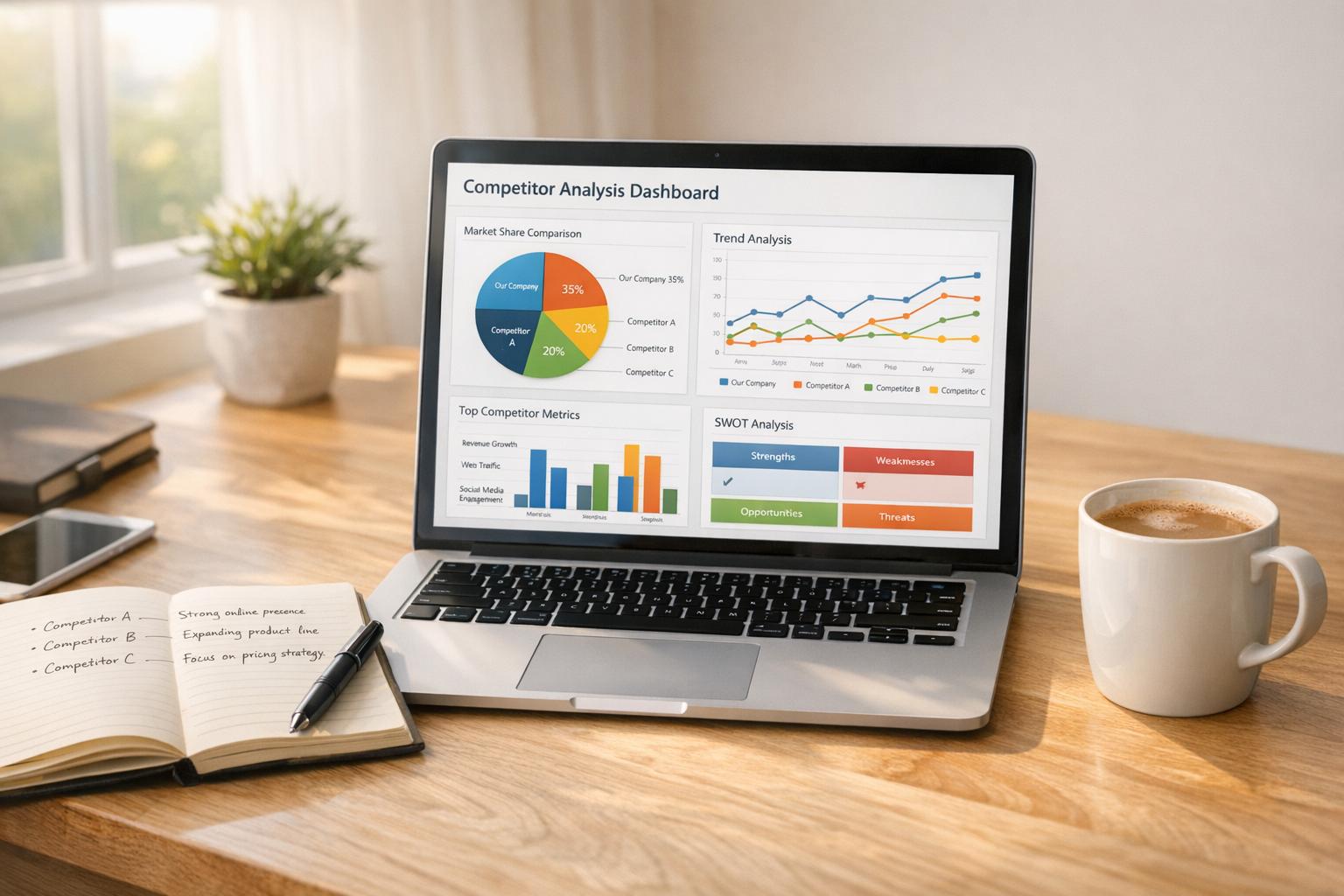
AI is transforming competitor research for local businesses, cutting analysis time from 18–25 hours to just 2–3 hours. It automates competitor discovery, tracks real-time updates, and analyzes customer reviews to reveal market gaps and opportunities. Businesses using AI for competitor analysis are 2.5x more likely to boost sales revenue.
Key Takeaways:
AI Advantages: Automates discovery, consolidates data, and provides real-time updates.
Challenges Solved: Identifies all competitors, reduces manual work, and ensures data stays current.
Actionable Insights: AI pinpoints pricing gaps, service weaknesses, and content opportunities.
Proven Results: Companies see a 35–50% increase in leads with consistent AI usage.
Quick Workflow:
Set Goals: Define focus areas like pricing or service tracking.
Choose Tools: Use AI platforms for SEO, review analysis, and tracking.
Monitor Regularly: Set real-time alerts and schedule monthly reviews.
Apply Insights: Adjust pricing, refine messaging, and optimize content.
AI simplifies competitor research, making it faster, more precise, and actionable for local businesses.
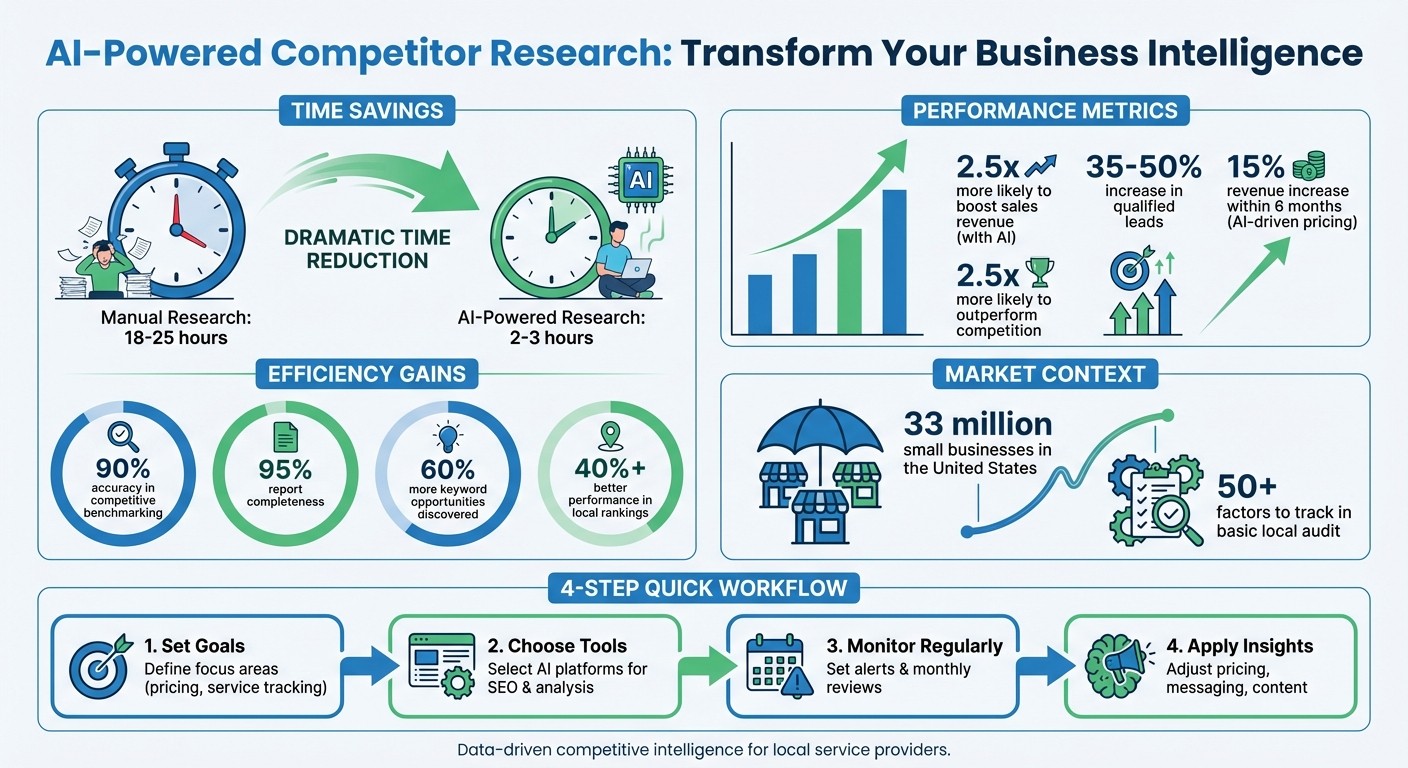
AI-Powered Competitor Research: Key Statistics and Benefits for Local Businesses
Common Problems in Local Competitor Research
Difficulty Finding All Local Competitors
With more than 33 million small businesses in the United States [10], identifying every competitor in your local area is no small feat. Local competitors are scattered across a wide range of platforms - Google Maps, Yelp, Facebook, Instagram, TikTok, and even niche directories like Angi and Houzz [10][6]. Each platform provides only a partial picture, making it tough to piece together the full competitive landscape.
Google's localized search results add another layer of complexity. Search rankings can shift dramatically depending on the searcher’s exact location. Businesses in the same building or neighborhood might not even appear in the same results due to Google’s filtering. And let’s not forget the issue of spammy listings - those with keyword-stuffed names or fake addresses can easily obscure legitimate competitors.
Manual Research Takes Too Much Time
Digging into competitor data manually is a time sink. Completing a thorough competitive audit can take anywhere from 18 to 25 hours, involving multiple stages like gathering data, organizing it, and analyzing the findings [5].
"Manual searches are not sustainable on a regular basis, especially if you target more than one search query and more than a single location."
Ann Smarty, Brand and Community Manager, InternetMarketingNinjas[11]
A basic local audit means tracking over 50 factors, such as NAP (Name, Address, Phone) consistency, Google Business Profile categories, schema markup, and customer review sentiment. Add to that the need to understand how competitors appear in different neighborhoods, and it’s easy to see how the workload can spiral out of control [9][11].
Limited Data and No Ongoing Updates
Manual research provides only a snapshot of your competitors at one point in time. By the time you’ve compiled spreadsheets and screenshots, the data is likely already outdated. Competitors may have rolled out new promotions, adjusted their pricing, or updated their service offerings [5]. Local search rankings, review counts, and messaging shift too quickly for manual methods to keep up.
"Traditional competitor analysis required manual research, subjective interpretation, and time-intensive data compilation that often missed critical competitive intelligence opportunities."
Manual methods also tend to miss subtle but important trends, like changes in hiring patterns, updates to technical documentation, or shifts in local SEO strategies. Without automated tracking, businesses are left reacting to competitors’ moves after the fact, rather than staying ahead of the game. This gap highlights the need for tools that can provide continuous, real-time updates to competitor intelligence.
Analyze Competitors Fast with AI (just 10 minutes!)
How AI Solves These Competitor Research Problems
AI tackles three major hurdles in competitor research: identifying all competitors, reducing manual work, and keeping data up-to-date. By automating discovery, centralizing competitor profiles, and enabling real-time updates, AI turns competitor research from a tedious task into a strategic asset.
Automated Competitor Discovery and Data Collection
AI tools take the hassle out of identifying competitors by automating the entire process. Instead of manually scouring Google Maps, Yelp, and other directories, AI systems analyze search engine results and local listings to find businesses ranking for your target keywords [1][12]. Tasks that once devoured hours or even days are now streamlined into efficient, automated workflows.
These tools use web scraping and API integrations to continuously gather data from sources like Google Business Profiles, tracking everything from service offerings to pricing changes [1][8]. For example, platforms like Cohesive AI scrape Google Maps to identify local businesses, making it especially useful for service providers like HVAC companies or landscapers. This approach ensures a constantly updated database that captures real-time changes, saving time and enabling more accurate analysis.
Complete Competitor Profiles in One Place
AI consolidates data from multiple platforms into unified competitor profiles, creating a "single source of truth" [5]. Using Natural Language Processing (NLP), these tools analyze reviews, social media, and website content to uncover how competitors position themselves and where opportunities might exist [1][6]. Beyond basic details like contact info, you'll gain insights into service offerings, customer satisfaction trends, and even technical SEO aspects like site speed and schema markup [1][11].
"Answering the basic market and competitive research questions of 'who, what, and why' can be done faster and more efficiently when AI is properly applied."
Bryan Dohmen, Senior Director of Strategy, Hero Digital[6]
Small businesses leveraging AI for competitor analysis are 2.5 times more likely to see notable increases in sales revenue [1]. With detailed profiles in place, real-time monitoring ensures the data remains actionable and relevant.
Real-Time Tracking and Updates
AI monitoring systems operate 24/7, alerting you whenever competitors roll out new services, adjust pricing, or tweak their messaging [8][3]. Instead of relying on outdated quarterly reports, you’ll have access to dynamic dashboards that provide instant updates [4]. These systems consolidate data from various sources - like traffic analytics, SEO rankings, paid ads, and social media - offering a complete view of competitor performance [5].
Businesses that adopt this level of competitor intelligence are 2.5 times more likely to outperform their competition [2]. In fast-changing markets, such as local search rankings, some companies now update their competitive data daily rather than monthly [5]. This constant vigilance ensures you stay ahead of the curve.
Best Practices for AI-Powered Competitor Research
To make the most of AI in competitor research, you need a well-structured approach. Gathering data is one thing, but transforming it into actionable insights is where the real value lies. Here's how local service businesses can turn competitor data into a strategic edge.
Group Competitors by Market and Type
Start by categorizing your competitors into three distinct tiers: primary competitors (direct rivals), secondary competitors (those meeting similar needs in different ways), and tertiary competitors (potential future rivals or businesses you might model for growth) [12].
AI tools can simplify this process using Strategic Group Mapping. This method visually organizes competitors based on factors like pricing, services offered, and target markets, helping you identify untapped opportunities or "white space" in the market [4]. For local service providers, geography plays a critical role - Google often prioritizes businesses closer to a city’s geographic or civic center. That means AI tools should consider factors like "proximity to centroid" when evaluating competitive threats [13].
By using AI for competitive benchmarking, businesses can achieve impressive results: around 90% accuracy, 95% report completeness, and a significant reduction in research time - from 18–25 hours of manual work to just 2–3 hours [5].
Once competitors are grouped, the next step is maintaining consistent and accurate data tracking across these categories.
Track the Same Data Points for Every Competitor
Consistency is everything when comparing competitors. AI helps by standardizing data collection from diverse sources - like traffic analytics, SEO tools, social media, and review platforms - into one unified system [5]. This ensures you're comparing apples to apples.
Here’s a breakdown of key data categories and what to monitor:
Key Data Category | Specific Data Points to Track |
|---|---|
Google Business Profile | Categories, star rating, review count, owner response rate, Q&A count, photo quality |
SEO & Authority | Domain Authority, keyword rankings, backlink count, referring domains |
Content Strategy | Publishing frequency, word count, topic coverage, update frequency |
Digital Presence | Website changes, pricing updates, mobile friendliness, HTTPS status |
Social/Sentiment | Share of voice, sentiment ratio, engagement rates, top mention sources |
To keep your comparisons accurate, create a "benchmark dictionary" that defines every metric clearly - whether it’s a "lead", an "engagement", or another key term [5]. This ensures your AI tools analyze data consistently across all competitors. Also, set regular update schedules based on the type of data. For instance, track keyword rankings weekly, but perform detailed content audits monthly [5].
Once your data is standardized, you can dive deeper into reviews and messaging analysis using AI.
Use AI to Analyze Reviews and Marketing Messages
Star ratings only scratch the surface. AI, powered by Natural Language Processing, can dig deeper into reviews to uncover customer sentiment and pinpoint competitors' weaknesses. This allows businesses to adapt their strategies quickly [4].
AI also monitors competitor messaging in real time, tracking shifts like new landing pages, pricing updates, or changes in branding. These insights help you respond swiftly to market changes [4][3]. By analyzing the kinds of questions competitors address in their content, you can better understand user intent and identify gaps in the market [7].
However, while AI can provide valuable insights, it’s essential to verify its findings with experienced professionals before making major decisions. Think of AI data as a useful starting point rather than the final word [6].
Step-by-Step Workflow for Local Service Providers
Here’s how you can use AI to analyze your local market and stay ahead of the competition.
Set Up Your AI Research Tools
Start by defining your goals. Are you looking to identify pricing gaps, track new service launches, or uncover content opportunities? Once you’ve got your focus, list 5–10 competitors - both direct and indirect - within your service area. With this foundation, AI tools can gather data from sources like Google Business Profiles, social media, customer reviews, and financial reports to create in-depth competitor profiles.
Choose AI tools that specialize in SEO, sentiment analysis, and competitor tracking. Tools like Cohesive AI can also handle lead generation and outreach. Automate data collection to monitor changes in competitor websites, pricing, and content updates. For seamless integration, connect these tools to your CRM or marketing systems using APIs. This setup can generate dashboards loaded with actionable reports. The implementation process typically takes 8–9 weeks but slashes manual research time from 18–25 hours per week to just 2–3 hours. [5]
Once everything is in place, establish a routine to regularly review and refresh your data.
Create a Monthly Research Schedule
Consistency is the secret to staying competitive. Use a tiered approach for monitoring: set up real-time alerts for major shifts like pricing changes or new service launches, conduct weekly check-ins for metrics such as Local Pack rankings and review rates, and dive deeper into strategic analysis on a monthly basis.
Pay close attention to content gaps your competitors may have overlooked. Businesses that consistently analyze their competitors tend to outperform others by over 40% in local rankings. While a thorough competitor analysis may take 4–6 hours each month, it can lead to a 35–50% increase in qualified leads. Automate as much of this process as possible to save time, and consider conducting quarterly reviews to refine your long-term strategies. [14]
The next step is turning these insights into practical improvements for your business.
Apply Research Findings to Your Business
Put the insights from your AI tools into action. Use natural language processing (NLP) to analyze competitor reviews and identify recurring themes like "slow service" or "poor communication." Then, adjust your offerings and messaging to address these gaps.
If you spot pricing weaknesses in the market, consider dynamic pricing adjustments. Studies show that businesses using AI-driven pricing strategies can increase revenue by roughly 15% within six months. [2]
Leverage AI to find keywords your competitors rank for and create localized content to capture those opportunities. AI tools can uncover up to 60% more keyword possibilities than manual research. Examine the top competitors in the Local Pack to understand their focus areas, review trends, and posting habits, then optimize your own Google Business Profile accordingly. [14]
Tools like Cohesive AI can even scrape Google Maps for local leads and personalize cold email campaigns. This automation targets prospects who might be dissatisfied with their current providers, guaranteeing at least four interested responses per month - or you get a free month credit. By acting on these insights, you can strengthen your local market presence and improve your competitive edge.
"We view the content and insights that we get [from AI] as a starting point to be refined by seasoned professionals."
– Bryan Dohmen, Senior Director of Strategy, Hero Digital [6]
Conclusion
AI-driven competitor research is reshaping how businesses make decisions by cutting down analysis time from 18–25 hours to just 2–3 hours, all while processing data on a scale that's 100 times larger[5][16]. These advancements tackle key challenges like identifying local competitors and keeping up with real-time changes.
The stats speak for themselves: companies leveraging AI for competitive intelligence are 2.5 times more likely to outperform their rivals[2]. Even more impressive, businesses that consistently apply these insights can see a 35–50% increase in qualified leads[14]. For organizations operating on slim margins, these gains can be game-changing.
Cohesive AI takes this a step further by combining competitor intelligence with automated lead generation. It scrapes Google Maps for business leads, crafts personalized cold emails, and manages campaigns - all for a flat $500 per month. There are no long-term contracts, and they guarantee at least four interested responses monthly. This kind of integration highlights a major shift in how businesses approach market competition.
While others are using AI to analyze reviews, monitor pricing trends, and predict market shifts, relying on manual methods leaves you stuck with outdated data in an ever-changing landscape[15].
FAQs
How can AI make competitor research more efficient for local businesses?
AI takes the hassle out of competitor research for local businesses by automating time-consuming tasks like gathering and analyzing data. With machine learning, it can pull information from sources like Google Maps, review sites, government records, and social media in a fraction of the time it would take manually. This means businesses can skip the tedious work and get straight to actionable insights, such as spotting pricing patterns, understanding customer sentiment, or identifying gaps in services.
On top of that, AI tools can keep businesses in the loop with real-time updates on competitors' moves - whether it’s changes in their advertising strategies or new customer reviews - allowing for quicker reactions. Some advanced systems even predict how competitors’ strategies might shift, helping businesses stay a step ahead. Platforms like Cohesive AI go a step further by automating tasks like lead generation and outreach, giving local service providers the freedom to focus on growing their business instead of relying on outdated, time-heavy methods.
What key metrics should you track with AI for competitor analysis?
AI takes the guesswork out of competitor analysis by zeroing in on the data that matters most. For instance, tracking pricing changes and promotions, like new discounts or updated service rates, can reveal shifts in market strategy. Similarly, keeping an eye on product or feature launches helps you stay informed about developments that could reshape the competitive landscape. Even subtle changes, such as branding and messaging updates - think new taglines or ad campaigns - can hint at emerging strategies.
For local service businesses, AI tools offer even more targeted insights. By analyzing customer reviews, these tools can detect patterns in sentiment, star ratings, and frequent complaints, giving you a clear picture of a competitor's reputation. On the digital front, monitoring SEO performance, like keyword rankings and content gaps, alongside digital marketing efforts, such as ad spend and campaign creatives, uncovers deeper layers of their strategy. Tools like Cohesive AI take all this raw data and turn it into actionable insights, making them especially valuable for industries like janitorial services, landscaping, and HVAC.
How can local service businesses use AI insights to strengthen their market presence?
AI tools are transforming how local service businesses shape their market strategies, making the process faster and more precise. By digging into competitor data - like Google Maps listings, public reviews, advertising trends, and even public filings - these tools can uncover valuable patterns. Think high-performing keywords, popular services, or pricing strategies. The result? Businesses can pinpoint market gaps and opportunities, focusing their efforts where it matters most.
To put these insights to work, businesses can set specific goals, like improving their local search rankings or increasing monthly leads. AI tools can then recommend actionable steps, such as refining service descriptions or targeting areas with unmet demand. On top of that, these platforms can craft personalized marketing content - like localized ad copy or tailored email campaigns - to better connect with potential customers. And with continuous monitoring, businesses can stay ahead by adapting quickly to shifts in customer preferences or competitor moves.
For local service providers, platforms like Cohesive AI make this process seamless. By integrating data analysis, actionable insights, and personalized outreach into one system, these tools help businesses attract better leads, boost visibility, and grow revenue - all without the need for traditional lead-generation agencies.