Geocoding API Pricing: Costs for Local Businesses
Jan 8, 2026
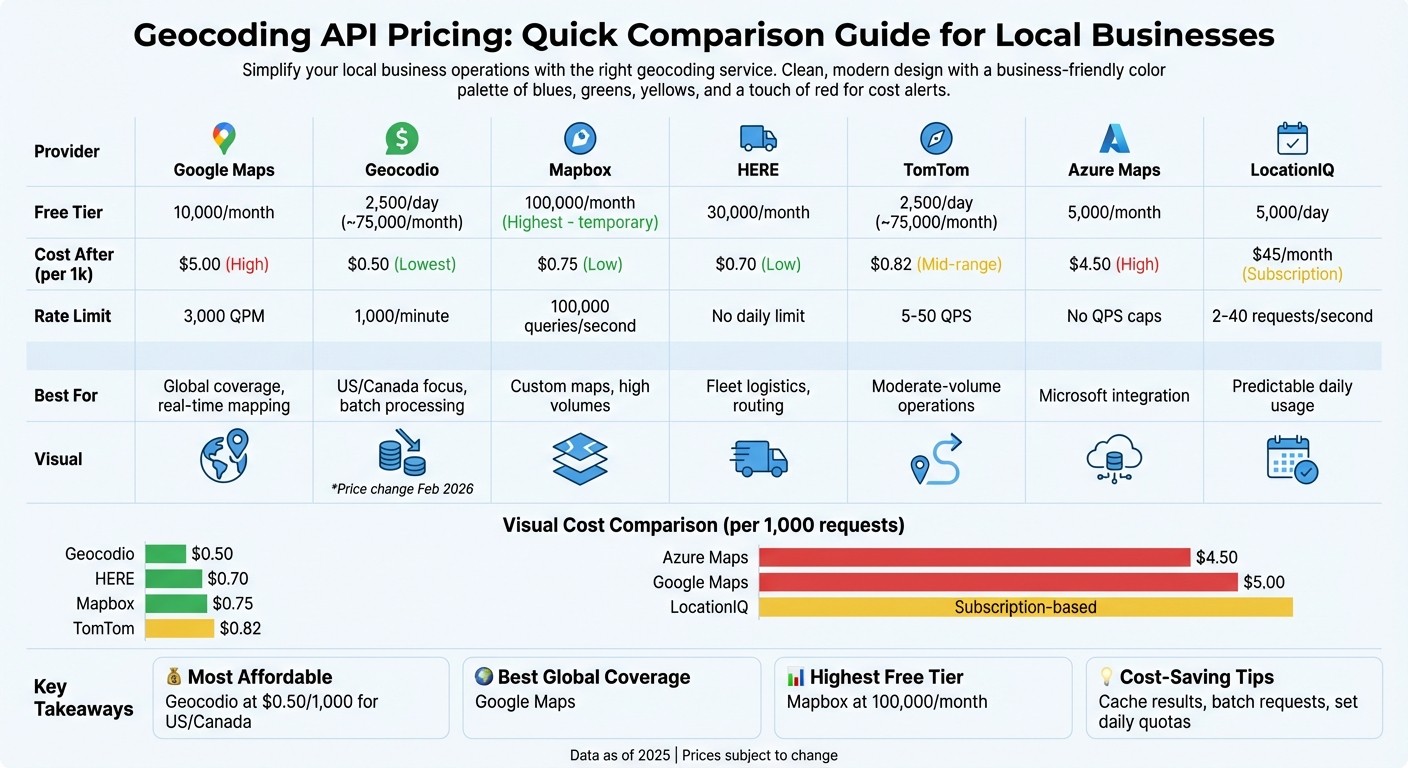
If you're a small business in the U.S. and rely on mapping tools for tasks like lead generation, routing, or service area mapping, understanding geocoding API costs is crucial. Providers like Google Maps, Geocodio, Mapbox, and others offer varying free tiers, pricing models, and features. Here's a quick breakdown:
Google Maps: 10,000 free monthly requests; $5.00 per 1,000 requests after. Subscription plans start at $100/month for 50,000 calls.
Geocodio: 2,500 free daily lookups (~75,000/month); $0.50 per 1,000 requests after. Price changes expected February 2026.
Mapbox: 100,000 free monthly requests for temporary geocoding; $0.75 per 1,000 requests after.
HERE: 30,000 free monthly requests; $0.70 per 1,000 after.
TomTom: 2,500 free daily requests (~75,000/month); $0.82 per 1,000 requests after.
Azure Maps: 5,000 free monthly requests; $4.50 per 1,000 after.
LocationIQ: 5,000 free daily requests; subscription plans start at $45/month for 10,000 daily requests.
Quick Comparison
API | Free Tier | Cost After Free Tier | Best For |
|---|---|---|---|
Google Maps | 10,000/month | $5.00/1,000 requests | Global coverage, real-time mapping |
Geocodio | 2,500/day (~75,000/month) | $0.50/1,000 requests | U.S./Canada-focused, batch processing |
Mapbox | 100,000/month (temporary) | $0.75/1,000 requests | Custom maps, high volumes |
HERE | 30,000/month | $0.70/1,000 requests | Fleet logistics, routing |
TomTom | 2,500/day (~75,000/month) | $0.82/1,000 requests | Moderate-volume operations |
Azure Maps | 5,000/month | $4.50/1,000 requests | Microsoft integration |
LocationIQ | 5,000/day | $45/month (10,000 daily) | Predictable daily usage |
Key Takeaways
Small businesses: Geocodio offers the lowest costs for U.S.-focused needs, while Google Maps provides global reach.
Cost-saving tips: Use free tiers, set daily quotas, cache results where allowed, and batch requests to avoid surprises.
Subscription vs. pay-as-you-go: Subscription plans (like Google Maps' $100/month Starter plan) help with budgeting, while pay-as-you-go models (Geocodio, Mapbox) scale with usage.
Choose the right API based on your volume, region, and specific mapping needs.
Geocoding API Pricing Comparison for Local Businesses 2025
1. Google Maps Geocoding API
Free Tier Limits
Google Maps provides 10,000 free geocoding requests per month for most regions, including the United States [4]. This replaced the previous $200 monthly credit system on March 1, 2025 [5]. For small businesses just starting out with lead generation or territory mapping, this free tier often covers basic needs without requiring any upfront investment.
The API has a rate limit of 3,000 queries per minute (QPM), which includes both client-side and server-side requests [1][2]. If your app or tool sends a large number of requests simultaneously, adding random intervals (jitter) can help spread the load and avoid hitting the limit [2].
Pay-as-You-Go Pricing
If you exceed the 10,000 free requests, Google charges $5.00 per 1,000 requests for usage between 10,001 and 100,000 [4]. As usage grows, discounts kick in automatically: the rate drops to $4.00 per 1,000 requests for 100,001 to 500,000 requests, and businesses handling over 5 million requests see a reduced rate of $0.38 per 1,000 [4].
Google also offers subscription plans for predictable monthly costs. The Starter plan, priced at $100 per month, includes 50,000 combined calls, while the Essentials plan costs $275 per month and covers 100,000 calls [5]. For businesses processing around 50,000 addresses a month, the Starter plan provides a cost-effective and predictable option.
Rate Limits and Scalability
Efficiently managing request rates is key to keeping costs under control. If higher quotas are required, businesses can request them through the Google Cloud Console [1]. To avoid unexpected charges, setting daily quota limits is a smart way to manage costs as your usage scales [1].
For faster results, Google suggests using client-side geocoding (via the Maps JavaScript API) for addresses entered by users, as it leverages the browser's context [2]. Server-side geocoding is better suited for static datasets, such as a pre-existing list of addresses. Additionally, following Google's caching policies allows you to temporarily store results, reducing redundant queries [2][3].
Suitability for US-Based Local Businesses
For US-based service businesses operating on tight technology budgets, understanding these pricing details is essential. Google Maps is a practical choice for local service industries such as HVAC, landscaping, and janitorial services. The billing cycle resets monthly at midnight Pacific Time [5], and the 10,000 free monthly requests are often sufficient for initial lead mapping. Plus, as your business grows, automatic volume discounts mean lower per-request costs.
2. Mapbox Geocoding API
Free Tier Limits
Mapbox offers 100,000 free requests per month for its Temporary Geocoding API [7][10]. This allowance stands out compared to other providers, making it an appealing option for startups or small businesses. The free tier is strictly for Temporary Geocoding, where results are used immediately for display purposes. If you need to store geocoded addresses - called Permanent Geocoding - the cost starts at $5.00 per 1,000 requests, beginning with the first query [7][10].
Additionally, Mapbox's Address Autofill feature includes 1,000 free sessions per month [7].
Pay-as-You-Go Pricing
If you exceed the free tier, pricing for Temporary Geocoding follows a sliding scale. The cost is:
$0.75 per 1,000 requests for 100,001–500,000 calls.
$0.60 per 1,000 requests for 500,001–1,000,000 calls.
$0.45 per 1,000 requests for usage beyond 1,000,000 calls [7].
For Permanent Geocoding, pricing starts at $5.00 per 1,000 requests, dropping to $4.00 per 1,000 requests for volumes exceeding 500,000 [7]. Unlike Google Maps, which limits geocoded data storage to a 30-day cache, Mapbox's Permanent API allows unlimited data storage [10].
Rate Limits and Scalability
Mapbox’s infrastructure is designed for high performance, managing over 100,000 geocoding queries per second and processing hundreds of millions of queries daily [9]. The platform also updates maps more than 700,000 times each day, drawing on feedback from its 600 million monthly active users to keep address data accurate. Leveraging the structured_input parameter can further improve processing speeds [9]. These efficiencies can help businesses lower their overall geocoding costs.
Suitability for US-Based Local Businesses
With its competitive pricing and robust performance, Mapbox is an excellent choice for local businesses in the United States. Companies handling 50,000 to 100,000 addresses per month - like landscaping services creating territory maps or HVAC contractors managing service locations - may find they can operate entirely within the free tier during their initial growth stages. Another key benefit is the flexibility to use geocoded data with any mapping platform, as Mapbox does not require the results to be displayed on its own maps [9][10].
3. HERE Geocoding API
Free Tier Limits
The HERE Base Plan provides a generous allowance of 30,000 free transactions per month for both Geocoding and Reverse Geocoding services [11]. This is significantly more than Google Maps' free tier, which offers just 10,000 monthly requests [4]. Additionally, HERE allocates separate quotas: 30,000 transactions for Geocoding, 30,000 for Autocomplete, and 5,000 for Discover/Search [11]. However, it's important to note that the Base Plan does not permit permanent storage of geocoded results. Organizations needing long-term storage must opt for an Enterprise agreement [11].
Pay-as-You-Go Pricing
Once you exceed the free tier, HERE uses a straightforward pay-as-you-go pricing model. For volumes between 30,001 and 5,000,000 transactions, the cost is €0.66 per 1,000 transactions (roughly $0.70 USD) [11]. For higher volumes, between 5,000,001 and 10,000,000 transactions, the rate drops to €0.53 per 1,000 (approximately $0.56 USD) [11]. This pricing lands between Google Maps' $5.00 and Geocodio's $0.50 per 1,000 requests [4][6]. Autocomplete services are priced at the same €0.66 rate, while Discover/Search costs €2.20 per 1,000 transactions after the initial 5,000 free requests [11].
Rate Limits and Scalability
The HERE Base Plan offers flexibility with no daily transaction limits, making it a scalable option for businesses with fluctuating demand [11]. The platform supports over 400 million address locations across 100+ countries [13] and includes a database of around 120 million places and points of interest [12].
Lyft, for example, relies on HERE Geocoding & Search as its primary provider for destination requests in the U.S. and Canada. Ashwin Raj, Head of Rideshare at Lyft, shared:
Using HERE's search, our riders are now connected to a rich catalog of addresses and points of interest, which are continuously updated, ensuring reliability and an improved rider experience. [12]
For businesses requiring more control or reduced latency, HERE also offers self-hosting options [12][13].
Suitability for US-Based Local Businesses
HERE's features cater well to the needs of local businesses in the U.S. For instance, Eleos, a fleet management platform, uses HERE Geocoding to display asset locations for trucking companies. Kevin Survance, CEO and Co-Founder of Eleos, noted:
We needed a platform that would allow us to build our own version of the driver experience. Thanks to HERE, the driver is able to see how each trip is laid out. [12]
Small businesses can take advantage of the free tier to get started, while those with growing needs - such as truck-specific routing or international expansion - can benefit from HERE's advanced capabilities [11][13].
Get a shockingly-high Google geocoding bill?
4. TomTom Geocoding API
TomTom takes a slightly different approach, offering features that cater well to moderate-volume operations in the US.
Free Tier Limits
TomTom's Freemium plan includes 2,500 free geocoding requests and 50,000 free map tile requests daily, which adds up to about 75,000 geocoding requests per month. These limits reset every 24 hours, making it easier to manage and predict usage. Plus, the free tier is available for commercial use without needing a credit card [14].
Pay-as-You-Go Pricing
If you exceed the free daily quota, TomTom charges €0.75 per 1,000 geocoding requests (approximately $0.82 USD) and €0.50 per 1,000 reverse geocoding requests. Payments are handled through a prepaid credit system, with credits that expire after one year. The system is designed to handle typos and incomplete addresses, reducing the chance of failed requests [14].
Rate Limits and Scalability
TomTom's default rate limits range between 5 and 50 Queries Per Second (QPS), depending on the API. The Geocoding API can handle up to 100 results per single request and allows a maximum result set offset of 2,000. For businesses needing more, enterprise contracts provide options like flexible QPS limits, dedicated support engineers, and access to the Premium Geocoding API. This premium option is particularly useful for last-mile delivery needs, offering details like building entrances, floor numbers, and parking points, all available through a custom quote [14][16].
Ideal for US-Based Local Businesses
TomTom's API includes US-specific address details, such as full state names (countrySubdivisionName) and postal area names (postalName). Adding the countrySet=US parameter can further enhance accuracy for regional searches. With 2,500 free requests daily, TomTom is well-suited for businesses with moderate geocoding needs. For example, a landscaping company handling 50–70 geocoding requests per day could easily operate within the free tier [15].
5. Bing Maps and Azure Maps Geocoding
Microsoft has shifted from Bing Maps Enterprise to Azure Maps, requiring existing Bing Maps users to move to Azure Maps by June 30, 2028 [19]. Fortunately, this transition doesn’t involve changing API keys or Active Directory Client IDs [17]. Below, we’ll explore Azure Maps’ free tier, pricing structure, and scalability, showcasing why it’s a strong option for local businesses in the US.
Free Tier Limits
Azure Maps Gen2 provides a free monthly allowance that includes 5,000 geocoding transactions, along with 1,000 routing requests and 1,000 weather data requests [17][4].
Pay-as-You-Go Pricing
If you exceed the free tier, Azure Maps charges $4.50 per 1,000 transactions for the first 500,000 requests each month. The Geocode Autocomplete feature is billed at a rate of one transaction per 10 autocomplete requests. This pricing undercuts Google Maps, which charges $5.00 per 1,000 requests [17][4].
Rate Limits and Scalability
Azure Maps Gen2 eliminates the Queries Per Second (QPS) caps that were part of earlier versions. This means businesses can handle sudden surges in traffic without worrying about throttling [18].
Ideal for US-Based Local Businesses
Azure Maps is an excellent fit for service-oriented businesses in the US, such as landscaping or HVAC companies. Its geocoding capabilities are bundled with integrated tools like routing, real-time traffic updates, and weather data. For instance, a landscaping team can use the weather feature to check forecasts and severe weather alerts before scheduling outdoor tasks, while the routing service ensures efficient travel between multiple job sites. Additionally, seamless integration with other Microsoft services makes Azure Maps a practical choice for businesses already using Azure subscriptions or Enterprise Agreements [18].
6. Geocodio
Geocodio focuses on geocoding services in the US and Canada, allowing you to store geocoded results permanently in databases or CRMs. This makes it a practical choice for building customer address lists and planning routes efficiently [20].
Free Tier Limits
Geocodio provides up to 2,500 free lookups daily, with the quota resetting at midnight [8]. You don’t need to provide a credit card to get started, which means you can test real address data without any upfront commitment.
Pay-as-You-Go Pricing
If you exceed the daily free limit, Geocodio charges $0.50 for every 1,000 lookups. This is a much lower rate compared to Google Maps, which charges $5.00 for the same number of lookups [20]. If you choose to include additional data fields like Census tracts or timezones, each extra dataset is counted as one additional lookup per record. For example, geocoding 1,000 addresses with two extra data fields would result in 3,000 lookups. Note that pricing adjustments are scheduled for February 1, 2026 [8].
Rate Limits and Scalability
The standard plan supports up to 1,000 lookups per minute [8]. For businesses requiring higher throughput, the Self-Serve Unlimited plan is available at $1,000 per month. This plan processes up to 200,000 lookups per hour and allows you to set daily caps (up to 50,000) to manage costs effectively.
Ideal for US-Based Local Businesses
Geocodio is particularly useful for local service providers in the US, such as janitorial services, landscapers, and HVAC contractors. Its no-code spreadsheet uploader supports CSV, TSV, or Excel files, making it accessible even for those without technical expertise [20]. The platform delivers about 70% rooftop-level accuracy by leveraging official US Census and municipal data [6]. Additionally, customer surveys conducted between 2024 and 2025 gave Geocodio an impressive 9.9 out of 10 recommendation score [6]. With its cost-effective pricing and user-friendly features, Geocodio is a great fit for US-based service providers looking to streamline operations.
Next, we’ll dive into LocationIQ and PositionStack, which provide different pricing structures and feature sets.
7. LocationIQ
LocationIQ operates on a tiered subscription model, making it a practical choice for businesses with consistent daily usage needs.
Free Tier Limits
The free plan from LocationIQ includes up to 5,000 requests per day [21]. It boasts an impressive 99.99% uptime [22], providing reliable geocoding access for businesses that depend on steady performance. However, the free plan does come with some restrictions: it supports only 2 requests per second and caps at 60 requests per minute [21]. These limits may pose challenges for tasks that require processing large volumes of data quickly.
Subscription Pricing
Rather than offering a pay-as-you-go option, LocationIQ uses a fixed subscription model. For instance, a plan allowing 10,000 daily requests is priced at $45 per month [21]. This setup means you pay a set amount each month, regardless of whether you utilize your full quota. If your geocoding needs fluctuate significantly, this pricing structure might not be the most cost-effective solution.
Rate Limits and Scalability
LocationIQ adjusts rate limits based on the subscription tier. While the free plan allows 2 requests per second, higher-tier plans can handle up to 40 requests per second [21]. Additionally, paid plans include "soft limits", enabling users to temporarily double their daily quota during periods of increased demand [21]. This flexibility makes it easier to manage occasional traffic spikes without committing to a higher-tier plan permanently.
Ideal for US-Based Local Businesses
For US-based local businesses like HVAC services or landscaping companies, LocationIQ provides a straightforward pricing model that supports predictable budgeting. The key is to match your daily geocoding needs with the right subscription tier to ensure you’re getting the best value without overpaying for unused capacity.
Advantages and Disadvantages
When it comes to geocoding APIs, the choice often boils down to balancing cost, performance, and coverage - especially for businesses operating in the US. Each provider has its own strengths and weaknesses, and selecting the right one can significantly impact your budget and operational efficiency. Let’s break it down.
Google Maps stands out for its unmatched global accuracy and a generous 3,000 queries per minute (QPM) limit. However, it comes with a hefty price tag once you exceed the free tier, charging $5.00 per 1,000 lookups. On top of that, its strict caching rules and complex billing structure demand careful quota monitoring to avoid unexpected costs.
For businesses primarily focused on the US and Canada, Geocodio offers a budget-friendly solution. It provides 2,500 free lookups per day (around 75,000 monthly) and charges just $0.50 per 1,000 lookups for overages [4][6]. While its coverage is limited to North America, this isn’t usually a problem for local businesses like HVAC companies or landscapers. However, keep in mind that Geocodio’s pricing is set to increase on February 1, 2026.
Other providers, like Mapbox, HERE, and TomTom, offer advanced customization and high-quality data. These features are great for developers, but they often come with higher costs and may require technical expertise to implement. Meanwhile, LocationIQ offers affordable batch processing, with subscription plans starting at $45 per month for 10,000 daily requests. However, it lacks some of the data enrichment features found in other APIs. Bing Maps, on the other hand, integrates seamlessly with Microsoft services but typically requires an Azure account, making it less appealing for standalone use [23].
Here’s a quick comparison to help visualize the trade-offs:
API | Best Advantage | Key Disadvantage | Ideal Use Case |
|---|---|---|---|
Google Maps | Highest accuracy; 3,000 QPM; global reach | Expensive ($5.00/1k); complex billing | Apps requiring global coverage and accuracy |
Geocodio | Low cost ($0.50/1k); 75k free/month | Limited to US/Canada; price hike in 2026 | Batch processing, mailing lists, back-office tasks |
Mapbox | Customizable maps with developer tools | High costs; variable rural accuracy | Apps needing custom map design |
HERE/TomTom | Automotive-grade data; robust routing | Enterprise-focused; complex for basic use | Fleet management and logistics |
LocationIQ | Affordable batch processing | Limited data enrichment features | Predictable, daily geocoding needs |
Bing Maps | Smooth Microsoft integration | Azure account required; less geocoding focus | Businesses already using Microsoft services |
For moderate geocoding needs - like scheduling or territory mapping - Geocodio’s free tier often provides more than enough capacity without breaking the bank. However, if your business requires international support or real-time, interactive maps, Google Maps may be worth the extra cost. Just remember to set daily quotas in the Google Cloud Console to manage expenses effectively [1].
How to Reduce Geocoding Costs
Using client-side geocoding through the Maps JavaScript API can help you save on costs while delivering faster results and better accuracy by factoring in user context. This approach also reduces the load on your server and minimizes billing expenses [2].
To keep expenses in check, set daily usage limits and alerts in the Google Cloud Console. This way, you can avoid unexpected charges [1]. If your geocoding needs are consistent, consider Google’s subscription plans for predictable monthly costs. For instance, the Starter plan offers 50,000 calls for $100 per month, while the Essentials plan includes 100,000 calls for $275 [5]. These plans make budgeting more manageable.
Another cost-saving strategy is caching geocoding results to cut down on duplicate calls. While some providers limit how long data can be stored, Google Maps Platform allows caching for up to 30 days [24]. You can also lower expenses by switching to the Maps Static API or using thumbnails, as both are billed at lower rates compared to dynamic maps. Additionally, avoid loading multiple map instances on a single screen - reuse one map and update its viewport and markers as users interact with it [24].
If you're working with large datasets, spreading out your requests over time instead of sending them all at once can help manage costs. Add random intervals between each batch of requests to stay under the 3,000 queries per minute limit [1][2].
For local service businesses, these strategies can be especially impactful. Platforms like Cohesive AI, which scrape Google Maps to identify local business owners in industries like HVAC, landscaping, and janitorial services, can benefit greatly. By batching requests, caching data, and taking advantage of Google’s free tier - offering 10,000 free geocoding requests per month as of March 1, 2025 [25] - businesses can efficiently process large volumes of location data. This allows them to generate leads cost-effectively while maintaining the precision needed for targeted outreach campaigns.
Conclusion
For US-based local businesses, selecting the right geocoding API comes down to your priorities and budget. If your focus is mainly on addresses in the United States and Canada, Geocodio stands out for its affordability, charging just $0.50 per 1,000 lookups compared to Google Maps Platform's $5.00 rate [6][4]. Plus, its free tier - offering 2,500 lookups daily - means many small businesses can operate without incurring any cost [6]. On the other hand, if your needs extend to global coverage, Google Maps Platform is a strong contender, providing real-time mapping and seamless integration with Google's ecosystem. Their 10,000 free monthly requests make it accessible for smaller operations to get started [5].
For businesses managing sensitive data or requiring HIPAA compliance, Geocodio’s Enterprise tier, priced at $2,500 per month, ensures that all data remains within the United States [6].
Local service businesses using tools like Cohesive AI to extract leads from Google Maps data should consider batch processing and caching strategies. By spreading out requests over time and caching results (where allowed), you can stretch free tiers further and reduce expenses. Combining the strengths of different APIs can also be an effective strategy - using Geocodio for cost-effective bulk lookups in the US and Google Maps' free tier for smaller, global needs creates a practical hybrid approach for many businesses.
Ultimately, Geocodio is the go-to for high-volume, US-focused needs where cost is a key factor, while Google Maps Platform shines for businesses requiring global reach and real-time precision. Both providers offer free tiers, giving small businesses the opportunity to explore their services before committing, making cost optimization achievable with the strategies discussed here.
FAQs
What should local businesses consider when selecting a geocoding API?
When picking a geocoding API, local businesses should pay attention to cost, usage limits, and integration needs. Many APIs, including Google’s Geocoding API, use a pay-as-you-go pricing structure, where costs are tied to the number of requests. Google, for instance, provides a $200 monthly credit, and businesses can set daily quotas to manage spending. For those seeking more predictable expenses, subscription plans are an option - like $100 per month for 50,000 requests or $275 per month for 100,000 requests.
Another key consideration is usage limits and how the API will be implemented. Google, for example, enforces a daily quota and caps requests at 3,000 per minute. Businesses need to decide whether they need client-side geocoding for real-time user input or server-side geocoding for processing large batches of addresses. Lastly, integration should be straightforward and dependable. Most APIs require an API key or token, and Google simplifies the process by offering libraries for popular programming languages such as Python, Java, and Node.js.
By evaluating these aspects - pricing, usage restrictions, deployment preferences, and ease of integration - local businesses can select a geocoding API that aligns with their budget and operational goals.
What are the best ways for small businesses to manage Geocoding API costs?
Small businesses can keep Geocoding API costs under control with some smart strategies. First, set up billing alerts and daily quota limits in the Google Cloud Console. These tools help track spending and prevent unexpected charges. Plus, don't forget about the $200 monthly free credit from Google - it can go a long way in covering your API usage.
To make the most of your budget, streamline your requests. Use batching or caching to cut down on repetitive API calls. If you're handling user-entered addresses, client-side geocoding can be a more budget-friendly option. These approaches ensure you're only paying for what you actually use while keeping your service running smoothly.
What benefits does Geocodio offer for U.S.-based businesses?
Geocodio is a budget-friendly geocoding service designed specifically for handling U.S. and Canadian address data. It's a great fit for businesses that need to process large volumes of addresses efficiently. One standout feature is its free daily allowance of 2,500 lookups, with additional lookups costing just $0.50 per 1,000. This straightforward pay-as-you-go pricing model helps keep costs predictable, and users can set limits to avoid unexpected charges - no subscriptions required.
Beyond affordability, Geocodio offers valuable U.S.-centric data enrichment options. These include details like congressional districts, school districts, time zones, and census tracts. The platform is built to handle large-scale operations, supporting bulk uploads up to 1 GB and API batch requests for up to 10,000 records at a time. For businesses with even greater needs, Geocodio provides unlimited plans and enterprise solutions, featuring perks like dedicated servers and compliance with SOC 2 and HIPAA standards.
Thanks to its flexible pricing, detailed data offerings, and ability to scale, Geocodio is a smart choice for U.S.-based businesses managing tasks like marketing campaigns, logistics, or lead generation.