5 Benefits of Real-Time AI Lead Identification
Dec 10, 2025
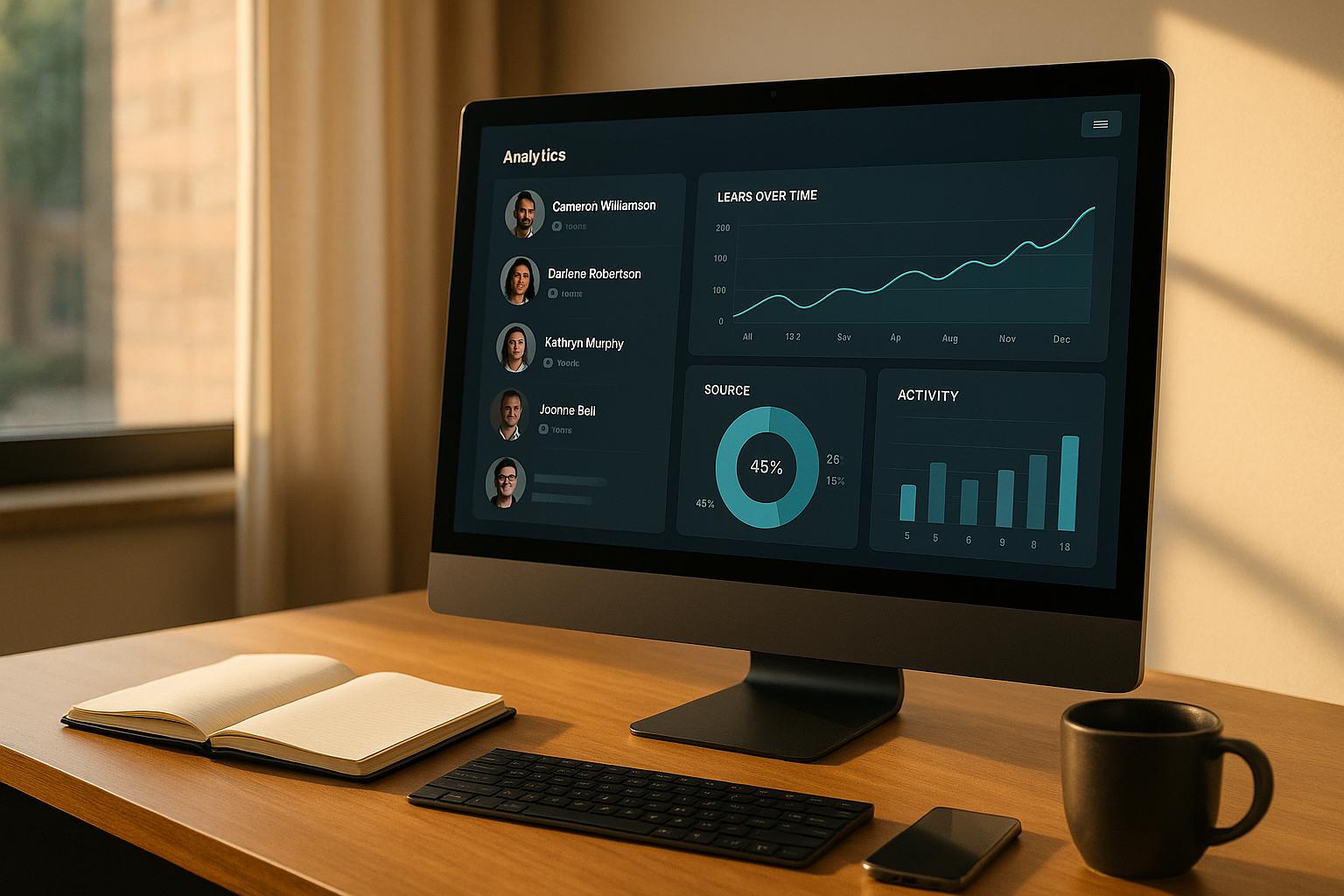
Real-time AI lead identification is transforming how businesses find and engage potential customers. By automating tasks like lead scoring, data enrichment, and outreach, AI allows companies to respond faster, improve lead quality, and reduce costs. Here’s a quick breakdown of the key advantages:
Faster Lead Response: AI processes and engages leads within seconds, increasing qualification rates by up to 21x compared to manual methods.
Improved Lead Scoring: AI uses data-driven models to score leads accurately, boosting conversion rates by 25-30%.
Scalability Without Extra Staff: AI handles large lead volumes, cutting labor costs and reducing cost-per-lead by up to 30%.
Continuous Learning: AI adapts to real-time data, refining lead scoring and outreach strategies automatically.
24/7 Availability: AI captures and engages leads round-the-clock, ensuring no opportunities are missed.
For local service businesses like HVAC or landscaping, AI tools streamline lead generation, save time, and improve revenue without increasing overhead. Platforms like Cohesive AI make it easy to implement these solutions for just $500/month.
1. Faster Response Times to New Leads
Speed-to-Lead Response Time
Reaching out to a lead within just 5 minutes can make a massive difference - boosting your chances of qualifying that lead by a staggering 21 times compared to waiting 30 minutes [3]. This quick reaction often turns potential prospects into actual customers.
Here’s the thing: manual research can take hours, but AI tools? They can do the same job in just 30–60 seconds [3]. That kind of speed allows sales teams to connect with leads while they’re still interested and engaged.
But speed isn’t the only advantage. Automation takes things even further.
Automation of Lead Engagement
AI-powered systems don’t just identify leads - they engage with them instantly. By monitoring channels in real time and continuously updating data, these tools ensure no opportunity slips through the cracks. For example, platforms like Cohesive AI simplify the process for local service businesses. They automatically find new leads by scraping Google Maps and government filings, craft personalized cold emails using AI, and even manage campaigns - all without requiring manual effort.
And it doesn’t stop there. AI chatbots and automated email responses can acknowledge inquiries 24/7, even when your team isn’t available. This seamless engagement has real results: companies report a 30% reduction in their sales cycle and a 25% increase in conversion rates [3]. The outcome? More closed deals and a noticeable bump in monthly revenue.
2. More Accurate Lead Scoring Without Human Error
Accuracy in Lead Scoring
Manual lead scoring often comes down to gut feelings and subjective opinions. AI, on the other hand, takes a more objective, data-driven approach, delivering consistent and reliable scores. Research shows that AI-powered scoring can increase sales-qualified leads by 30%, improve lead quality by 12%, and boost conversion rates by 25% [1][3][6]. This consistency also ensures that lead scoring can be updated dynamically and in real time.
Take local service businesses as an example. Platforms like Cohesive AI automate essential processes like business verification through Google Maps and government filings. They also assess leads based on fit and engagement levels, eliminating the guesswork. The result? Faster, more informed decisions that go hand-in-hand with real-time lead identification.
Adapting to Real-Time Data
One of AI's standout features is its ability to update lead scores in response to real-time behavior. Imagine an HVAC company revisiting your pricing page multiple times or downloading a brochure - AI recognizes this as a sign of growing interest and adjusts the lead's score accordingly [1][3][4].
Over time, machine learning models get even smarter. For instance, if landscaping companies with 10–50 employees in Texas suddenly start converting more frequently, the AI recalibrates its scoring system to prioritize similar leads [1][3][6]. Unlike manual scoring systems that demand constant maintenance, AI evolves naturally with shifting market trends, ensuring lead scores remain relevant as customer behaviors change.
3. Handle More Leads Without Hiring More Staff
Scalability of Operations
Sales teams face a common challenge when lead volumes surge: managing the extra workload. More leads mean more research, data entry, and follow-ups, which often leads to the need for additional hires. But AI can handle this influx seamlessly. These systems can process thousands of leads simultaneously - scoring, enriching, and routing them - all without increasing headcount [2][7]. So, when a successful ad campaign floods your pipeline, the AI instantly evaluates every contact, keeping your team size unchanged.
The numbers back this up. Companies leveraging AI for lead qualification have seen a 30% drop in cost per lead by working smarter, not harder [3]. AI-driven contact enrichment has also helped businesses cut sales cycle times by 30% and boost conversion rates by 25%, all while keeping staffing costs steady [3]. For small and mid-sized U.S. businesses, where labor costs are a significant expense, these efficiencies directly translate into healthier profit margins.
And it’s not just about handling a high volume of leads - AI ensures continuous engagement, too.
Automation of Lead Engagement
AI doesn’t stop at identifying leads; it also nurtures them. Tools like automated emails, chatbots, and reminders take care of routine tasks, allowing sales reps to focus on more impactful activities like discovery calls, proposals, and closing deals [2][5]. Some effective strategies include sending immediate welcome messages, scheduling multi-step follow-ups for unresponsive leads, and running re-engagement campaigns when new offers are introduced [2][5].
For example, consider a regional janitorial company. By integrating its website forms and ads with an AI platform, it can automatically enrich each inquiry with details like business size and location. Meanwhile, Cohesive AI takes it a step further by scraping Google Maps and government filings to identify new local businesses. It then generates personalized cold emails and manages campaigns at scale for just $500 per month. The sales team only gets notified about high-scoring inbound leads and positive responses from outbound efforts. This setup allows a small team to manage hundreds of accounts and expand into new ZIP codes without the need for additional hires [3][4].
With AI handling routine engagement tasks, your team can focus on closing deals while ensuring every lead gets timely attention. It’s a win-win for scalability and efficiency.
4. AI Models That Learn and Improve Over Time
Real-Time Data Integration
Unlike rigid, rule-based systems, AI works dynamically, updating lead scores as prospects interact with your business. Whether someone visits a pricing page, opens an email, or submits a quote request, the AI recalibrates their score instantly. Over time, as the model processes fresh engagement data, it adjusts to factors like seasonality, new competitors, or shifts in the ideal customer profile. This constant learning ensures lead scoring stays accurate and relevant without requiring manual updates.
Smarter Lead Scoring
Traditional scoring methods often fall behind as buyer behavior changes. AI-based systems, however, continuously retrain themselves using a mix of data - like firmographics, online behavior, and engagement trends. This enables them to identify patterns and insights that manual approaches might overlook. The result? A sharper ability to separate serious buyers from casual browsers, helping U.S. businesses grow their sales pipeline without increasing marketing costs.
Automating Lead Engagement
AI doesn’t just score leads - it learns which outreach strategies work best. By analyzing which messages, channels, and timings deliver results, the system refines its approach. For instance, it might discover that U.S. HVAC decision-makers respond most to brief, mid-morning emails highlighting cost savings. From there, the AI adjusts future campaigns to mirror these successful tactics. Tools like Cohesive AI take things further by personalizing cold emails for local business owners and managing campaigns, fine-tuning strategies based on response rates. This continuous improvement ensures the AI focuses efforts on the most promising leads, maximizing the impact of lead generation efforts.
How to Use AI to Get More Leads for Your Business
5. Round-the-Clock Lead Capture and Follow-Up
With faster response times and accurate lead scoring in place, round-the-clock lead capture ensures no opportunity slips through the cracks - no matter when it arises. AI systems work tirelessly, capturing leads the instant they appear and initiating contact immediately, whether it’s 2:00 PM on a weekday or 2:00 AM on a weekend. This eliminates the delays common in manual processes, where leads emerging outside regular business hours might be overlooked. For local service providers in competitive industries like HVAC or landscaping, this constant availability can be the difference between securing or losing a client.
Automation of Lead Engagement
AI systems take the reins when it comes to engaging leads, operating 24/7 without requiring human involvement. These platforms monitor for new opportunities even during off-hours, enrich lead data in as little as 30 to 60 seconds[3], and send out tailored communications while your team is offline. For example, Cohesive AI automates lead generation for local service businesses, ensuring personalized messages reach prospects at just the right time - even when your sales team isn’t available. This level of automation allows businesses to handle a larger volume of leads effortlessly.
Scalability of Operations
AI’s ability to process large volumes of leads around the clock makes scaling operations seamless and cost-efficient. Businesses using AI-powered lead targeting report a 40% reduction in manual tasks[8], allowing sales teams to concentrate on closing deals rather than chasing leads. Whether your business is managing 50 leads or 5,000, the system ensures consistent engagement and personalization, enabling growth without the need for additional resources or higher costs.
Comparison Table
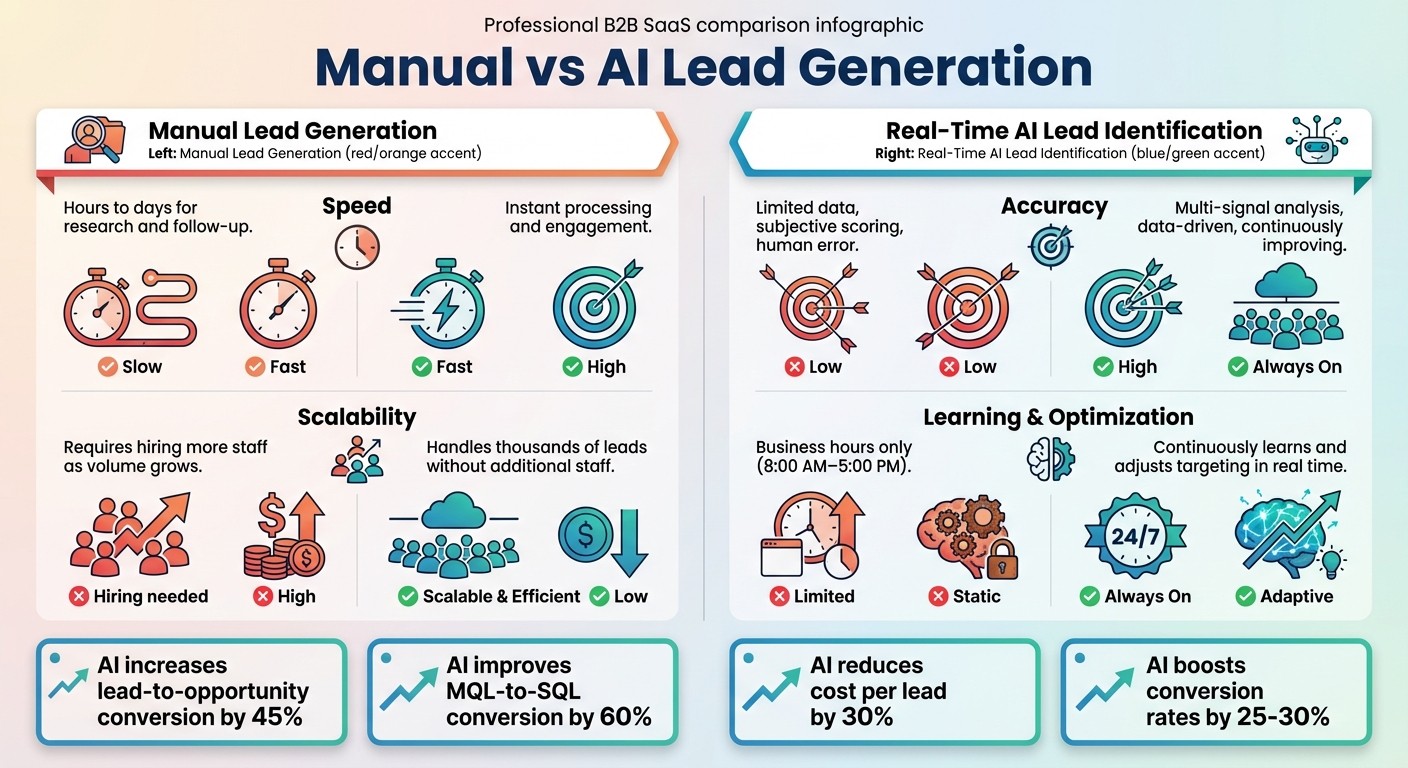
Manual vs AI Lead Generation: Speed, Cost, and Performance Comparison
When it comes to processing leads, real-time AI operates at lightning speed, handling them instantly, while manual methods can take hours or even days to complete [2][4][11]. This difference in speed can be a game-changer, especially when you need to engage prospects while their interest is still fresh.
Manual approaches often depend on basic filters and subjective judgment, which leaves them prone to human error and bias [2][6]. In contrast, AI leverages extensive data to deliver precise lead scoring. The results? Companies using AI-driven lead scoring have reported a 45% boost in lead-to-opportunity conversion rates and a 60% improvement in MQL-to-SQL conversion rates [9].
The cost structures of these methods are also worlds apart. Manual systems demand expanding payroll or paying agency fees as your needs grow. On the other hand, AI platforms operate on a flat monthly fee. For instance, platforms like Cohesive AI charge $500 per month, offering consistent costs whether you're managing 50 or 5,000 leads. Over time, this translates to a much lower cost per lead [2][4][10].
Here’s a side-by-side comparison of the key differences:
Metric | Manual Lead Generation | Real-Time AI Lead Identification |
|---|---|---|
Speed | Hours to days for research and follow-up | |
Accuracy | Limited data, subjective scoring, and human error | Multi-signal analysis, data-driven, and continuously improving [2][4][6][9] |
Scalability | Requires hiring more staff as volume grows | Handles thousands of leads without additional staff [4][10][11] |
Cost | $50,000–$100,000 per year per rep or agency retainer fees | Flat subscription (e.g., $500/month) with low marginal cost per lead [2][4][10] |
Availability | Business hours only (e.g., 8:00 AM–5:00 PM) | |
Learning & Optimization | Static rules updated infrequently | Continuously learns and adjusts targeting in real time [2][6][9][11] |
For industries like janitorial services, landscaping, or HVAC, the benefits of AI are particularly striking. Manual methods often mean building a costly in-house sales team or relying on agencies with fluctuating fees as demand grows. By contrast, AI platforms work tirelessly, 24/7, ensuring leads are captured and scored with precision - whether they come in during the day or in the middle of the night [4][10][11].
Conclusion
Real-time AI is reshaping lead generation for local service businesses by combining speed, precision, scalability, continuous learning, and round-the-clock availability. These advancements don't just simplify operations - they drive revenue growth. For instance, AI-powered scoring has been shown to increase conversion rates by 25–30% while cutting the cost per lead by 30% on average [3][8].
By streamlining workflows, AI allows your team to focus on closing deals rather than chasing leads. For U.S.-based businesses in industries like janitorial services, landscaping, HVAC, or catering, this technology levels the playing field. It lets you compete with larger regional competitors without the need to invest in costly sales teams or deal with unpredictable agency fees. Tools like Cohesive AI take this a step further by scraping Google Maps and government filings to identify potential clients, crafting personalized cold emails, and managing campaigns 24/7. This approach not only reduces hiring uncertainties but also offers a clear financial advantage through a predictable cost structure. The integration of AI-driven insights ensures measurable improvements in capturing and converting leads.
If your business struggles with low lead volume, missed opportunities after hours, or stagnant conversion rates despite steady ad spend, these are strong indicators that real-time AI could provide a solution. Start small by piloting the technology in one territory or service line, and monitor key metrics like response times, conversion rates, and cost per job. Once you see positive results, consider scaling the solution across your operations.
The local service market is moving toward data-driven, always-on lead generation. By adopting real-time AI, businesses can seize more opportunities, close deals faster, and grow revenue - all without the need for a bigger payroll. This shift offers a powerful edge in an increasingly competitive landscape.
FAQs
How does AI improve the accuracy of lead scoring?
AI brings a new level of precision to lead scoring by processing massive amounts of data in real-time. It identifies patterns and insights that would be challenging, if not impossible, to catch through manual methods. By evaluating leads based on a variety of factors - like their behavior, demographics, and engagement levels - it delivers more accurate predictions about their potential.
What’s even better? With the power of machine learning algorithms, AI doesn’t just stop at initial scoring. It keeps refining its models by adapting to new data and shifting trends. The result? More focused outreach efforts that save time and resources while boosting the likelihood of converting top-quality leads.
How does AI help save money in lead management?
AI simplifies lead management by taking over tasks like gathering leads, crafting personalized outreach, and managing campaigns. This automation cuts down on the need for time-consuming manual work or hiring pricey agencies, resulting in major cost savings.
By managing these tasks efficiently and on a large scale, AI helps businesses lower overhead costs while boosting accuracy and speed, ensuring they maximize the return on their investment.
How does AI keep leads engaged after business hours?
AI makes it possible for businesses to engage with leads consistently, even outside regular working hours, by automating outreach efforts. With the help of advanced algorithms, it crafts tailored cold emails and handles email campaigns effortlessly. This means businesses can maintain communication with potential leads 24/7 without needing constant manual oversight, ensuring every opportunity is captured.