Predictive Analytics vs. Traditional Lead Generation
Dec 14, 2025
Predictive analytics is reshaping lead generation. It uses AI to analyze data, forecast outcomes, and prioritize high-quality leads. Compared to manual methods, it’s faster, more accurate, and cost-effective. Businesses using predictive analytics see higher conversion rates (20–25% vs. 5–10%) and lower costs per lead ($20–$60 vs. $50–$150).
Here’s the key difference:
Predictive Analytics automates lead scoring and outreach using real-time data, improving efficiency and scaling easily.
Traditional Methods rely on manual efforts like cold calling and static criteria, which are time-consuming and less effective.
Quick Comparison:
Metric | Predictive Analytics | Manual Lead Generation |
|---|---|---|
Speed to Identify Leads | Minutes to hours | Days to weeks |
Lead Qualification Accuracy | 70–85% | 30–40% |
Cost Per Lead | $20–$60 | $50–$150+ |
Conversion Rates | 20–25% | 5–10% |
Predictive analytics offers better results for less effort, making it the smarter choice for growth-focused businesses.
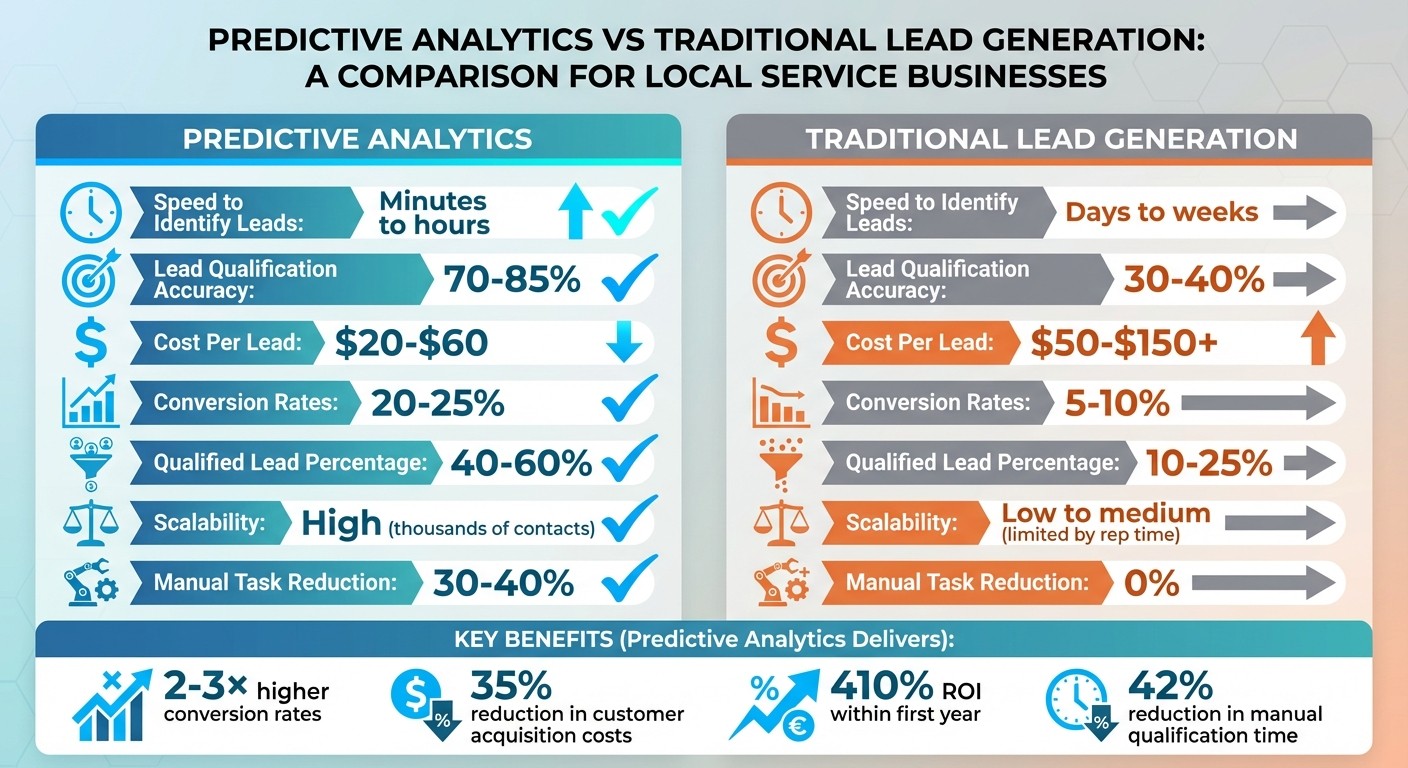
Predictive Analytics vs Traditional Lead Generation: Key Metrics Comparison
How to Use AI & Predictive Data to Find Better Leads Faster
How Predictive Analytics Works
Predictive analytics transforms raw data into meaningful insights by combining data collection, processing, and automation. This process starts with gathering information from a variety of sources, such as Google Maps listings, government business filings, CRM data, website analytics, and email engagement logs. For local businesses, this streamlined approach boosts both efficiency and accuracy, making predictive analytics a powerful tool.
AI and Machine Learning for Lead Scoring
Machine learning algorithms analyze numerous attributes to uncover patterns that lead to successful deals. Instead of relying on manual scoring with fixed rules, AI models learn from historical data to determine which behaviors and attributes are most likely to result in conversions. For example, if the data shows that local businesses with 10–50 employees visiting a pricing page three times and responding within 24 hours are more likely to convert, the model prioritizes similar leads. This removes guesswork and ensures the system gets better as it processes more data.
Take a janitorial service, for instance. The business might discover that leads from high-demand ZIP codes tend to yield higher contract values. The system then adjusts to prioritize similar prospects. This approach has been shown to improve conversion rates from lead to opportunity by about 38% and reduce cost-per-acquisition by 35% compared to manual methods [8].
Real-Time Insights and Pattern Recognition
Real-time monitoring takes this a step further by updating lead scores instantly when high-intent actions occur, such as repeated visits to a pricing page or submitting a quotation request. The system also identifies sequences of actions linked to successful conversions. For instance, it might recognize that a lead who visits the office cleaning page, checks the pricing page, and downloads a checklist within 48 hours is highly likely to convert. One mid-sized B2B company saw impressive results with this approach, cutting manual qualification time by 42% and shortening the sales cycle by 18 days within just six months [8].
Applications for Local Businesses
Local businesses can directly apply these predictive techniques to improve their operations. Service providers like HVAC companies, landscapers, and janitorial services can use predictive analytics to anticipate customer needs by analyzing property and service history data.
Cohesive AI integrates these methods seamlessly by pulling data from sources like Google Maps and government filings to create targeted lead lists. It then automates outreach with personalized email sequences. For $500 per month, the platform guarantees at least four interested responses monthly and reportedly achieves conversion rates of 20–25%, well above the 5–10% typically seen with traditional cold outreach [5]. High-scoring leads are automatically enrolled in email campaigns tailored to their business type, location, and potential pain points, with messaging adjusted dynamically based on engagement levels.
How Traditional Lead Generation Works
Traditional lead generation is rooted in manual processes that demand a lot of time and effort. Let’s break down how manual data collection, basic scoring, and the challenges of this approach shape the traditional methods of finding leads.
Manual Data Collection and Outreach
At its core, traditional lead generation revolves around hands-on prospecting. Sales teams spend their days researching potential clients, often starting with directories, business listings, or even collecting business cards at events. A typical workflow might include jotting down company names while driving through business districts, searching for contact details later, and manually building call lists. From there, it’s a grind: dialing numbers one by one, leaving voicemails, and sending follow-up emails. Despite these efforts, meaningful conversations are rare.
The tools used are basic - think purchased contact lists, spreadsheets, Google Maps searches, and simple CRMs. Emails are drafted individually using templates, calls are made without automation, and results are tracked manually. For example, one analysis revealed that sales teams spending $10,000 a month on manual targeting often generate only 100 leads, with just 20 qualifying as solid prospects [1].
This process is not only tedious but also relies heavily on outdated tools and static data, which brings us to the next piece of the puzzle: basic filtering and scoring.
Demographic Filtering and Basic Scoring
Traditional methods rely on straightforward criteria like company size, revenue, location, or job titles to create static prospect lists. For instance, a list might target “local restaurants with 10–50 employees within a 25-mile radius.” Once these lists are built, they rarely evolve, as they lack behavioral or real-time intent data.
Lead scoring, in this context, is equally simple and subjective. Sales teams assign points based on attributes like industry fit or decision-maker roles, as well as specific actions, such as answering a call. For example, a landscaping company might prioritize a property manager at a 50-unit complex who takes their call, while other leads are flagged for follow-up later. These scoring systems are often based on gut instinct and past experience rather than data-driven insights.
Challenges of Traditional Methods
The biggest hurdles of traditional lead generation are the time it eats up, its high costs, and the struggle to scale. Sales reps often spend more than half their time on research and manual outreach instead of actually selling [9]. Cold outreach tends to have low response rates, dragging out sales cycles and requiring significant personal effort. On top of that, static lists quickly become outdated - contact information can lose accuracy at a rate of 20–30% annually due to job changes and company turnover [5].
For small businesses, like a local HVAC firm, these challenges are even more pronounced. Between part-time rep wages, list purchases, and event fees, they might spend thousands of dollars each month chasing leads, often with inconsistent results. And because scaling traditional methods means hiring more reps, growth becomes expensive and unpredictable. Studies show that AI-driven targeting can increase conversion rates by up to 30% and cut manual labor by as much as 40% [1], which is why many companies are turning to data-driven approaches for more efficient and scalable solutions.
Key Differences Between Predictive Analytics and Traditional Lead Generation
Taking a closer look at how these approaches differ, let's break down their impact on efficiency, cost, and scalability.
Efficiency and Scalability Comparison
Predictive analytics takes the guesswork out of lead generation by automating tasks like data collection, enrichment, scoring, and outreach triggers. This can cut manual qualification time by an impressive 30–40% [1][10]. Picture this: with AI tools, a sales rep can handle thousands of local business leads simultaneously, quickly scanning sources like Google Maps listings, government filings, and engagement data. For example, a janitorial company expanding from one city to three can scale operations without needing to dramatically increase staff.
On the flip side, traditional lead generation relies heavily on manual labor. Sales teams often spend countless hours building lists, qualifying contacts, and sending individual outreach messages. This approach doesn't scale well. As lead volumes grow, the process becomes a bottleneck, limiting a team's ability to keep up [1][11]. Platforms like Cohesive AI address these challenges by automating many of these tasks, providing a scalable solution.
Cost and ROI Analysis
At first glance, traditional methods might appear less expensive, but the hidden costs - primarily high labor expenses - can add up fast. For example, a team using manual targeting could spend around $10,000 per month to generate 100 leads, only to find that just 20 of those leads are truly qualified prospects [1].
Predictive analytics flips this script by reducing manual effort and improving lead quality. This not only lowers the cost per lead but also the overall cost per acquisition. Research shows that AI-driven targeting can slash customer acquisition costs by up to 35% while boosting conversion rates by 25–30% [1][8]. For instance, a local HVAC business might consolidate multiple agency contracts into a single SaaS platform costing $500 per month, significantly reducing expenses. These differences are clearly reflected in the metrics below.
Key Metrics Comparison Table
Here’s how predictive analytics stacks up against traditional methods for U.S.-based local service businesses:
Metric | Predictive Analytics / AI-Driven | Traditional Lead Generation |
|---|---|---|
Speed to identify new leads | Minutes to hours (automated) | Days to weeks (manual research) |
Qualification accuracy | High (data-driven scoring) | Medium to low (rules plus intuition) |
Scalability | High (thousands of contacts with similar effort) | Low to medium (limited by rep time) |
Lead quality (qualified %) | 40–60% of leads qualified | 10–25% of leads qualified |
Cost per Lead (US$) | $20–$60 after scale | $50–$150 or more (labor-intensive) |
Lead-to-customer conversion | 15–25% typical; up to 2–3× higher than traditional | 5–10% typical |
While results may vary depending on the industry and execution, these metrics highlight how predictive analytics offers clear advantages in terms of cost-efficiency, lead quality, and overall scalability [1][10][5].
Benefits of Predictive Analytics for Local Service Businesses
Higher Conversion Rates and Revenue Growth
Predictive analytics can significantly boost both conversion rates and revenue. By analyzing over 50 data points, AI-powered lead scoring achieves an impressive qualification accuracy of up to 85% [6]. This accuracy translates into a 25–38% increase in conversion rates and an 81% surge in revenue [1][8][6][2].
Take HVAC businesses, for example. When targeting landscaping firms that show intent signals - like researching competitors - they can achieve conversion rates of 20–25%, compared to the 5–10% typical with older methods [5]. In a 2024 case study documented by Forrester, a medium-sized B2B company saw transformative results: a 42% reduction in manual qualification time, a 31% increase in MQL-to-SQL conversion rates, and a staggering 410% ROI within the first year [8]. These results highlight how better lead quality enables a more efficient and personalized outreach process.
Automation and Personalization for Lead Outreach
AI-powered tools like Cohesive AI take the hassle out of manual lead generation. The system automatically gathers data from sources like Google Maps and government filings to identify local business owners in industries such as janitorial, landscaping, and HVAC. Instead of spending hours creating lead lists, businesses receive pre-qualified, targeted leads automatically.
What makes this approach stand out is its ability to combine automation with personalization. By analyzing real-time behaviors - such as email opens, visits to pricing pages, or content downloads - AI tailors outreach messages for maximum engagement [6]. For instance, businesses can send thousands of customized emails based on intent signals, achieving higher response rates without the heavy time investment. One SuperAGI client, after implementing AI-powered targeting enriched with intent data, reduced their sales cycle by 30% and boosted revenue by 25% [1]. With conversions improving and outreach automated, the cost savings become even more substantial.
Cost-Effective and Results-Driven Solution
Cohesive AI offers a straightforward pricing model: $500 per month on a month-to-month basis, with a guarantee of at least four interested responses each month - or a free month credit if this benchmark isn’t met. Predictive analytics also delivers qualified leads for $15–$50 each, compared to the $50–$200 range of traditional methods [6]. By automating tasks like research, scoring, and outreach, businesses can replace multiple costly agency contracts with a single platform, cutting expenses by 60–75% while simultaneously improving lead quality. This streamlined approach not only reduces costs but also resolves the scalability and inefficiency challenges of manual processes, delivering a superior return on investment.
Why Predictive Analytics Outperforms Traditional Methods
Data-Driven Precision and Continuous Learning
Predictive analytics leverages machine learning to refine lead scoring with impressive accuracy - achieving 70–85% qualification rates compared to just 30–40% using manual methods. This approach also enhances lead quality by up to 30% by continuously integrating new data points like website visits, email engagement, and pricing page interactions. These updates allow predictive models to adapt to shifting customer behaviors in real time[6][1][3].
For local service businesses, this level of precision can lead to conversion rates that are 2–3 times higher. Leads identified through intent-driven predictive analytics convert at a rate of 20–25%, far surpassing the 5–10% conversion rate of traditional methods[5]. Companies adopting predictive analytics also report decision-making processes that are 73% faster and campaign performance that is nearly three times higher[7]. In contrast, traditional lead scoring depends on static demographic criteria, which require frequent manual updates to remain relevant[4].
This foundation of data-driven insights is paving the way for even more real-time, responsive strategies.
Future Trends in Predictive Analytics
As machine learning continues to refine lead scoring, emerging trends are reshaping how businesses approach AI-driven outreach. Modern systems can now identify high-intent behaviors across multiple touchpoints - such as tracking competitor page visits within a 48-hour window. This allows for immediate follow-ups that significantly boost response rates[1][6]. For local businesses, this capability is especially impactful in time-sensitive industries like landscaping or HVAC services, where quick action can make or break a deal.
Platforms are increasingly integrating intent data from sources like website traffic and social media activity, pushing conversion rates to 20–25%[6]. Looking ahead to 2025–2026, advancements in behavioral prediction models and automation are expected to shorten sales cycles by 12–30%[1][6]. Tools like Cohesive AI are already leading the charge, scraping Google Maps for local business data and using AI to craft personalized email campaigns. These systems continuously adjust their strategies, eliminating the need for traditional agencies while delivering better ROI.
Conclusion: The Case for Predictive Analytics
Predictive analytics combines scalability, automation, and precision to revolutionize lead generation for local service businesses. Companies have reported conversion rate increases of 25–30%, a 30–40% reduction in manual tasks, and up to a 410% ROI within the first year of implementation[1][8]. For example, one medium-sized B2B company cut manual qualification time by 42%, improved MQL-to-SQL conversion rates by 31%, and shortened its sales cycle by 18 days[8].
For industries like janitorial services, landscaping, HVAC, catering, or business brokerage, predictive analytics is no longer optional. It has moved from being an emerging technology to a must-have tool for driving sustainable growth and staying competitive in today’s market. By continuously learning and adapting, it offers a smarter, more efficient way to generate leads and close deals.
FAQs
How does predictive analytics boost lead conversion rates compared to traditional methods?
Predictive analytics boosts lead conversion rates by leveraging data insights to pinpoint and prioritize leads with the highest potential. This means businesses can concentrate their efforts on the most promising opportunities, cutting down on wasted time and resources.
Instead of relying on broad, one-size-fits-all outreach methods, predictive analytics empowers companies to craft personalized communication that aligns with each lead’s unique needs and behaviors. This tailored strategy not only enhances engagement but also greatly improves the chances of turning leads into loyal customers.
What data sources are typically used in predictive analytics for generating leads?
Predictive analytics taps into a variety of data sources to pinpoint promising leads. For example, Google Maps delivers location-specific business details, while government filings supply verified information about local companies. Together, these datasets provide crucial insights, helping businesses zero in on the most relevant prospects with precision.
What advantages does predictive analytics offer local businesses compared to traditional lead generation?
Predictive analytics transforms how local businesses approach lead generation by relying on data-driven insights. Instead of sticking to outdated methods, it pinpoints high-quality leads with greater precision, cutting down on wasted time and unnecessary expenses.
By automating outreach efforts and tailoring marketing strategies to individual preferences, predictive analytics boosts customer engagement. This not only enhances connections with potential clients but also delivers a stronger return on investment (ROI). It's particularly helpful for industries like janitorial services, landscaping, and HVAC, where reaching the right audience can have a noticeable impact.